





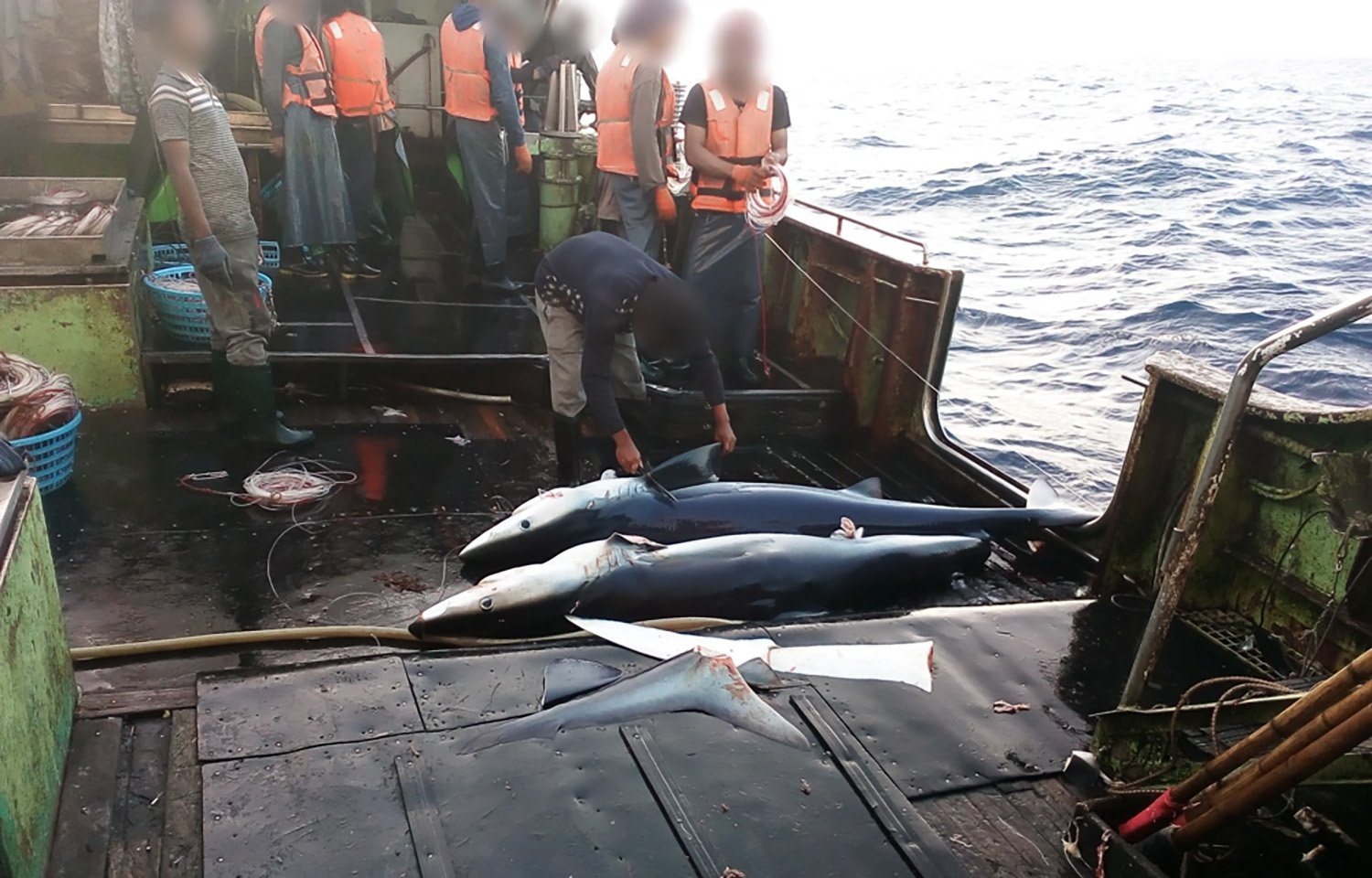
The Senegalese port of Dakar has become a “regional hub” for illegal shark fin trade associated with Chinese and Taiwanese distant-water tuna longliners operating in the Atlantic Ocean, a new investigation conducted by the Environmental Justice Foundation (EJF) claims.
EJF’s report, “Cut & Run: Exposing Senegal as a gateway for the global shark fin trade,” is based on 124 interviews with Indonesian and Filipino fishers who worked aboard Chinese and Taiwanese tuna vessels, with their testimonies purporting widespread shark finning, concealment of fins on board, and inadequate port inspections.
Around 57 percent of Chinese vessels and 23 percent of Taiwanese vessels authorized to fish for tuna in the Atlantic were alleged by interviewed fishers to have engaged in shark finning, and the practice was particularly present on vessels calling at Dakar.
Of 71 vessels that visited the West African port between 2020 and 2025, interviewed fishers implicated 41 vessels in shark finning, including 70 percent of Chinese vessels and 42 percent of the Taiwanese vessels, while 47 fishers who had worked across 24 vessels said shark fins were landed in Dakar, either directly or after being transferred at sea to collection vessels.
Fishers interviewed for the investigation described deliberate efforts to conceal the practice from inspectors.
Allegations included hiding fins in secret compartments, dumping evidence before inspections, unloading fins at night, and confiscating mobile phones from crew to delete incriminating photographs and videos.
EJF insisted these accounts raise concerns about the effectiveness of current monitoring and enforcement measures.
Its report also pointed out Senegal is a signatory to the United Nations’ Port State Measures Agreement (PSMA), which is intended to prevent illegally caught fish from entering international markets through strengthened port inspections and controls. However, interviewed fishers described little or no meaningful inspection of shark fins or related catch documentation when vessels landed in Dakar.
EJF argued that weak implementation of port controls creates opportunities for illegal shark finning to be concealed and for associated tuna catch to enter global supply chains. It also said these implications extend beyond West Africa.
According to the report, more than 1,800 metric tons (MT) of tuna and tuna-like products suspected of being caught by vessels implicated in the investigation were exported directly from Senegal to Japan in 2024. Elsewhere, processing companies in Thailand and Singapore imported tuna landed at Dakar before re-exporting products to markets including the European Union, South Korea, and the United States.
EJF said this allows seafood linked to shark finning to enter international markets.
The organization is, therefore, calling on Senegal to strengthen inspections of high-risk vessels and introduce a mandatory “fins naturally attached” policy for all sharks landed at its ports. It is also urging the International Commission for the Conservation of Atlantic Tunas (ICCAT), as well as the flag states of China and Taiwan, to adopt the same rule and implement broader transparency measures contained in EJF’s Global Charter for Fisheries Transparency.
“When vessels can land their catch without effective scrutiny, illegal shark finning becomes easier to hide and harder to stop,” EJF said in a statement accompanying the report.
EJF noted that sharks are among the ocean’s most threatened species, with an estimated 80 to 100 million sharks killed each year by fishing operations while around 70 percent of pelagic shark species are now considered threatened with extinction. The organization said the decline of shark populations poses risks not only for marine ecosystems but also for the long-term sustainability of fisheries that depend on healthy ocean food webs.
The investigation comes amid growing scrutiny of shark bycatch management in tuna fisheries and increasing pressure on regional fisheries management organizations (RFMOs) to strengthen controls.
Its release also came soon after the Center for Biological Diversity (CBD) filed a petition asking NOAA Fisheries to identify and sanction China over not taking adequate action to stop shark finning, while the U.S. Fish and Wildlife Service (USFWS) confirmed the seizure of around 50,000 shark fins in October last year as part of “Operation Thunder.”
