





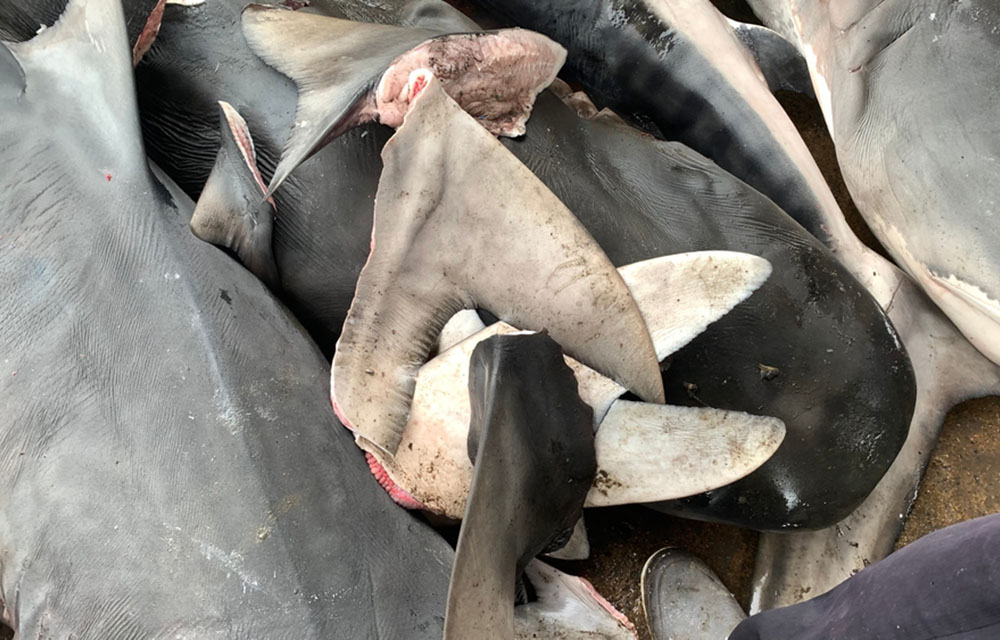
The Center for Biological Diversity (CBD) has filed a petition asking NOAA Fisheries to identify and sanction China over rampant shark finning by commercial fishing vessels.
Despite Chinese-flagged vessels catching and finning thousands of sharks in offshore waters, the group claims, China has not taken adequate action to stop finning.
“China catches so many sharks that stronger shark conservation policies in the country could actually save these incredible creatures from extinction. We’re asking the United States to use every tool at its disposal to make that happen,” CBD Senior Scientist Alex Olivera said in a release. “Sharks have survived for hundreds of millions of years, and it would be a tragedy to lose them in our lifetime. We've already lost more than two-thirds of the world’s oceanic sharks and rays in just the past five decades. These animals absolutely can’t withstand this level of overfishing.”
CBD claims China’s distant-water longline fishing fleet regularly targets sharks and harvests them as bycatch in regional fishery management organization (RFMO) convention areas around the world. In 2023, Chinese-flagged vessels discarded more than 10,000 blue sharks and nearly 1,700 shortfin mako sharks in the Western and Central Pacific, CBD claims.
The petition notes that, under the High Seas Driftnet Fishing Moratorium Protection Act, NOAA Fisheries is required “to identify nations if their fishing vessels have caught sharks on the high seas but the nation has not adopted and implemented shark conservation measures comparable to the United States.”
Though CBD acknowledged that China has banned shark finning, its protections do not meet U.S. standards, according to CBD. Most notably, China has not enacted a “fins naturally attached” policy – which requires all sharks landed by commercial fishers to have their fins still intact and attached – for all fisheries or a ban on possessing or trading shark fins that would help deter the practice.
In 2024, China and Japan were able to derail an attempt to enact a “fins naturally attached” policy by the International Commission for the Conservation of Atlantic Tunas (ICCAT), despite support from roughly 80 percent of member parties.
“We are exasperated that a strong, enforceable shark finning ban has once again been blocked by essentially two countries, despite clear scientific advice and overwhelming support from governments and conservationists alike,” Shark Advocates International President Sonja Fordham said at the time. “This failure marks 20 years of an ICCAT finning ban that is unacceptably difficult to enforce, continuing the risk of atrocious waste for some of the Atlantic’s most vulnerable animals.”
An Environmental Justice Foundation (EJF) investigation released earlier this year reported widespread shark finning among China’s distant-water fleet. The NGO interviewed 81 fishers from 60 Chinese-flagged vessels, finding that “60 percent of vessels allegedly engaged in the finning of sharks and disposal of bodies.” The report noted that China’s regulation on controlling shark finning does not apply to squid vessels operating in the Southeast Pacific.
If NOAA Fisheries agrees with the petition’s claims, the High Seas Driftnet Fishing Moratorium Protection Act would require the agency to conduct consultations and make a certification decision within two years. It also authorizes the president to restrict imports of Chinese seafood.
