







Canada-based Entosystem recently received independent verification of its greenhouse gas emission reductions as the company continues to refine its insect-based production system.
Entosystem was founded in Quebec, Canada, in 2016 and utilizes black soldier flies for “bioconversion,” which sees it recycle thousands of tons of food residue into usable projects using the insects.
The flies have been a staple for a number of different insect-based projects, including several partnerships from Innovafeed, as well as projects by BioMar, Protenga, and Protix.
Entosystem Co-Founder and President Cédric Provost told SeafoodSource during the 2026 Global Shrimp Forum that his company differentiates itself by the approach it took to making a viable black soldier fly business a reality, which he said has allowed it to live up to some of the promises that have fallen through elsewhere over the last decade.
“I really think the issues is we’re a young industry. There were a lot of promises that were made and not met – and not because people were not good-intentioned. It was just hard to build at the beginning,” Provost said. “You need to be an expert in pretty much everything.”
Provost said a lot of companies working to pioneer a viable insect protein startup aren’t fully insect-based and face a “chicken and egg” situation when it comes to production.
“That’s why when we started the company 10 years ago, we really focused on production because we knew that that was a challenge,” Provost said. “It’s not so much proving its use; we know it’s a good protein.”
He said the protein is already proven in nature, and anyone who has gone fishing and used a fly or a worm knows fish will eat them. The real obstacle for insect protein producers is whether or not they’re capable of scaling to a degree that it has a value proposition, he said.
“At the end, are you able to scale? That was the key,” he said.
Provost said that a hyperfocus on the farming aspect of creating insect protein is part of why Entosystem has flown under the radar in terms of insect producers. He said every bit of funding they got, they put toward production and staff and optimizing a sustainable production model that uses food waste.
Now, 10 years into that mission, Provost said the company has dialed in the secret to using food waste to create a viable end product. That was the key to creating a viable company because if the company had to pay for feed for its insects, the cost benefit didn’t make sense and it would also be falling short of its mission to treat waste and reduce carbon footprints.
“That’s why we really worked hard on finding those kinds of scenarios,” he said.
The company has spent time building its expertise in taking in food waste from a number of sources, which in many cases means it is dealing with all of the waste including packaging and non-food items that would end up harming its production. While black soldier fly larvae are fairly hardy, a contaminant could end up killing a large portion of the crop, which would remove all the benefit of using a waste item.
“We developed the technology to remove all the contaminants. That was really really hard,” Provost said.
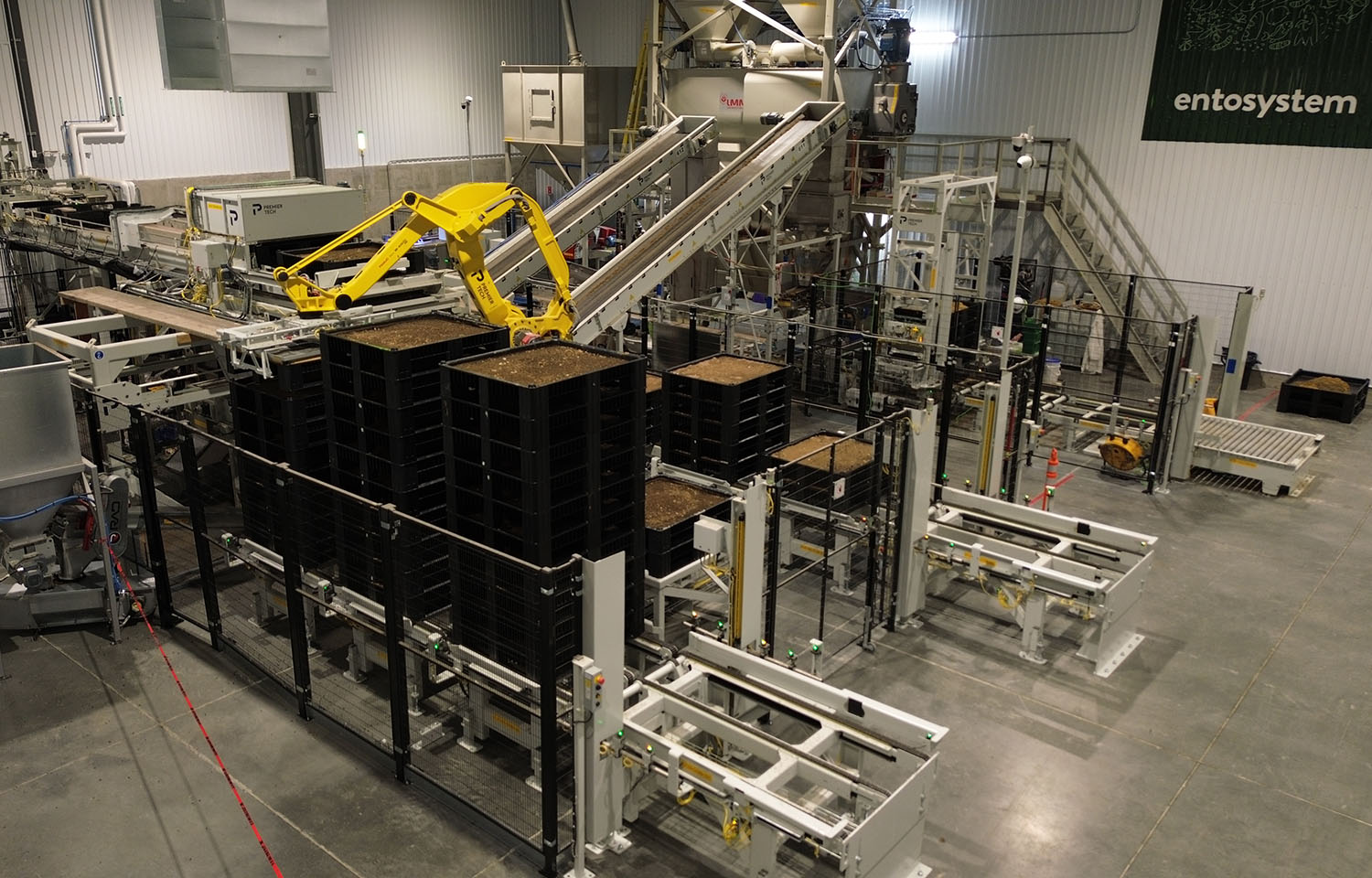
He further explained that many people tend to lump all insect production together under one roof, but producing a black soldier fly takes different equipment and techniques than producing something like a mealworm and is as different as comparing raising a cattle and raising a chicken, he said.
“[For] mealworm, you need a dry feed stock, and it needs to be stable. Most of the time you buy chicken feed to raise mealworms, They’re really different,” Provost said.
Entosystem has created a sustainable process that is repeatable and proven, and now, the company is at a point where it is ready to scale.
Provost said it has already managed to establish itself in the insect-feed industry for the backyard chicken industry in the United States.
“After dogs and cats, it’s chickens now that people have at home, so we’re selling pretty much everything in the U.S. now. It was a good high-margin market compared to let’s say aquaculture a few years ago,” Provost said. “That allowed use to scale slowly without making a big commitment that we would not have met. But, now that we’re pretty much at full capacity, everything we make is sold, and we’re looking to expand.”
Provost said the company has kept an eye on the dynamics of feed pricing across multiple industries, and the aquaculture feed market is increasingly promising. He attended this year's Global Shrimp Forum in part to investigate that potential, stating that the event – which featured a panel that highlighted a looming global shortage of aquaculture feed – confirmed that potential.
The recent confirmation that the company meets the requirements of ISO 14064-3, which makes it eligible for carbon credits under the CSA Group’s EcoProjects Registry, further adds to that potential.
“We’ve proven that our model works at a lower cost, so we want to capitalize on that,” Provost said. “That’s why we are [at the Global Shrimp Forum] today.”
He said the company is working to understand the opportunities that are there to scale and that it has established the processes it needs to do so. The end product needs to be handled differently depending on the market, so the company needs to have a clear runway in aquaculture if it wants to start production for that industry.
“In the backyard chicken sector, they need ‘puffy’ larvae, so you need a special drier that costs more and so on,” Provost said. “If you build a facility to do backyard chicken, pet food, and aqua all at once, it will be way more expensive. If I know who my end user is going to be, I‘ll be able to produce for less.”
As it produces black soldier fly, it also removes waste from landfills. The company said its current facility has a capacity of up to 90,000 metric tons (MT) of food waste and is projected to avoid 23,000 MT of CO2 equivalent emissions per year.
“You’ve got waste going to the landfill, and on the other side, you’ve got a protein shortage. So, we’re the missing link, I think, in the industry,” Provost said.
