

The Canada Department of Fisheries and Oceans (DFO) has revealed the results of its latest operation in the North Pacific to fight illegal, unreported, and unregulated (IUU) fishing.
Canada launched Operation North Pacific Guard in May, marking the third straight year Canada’s DFO has led the annual high-seas patrol. This year, an unprecedented four separate countries – South Korea, Japan, Canada, and the U.S. – participated in the mission, covering thousands of nautical miles.
“The thousands of hours that our fishery officers spend patrolling the North Pacific Ocean each year, by air and sea, detecting and deterring IUU fishing, is a strong demonstration that Canada backs its support for international laws with concrete action,” Canada Minister of Fisheries Joanne Thompson said.
This year, the Canadian Coast Guard vessel Sir Wilfrid Laurier led the mission, with participation from DFO surveillance aircraft, which flew missions alongside the vessel.
“This is one of the most expansive law enforcement missions in the world, delivered by six agencies from four nations from a Canadian Patrol vessel this year,” Sean Wheeler, the chief of international enforcement at the DFO, said during a press conference reviewing the results of the latest mission.
Wheeler outlined the scope of the mission, which left on 13 May from Victoria, British Columbia, Canada, and traveled to Osaka, Japan, conducting two 28-day patrols and inspecting fishing vessels throughout the region. Alongside the Sir Wilfrid Laurier, the country’s inspection aircraft completed 33 individual missions, flying a total of 254 patrol hours over an area spanning 47,000 nautical miles, DFO Fishery Officer Patricia DeMille said.
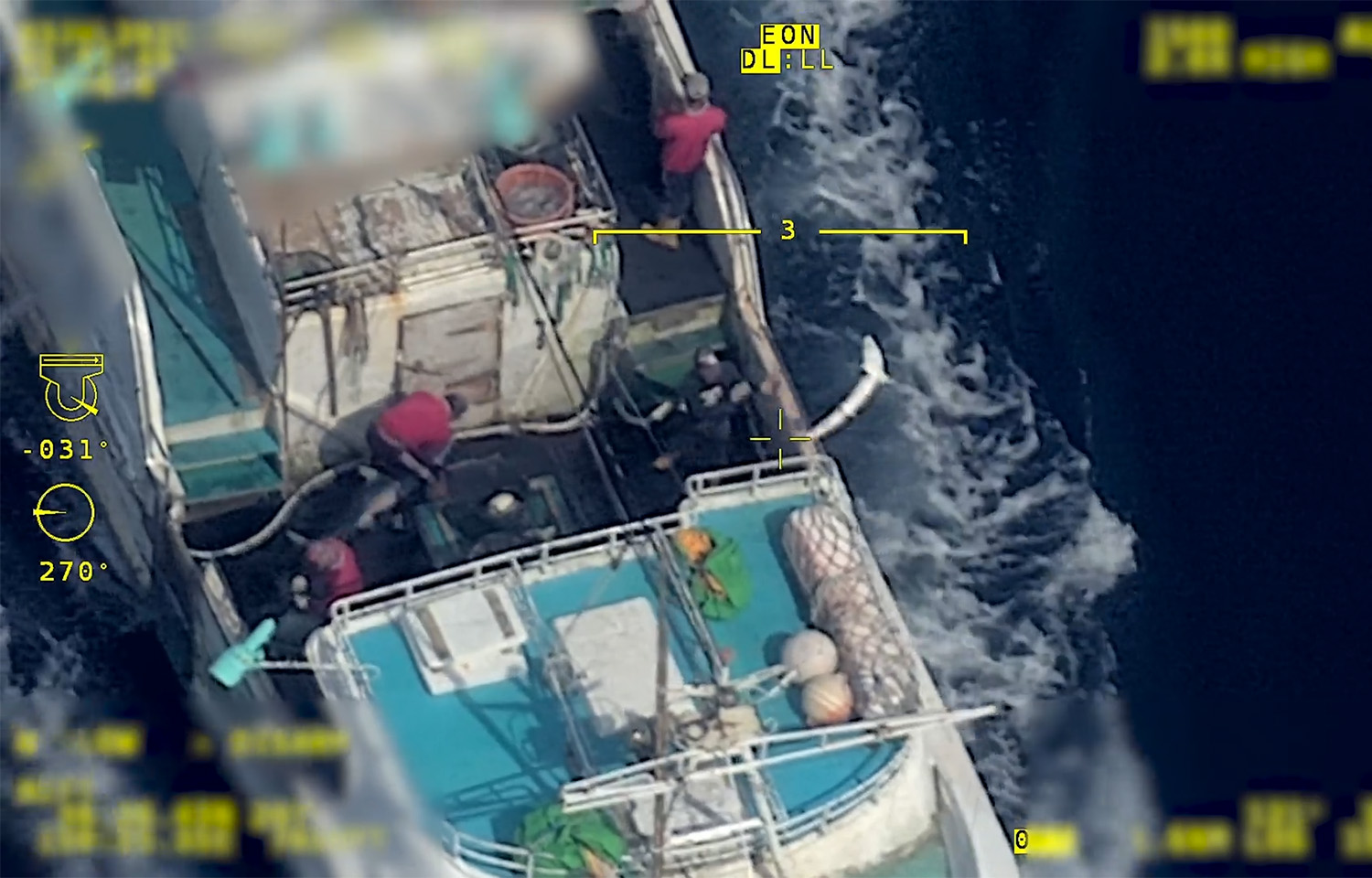
“This year's operation was unique in that it was the first time Canada delivered direct air support to our own inspection vessel,” DeMille said. “This means that our daily air missions provided vessel sighting information directly to ship-based fishery officers, who could then incorporate the aircraft’s findings into their patrol planning.”
Some of those findings included incidents of fishing vessels dumping whole sharks overboard ahead of an inspection, as the patrol aircraft is capable of monitoring for prohibited activity like shark finning.
“Our fishery officers’ expertise and our aircraft's technological capabilities are contributing to stronger marine protections in the North Pacific,” DeMille said.
Wheeler said during the expedition, the DFO detected several different potential violations, including incidents of shark finning, targeting of dolphins and other marine mammals for use as bait for sharks, deliberately misreported bycatch, destruction of evidence, and retention of prohibited species.
“All of this evidence gets taken up to a significant ‘court-ready’ level, and we provide this to both the international organizations and to the flag state responsible for that vessel,” Wheeler said.
As the DFO performs vessel inspections, it also has the opportunity to interact with the crews on board the vessels. As part of its operations, the crew on board the Sir Wilfred Laurier had capacity to operate in Japanese, Chinese, Korean, Russian, and English to communicate with fishers on board.
Wheeler said that through conversations with members of fishing crews, it has become clear that the presence of a Canadian patrol vessel has become a known and routine part of fishing in the North Pacific.
“We have seen some evidence there’s an effective deterrence occurring. We noticed through interviews with captains that they are aware and expecting a Canadian patrol presence, which is a good sign,” Wheeler said.
Wheeler also said evidence gathered by the patrol has helped Taiwan prosecute one captain upon their return to shore and that other evidence will aid countries along the Pacific and regional fisheries management organizations with potentially seeking sanctions against vessels.
“We do feel that there's a significant deterrence to our work because we're able to actually work with the other countries around the Pacific Rim and impose a sanction,” he said. “We’ve been out there since the ‘90s, but it’s actually in the last few years that the rulebook has really changed and a lot of new requirements have come in. Some of these captains are just unaware, or choose to ignore, those requirements, and that’s where we’re seeing our presence actually starting to influence the behavior.”
