






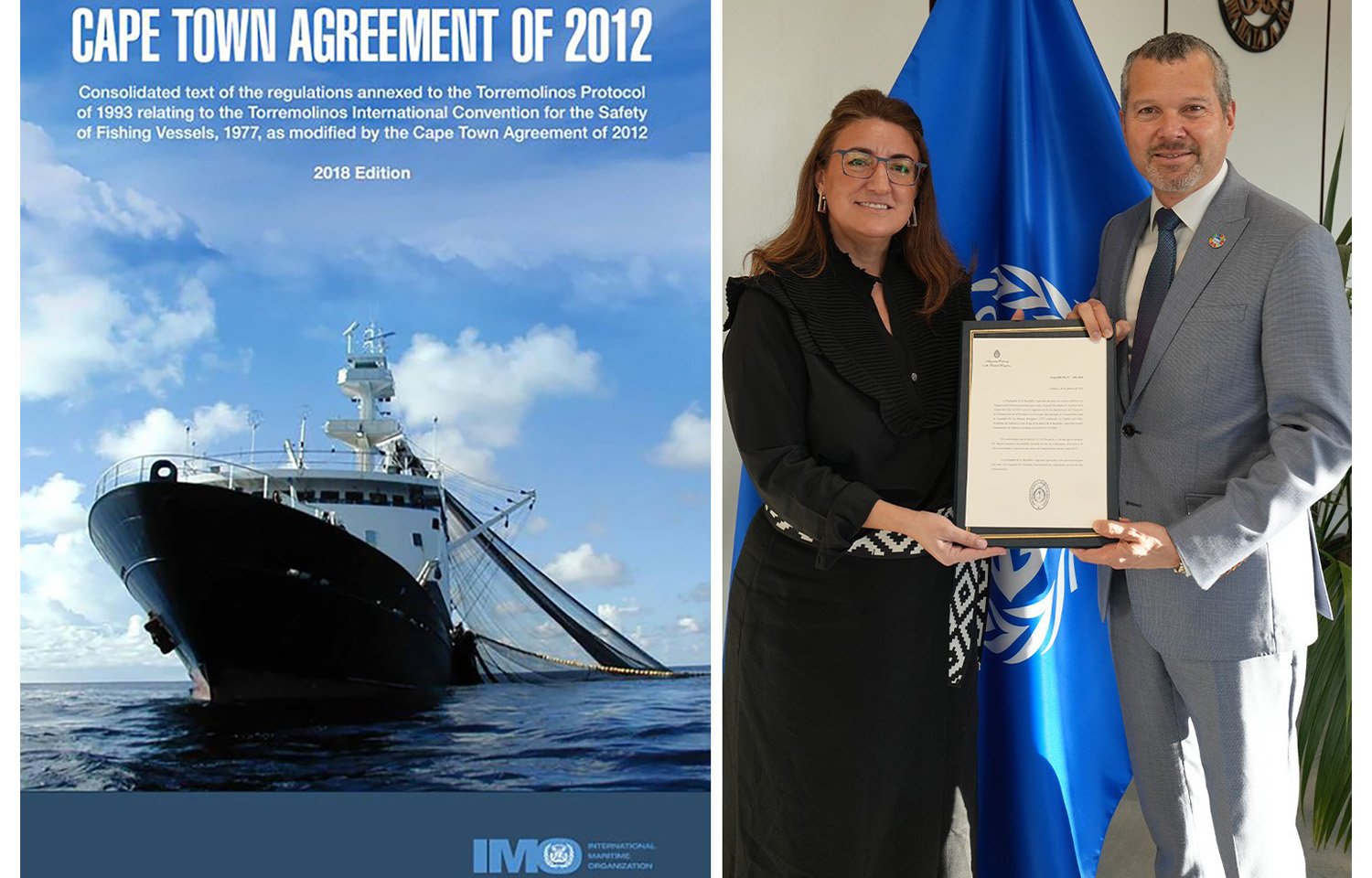
The 2012 Cape Town Agreement for the Safety of Fishing Vessels, commonly referred to as the Cape Town Agreement (CTA), has crossed the ratification threshold and will now enter into force in February 2027.
The CTA was created as a means of setting international safety standards on fishing vessels, and according to the International Maritime Organization (IMO), more than 45,000 fishing vessels of 24 meters in length and over will now fall under the regulation.
Argentina recently acceded to the agreement, officially bringing it across its threshold of at least 22 states representing at least 3,600 qualifying fishing vessels. Argentina was the 28th country to accede to the agreement, which brought the vessel count to 3,754.
Once the CTA is officially in force, states must incorporate the rules into national laws and enforce those rules as they would any other legislation.
“Thousands of fishers lose their lives every year while working to supply the world's growing appetite for fish and fish products. The 2012 Cape Town Agreement will help protect fishing crews, while safeguarding vessels,” IMO Secretary-General Arsenio Dominguez said in a release.
The CTA covers the design, construction, equipment, and inspection of fishing vessels along with vessel stability and seaworthiness, machinery and electrical installations, life-saving appliances, fire protection, and communications equipment, IMO said.
The ratification of the agreement comes years later than an earlier declaration from 48 countries, which publicly said they were committing to bringing it into force by October 2022. Those countries included major fishing nations like China, South Korea, Indonesia, Peru, Chile, Argentina, and the United Kingdom.
At the time, 13 countries had already ratified the agreement: Belgium, Congo, Cook Islands, Denmark, France, Germany, Iceland, Netherlands, Norway, Saint Kitts and Nevis, Sao Tome and Principe, South Africa, and Spain.
However, by October 2021, 32 governments that had earlier declared support still had not followed through, drawing criticism from NGOs.
In 2025, The Coalition for Fisheries Transparency added to calls to get the U.K. to adopt the agreement, but the country still has not done so despite its earlier declaration of support.
Several other countries have also failed to follow through on earlier promises to ratify the agreement, including China and Indonesia.
Regardless of the commitments, when it enters into force in February 2027, flag states will have to ensure that vessels comply with the regulations, and port states will have the right to inspect any foreign vessels in their ports to verify if they comply with the CTA.
The Pew Charitable Trusts applauded Argentina’s support of the agreement and said the CTA coming into force is an important step in the global fight against illegal, unreported, and unregulated (IUU) fishing.
"Until now, fishers lacked the same safety protections as other seafarers. With more than 100,000 people killed each year in the global fishing sector, protective action was critical,” Peter Horn, who heads the End Illegal Fishing Project for The Pew Charitable Trusts, said in a release. “When this treaty enters into force next year, it will dramatically improve the standards of life in the fishing industry – and, in turn, reduce fishing-related deaths.”
The CTA comes on the heels of the United Nations Agreement on Marine Biological Diversity of Areas beyond National Jurisdiction (BBNJ Agreement), also widely known as the High Seas Treaty, entering into force. It also joins other major agreements like the Port States Measures Agreement, which strengthens monitoring and controls to prevent IUU fishing, along with the International Labor Organization’s Work in Fishing Convention and the IMO’s International Convention on Standards of Training, Certification, and Watchkeeping for Fishing Vessel Personnel (STCW-F), which creates standards for training fishers.
"These ambitious plans for sustainable governance are only as good as their implementation," Horn said. "States must now do their part to turn words into action and deliver protections not only for global fisheries and fishers themselves, but for the entire ocean ecosystem."
