

U.S. regulators were forced to close the Northern Gulf of Maine scallop fishery less than two weeks into the season as fishers wait for the Trump administration to approve new quotas.
The New England Fishery Management Council (NEFMC) approved new scallop quotas for the 2025/2026 seasons under Amendment 39 in December 2024, establishing a quota for the Northern Gulf of Maine federal fishery of 675,563 pounds for 2025 and a quota of 506,672 pounds for 2026. However, those quotas have not yet received final approval from the federal government.
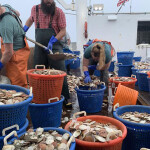
Fishers were able to start the season 1 April with a default quota of 350,000 pounds, which was quickly harvested. NOAA Fisheries was forced to close the Northern Gulf of Maine fishery 11 April once it became clear fishers had reached the default quota.
Now, those fishers are left in limbo, waiting for the Trump administration to officially approve the much higher 2025 quota and allow them back on the water. Uncertainty over when, or if, the quotas will be approved leaves many fishers with a difficult choice – do they moor their vessels close to the best scallop fishing areas and wait for approval, or do they pack up and head home until the season reopens.
“With sea scallops selling for USD 40 (EUR 35) a pound, it’s a difficult decision to head home, when regulators might reopen fishing any day," Togue Brawn, a NEFMC member and the operator of Downeast Dayboat Scallops, told Mainebiz. "It could be next week or the middle of next month. The longer this pause lasts, the more expensive it becomes.”
In a March filing in the Federal Register, NOAA Fisheries warned that a failure to approve the higher quota could hurt fishers.
“The default allocations are significantly lower than the allocations proposed in Framework 39. Delay of this action beyond the April 1 start of the fishing year would result in negative social and economic impacts to the scallop industry,” NOAA Fisheries noted in a March filing in the Federal Register.
The closure only impacts commercial fishing operations in federal waters; fishers may continue to fish in the state-managed waters off the coasts of Maine and Massachusetts.
Strained by staff cuts and limited by an executive order designed to stimy new regulations, the Trump administration has struggled to approve fisheries regulations before the season start.
“New England fisheries are expected to open late, according to the New England Fisheries Management Council. If everything stays the way it is, groundfish will miss their 1 May date [and] the scallop fishery may only partially open on 1 April,” Elizabeth Lewis, a senior associate attorney with Eubanks & Associates, said during a forum hosted by House Natural Resources Committee Democrats in early April.
“We are seeing reports that at least 5 percent of the workforce dealing with fisheries were probationary employees, who are now on administrative leave,” Lewis said. “So these people can’t write the regulations, they can’t do the science.”
In Alaska, only the last-minute intervention of the state’s senators was able to secure the final approvals from U.S. Secretary of Commerce Howard Lusk and U.S. Secretary of State Marco Rubio needed to start the black cod and halibut seasons.
“That was caught up in a process that most fishermen will not know. They don’t care to know how the sausage is made; they just want to know they’ll be able to get out on the water and be able to do their fishing,” U.S. Senator Lisa Murkowski (R-Alaska) told the Alaska state legislature in March. “We were able to do that for them, so that was a good win.”
Trump’s efforts to quickly shrink the federal workforce and freeze spending that doesn’t align with his administration’s priorities have left federal agencies like NOAA Fisheries in disarray. The New York Times reported this month that staffing cuts at NOAA Fisheries could prevent the release of millions of hatchery salmon in the Pacific Northwest because the government fired the employee in charge ensuring hatcheries complied with the Endangered Species Act. ProPublica reported that NOAA Fisheries scientists at the Northwest Fisheries Science Center have been forced to haul garbage and clean bathrooms after the Trump administration failed to renew contracts for janitorial services and building maintenance. Beyond a mere inconvenience, the lack of hazardous waste removal and basic lab sanitation could delay any chemical-intensive lab work.
