

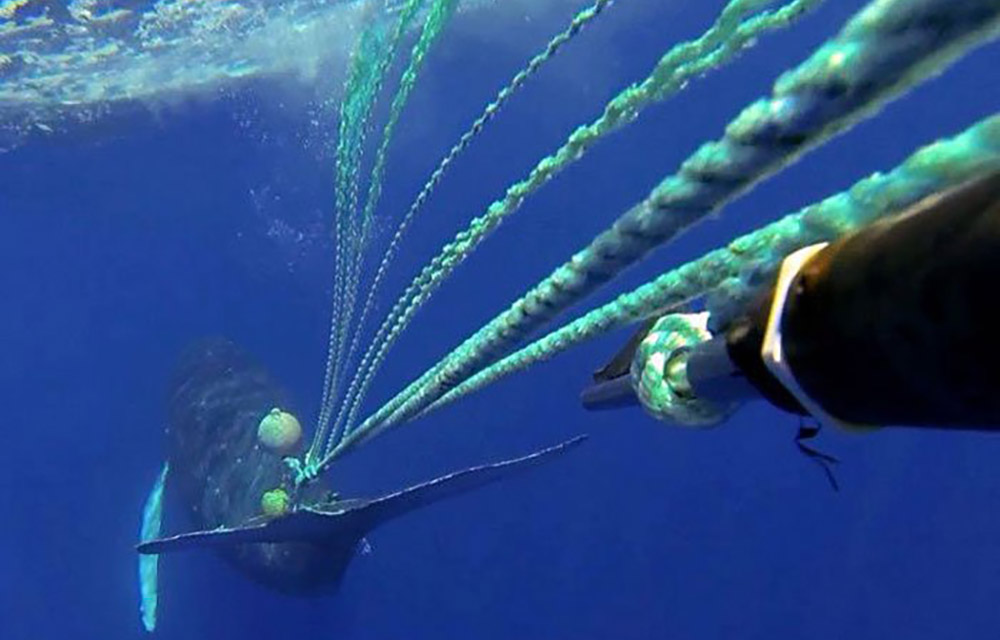
NOAA Fisheries has established a federal task force to address the problem of humpback whales becoming entangled in commercial fishing gear along the west coast.
The announcement came just prior to a 31 October deadline set by the courts in response to a lawsuit brought by conservation NGO the Center for Biological Diversity (CBD). The group sued NOAA Fisheries in 2022, claiming the agency’s sablefish fishery permit didn’t incorporate any plans to reduce entanglements or harm to the endangered whales. In 2023, NOAA Fisheries signed a legal agreement as part of a settlement, committing to create a task force by 31 October 2025.
According to the NOAA Fisheries announcement, the new Take Reduction Team (TRT) will develop a take reduction plan that reduces mortality and serious injury to the whales in the sablefish pot fishery.
“TRT is charged with developing consensus recommendations to reduce incidental mortality and serious injury of these stocks in this fishery to levels approaching a zero mortality and serious injury rate for each stock within 5 years of implementation of the plan pursuant to the MMPA,” the agency stated in a Federal Register posting.
The first meeting is slated for 20 November.
“I’m thrilled that our Pacific humpbacks will finally get action to keep them a bit safer from sablefish pot gear,” CBD Oceans Legal Director Kristen Monsell said in a statement. “These whales migrate hundreds of miles to feed off the West Coast and they need to arrive to safe waters. The agency has been authorizing the fishery without any measures to ward off entanglements for far too long. I look forward to working with other team members to develop protections for humpbacks.”
Monsell will serve on the team, which includes representatives from conservation groups, commercial fishers, Tribal groups, and state and federal fisheries officials.
The government estimates that roughly three humpback whales are killed or seriously injured in the sablefish pot fishery every two years, making up just a small number of the roughly 25 humpback whales that are entangled on the West Coast every year. The team will not address other West Coast pot fisheries that have gear that can entangle whales, including the Dungeness crab fisheries and California’s spot prawn, spiny lobster, and coonstripe shrimp fisheries. Conservation NGOs were critical of the federal government’s decision to limit the scope of the task force when it was first announced back in April.
“The Trump Administration’s latest cuts harm whales and create uncertainty for West Coast fisheries and they should reverse course immediately and restore funding to NOAA and its Take Reduction Team to protect wildlife and follow the law,” Oceana California Campaign Director Geoff Shester said in a statement. “This abdication of federal responsibility means that West Coast states must now step up their efforts to ensure whale entanglements are reduced to negligible levels as required by federal law. This includes shortening the fishing seasons for conventional vertical line fisheries, closing high risk areas, and allowing for the use of whale-safe pop-up gear in spring months. We call on West Coast states to fill the gaps left by the federal administration’s bad decisions and step up efforts to protect whales and ensure sustainable crab fisheries.”
Both CBD and Oceana have advocated for commercial fishers to adopt ropeless or popup gear that eliminates the standing vertical lines used in traditional pot fishing gear that risks entanglement.
“Most trap and pot fisheries use static vertical lines that can wrap around whales’ mouths, fins, or tail, wounding them and depleting their energy, often drowning them as they drag heavy traps and rope. Pop-up traps use bags or buoys on coiled ropes triggered by remote or time-release sensors to float the traps to the surface, eliminating static entangling lines,” CBD explained in its release.
The state of California has conducted a pilot program that allows commercial fishers to harvest Dungeness crab with ropeless gear after the regular commercial season ends. Participants have expressed approval of the new gear, and in 2025 the 12 fishers participating in the pilot program landed roughly 217,000 pounds of crab valued at approximately USD 1.4 million (EUR 1.2 million). Fishers lost only .2 percent of their gear, with the ropeless gear demonstrating a 98 percent reliability rate.
