






A new suite of research has found efforts to restore oyster reefs on the U.S. East Coast has knock-on effects benefitting the economies of Maryland, Virginia, and North Carolina.
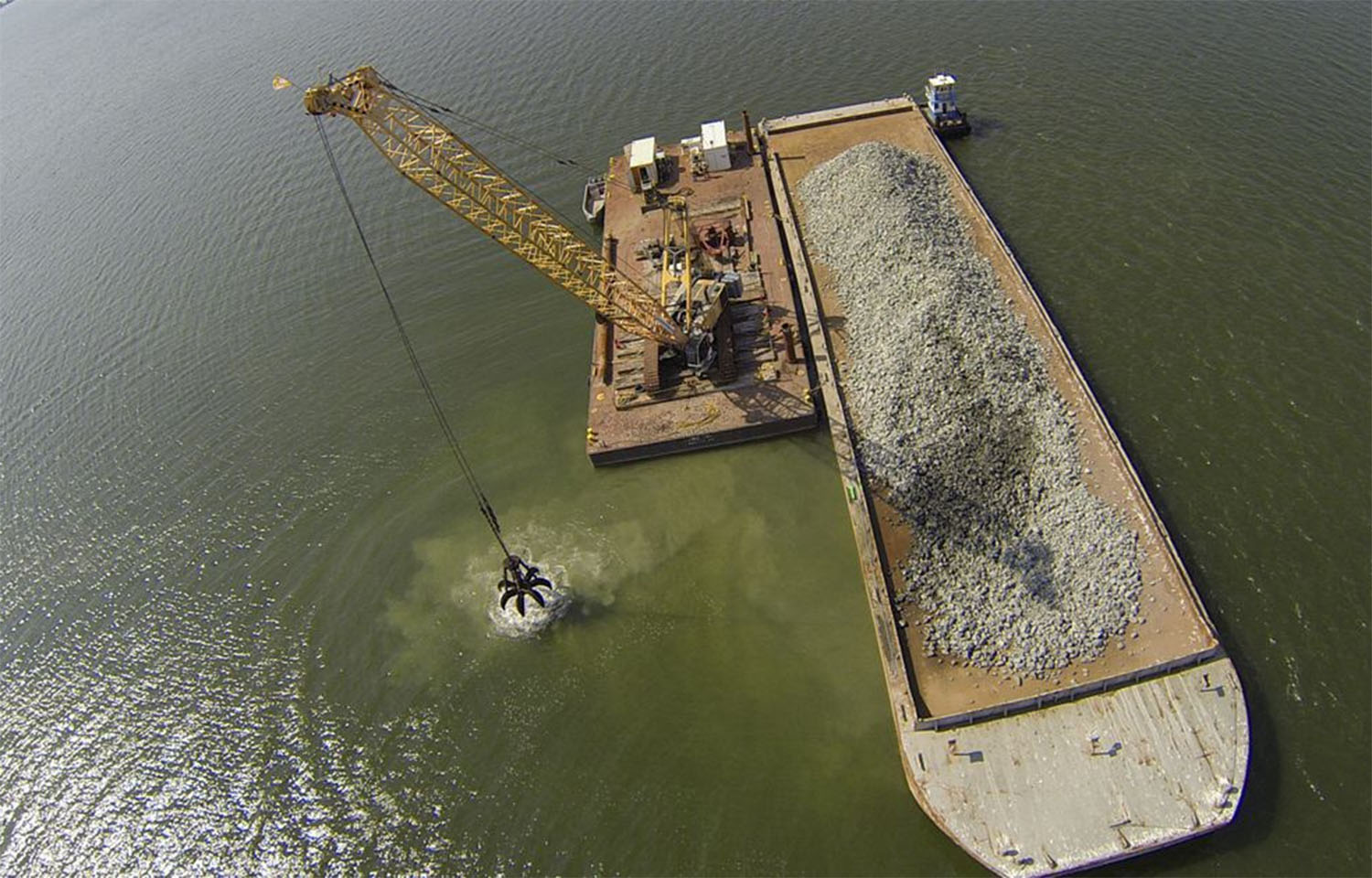
Two sets of research, one by the North Carolina Coastal Federation and another by Morgan State University’s Patuxent Environmental and Aquatic Research Laboratory in Maryland, U.S.A, found restoring oyster reefs would have direct economic benefits for the surrounding economies. The restoration projects use local quarries to supply rock to serve as the base of restoration projects, and once established the oyster reefs benefit the surrounding ecosystem which in turn boosts both commercial and recreational fishing.
The Morgan State University study used models incorporating biological data on plant and animal species in the waters off Virginia’s Middle Peninsula to estimate ecological and economic impacts of advancing oyster restoration alongside eelgrass recovery. The research estimates restoration efforts would result in an annual 122 percent increase in the region’s blue crab harvest, and a USD 3.1 million (EUR 2.8 million) in the region’s economy, if oyster reefs and eelgrass beds recover.
“NOAA and our partners have invested in large-scale oyster reef restoration around the Chesapeake Bay toward the Chesapeake Bay Program’s goal to restore reefs in 10 tributaries by the end of 2025,” NOAA Fisheries Spokesperson Rachel Hager said. “The intent of this study was to quantify the economic value of restoring oyster reefs and the habitat benefits they provide to other fisheries in the York and Piankatank Rivers.”
In recent years, there has been a strong push for oyster reef restoration in Virginia’s York and Piankatank rivers, designated as the NOAA Middle Peninsula Habitat Focus Area. Restoration has been spearheaded by members of Chesapeake Bay Program’s Virginia Oyster Restoration Workgroup – including NOAA, Viriginia Marine Resources Commission, U.S. Army Corps of Engineers, and The Nature Conservancy. So far, approximately 204 acres of oyster reefs in the York River, and 497 acres of oyster reefs in the Piankatank River have been restored.
Restoring oyster reefs has been shown to benefit eelgrass (Zostera marina), which creates important habitat for blue crabs. Eelgrass typically grows near oyster reefs because it requires abundant sunlight, and water filtration by oysters improves water clarity, allowing more light to reach the seagrass and for populations to grow.
The study found that if recently restored oyster reefs were lost there would be a 13-percent decrease in blue crab harvests annually, resulting in a yearly loss of USD 300,000 (EUR 264,000) from the Virginia economy. Conversely, if oyster reefs continue to grow, blue crab harvests could increase by 25 percent annually, generating an estimated USD 700,000 (EUR 617,000) for the economy.
“The ecosystem and economic benefits oyster reefs provide can vary greatly in different geographic locations due to varying water temperatures, salinity levels, and more. As such, these models are applicable to the York and Piankatank Rivers. This is the first time this modeling has been applied to these rivers,” Hager said.
The results, published in December 2024 in Ecological Modeling, highlight a potential for ecological data to help secure funding, political support, and local buy-in to restoration and conservation programs. Linking environmental restoration to economic gains offers a tangible roadmap for responsible fisheries management and restoration efforts, Hager said.
“The researcher’s modeled findings focused on blue crab harvest in the York and Piankatank Rivers. Other economic benefits for additional fisheries were estimated, but blue crabs showed the largest response to oyster reef habitat,” Hager said.
Oyster populations in the area are currently at just 1 to 2 percent of historic levels due to disease, habitat loss, and overharvesting. The estimates made in the study may be conservative of the overall economic benefit, as it focuses solely on blue crab harvest and does not account for benefits such as recreational fishing or the larvae production contributing to future harvestable oysters.
“The basic principles behind the models are adaptable and can be used in different applications. Researchers would need to update the models with new datasets to generate comparable estimates for oyster reefs/eelgrass and blue crab harvest in different systems,” Hager said.
Another May 2024 study found the living shorelines and marshes in the Middle Peninsula Habitat Focus Area have supported more than USD 6.4 million (EUR 5.6 million) each year from recreational fishing. After surveying 1,500 anglers, it was found fishers prefer to frequent the protected area more than others as they had more success fishing there.
Alongside the Morgan State University Study, a report by the North Carolina Coastal Federation also found similar economic benefits to the state’s economy from coastal oyster reef restoration. The economic report, part of an independent study by RTI International focusing on the 400-acre (1.6 square kilometer) Senator Jean Preston Oyster Sanctuary Network in North Carolina’s Pamlico Sound, found that for every USD 1.00 (EUR 0.88) spent on oyster restoration, the state sees USD 1.70 (EUR 1.50) in return.
It also found that through 2048 oyster reef restoration will produce USD 38 million (EUR 33.5 million) from ecosystem benefits – including support for commercial and recreational fishers, improvements to water quality (pollutants, sediments, and excess algae removal), and coastal protection from erosion by reducing waves and storm surges.
North Carolina has lost more than 90 percent of its oyster reef in the last century. Although oystermen cannot harvest from the 6 percent designated sanctuary reefs, those protected areas produce more than 25 percent of the Sound’s oyster larvae dispersed via currents.
“Investing in oyster reef restoration means investing in all of the benefits these reefs provide and the benefits of the restoration work itself,” NOAA Marine Habitat Resource Specialist Stephanie Krug said. “This report is vital in telling that story.”
