



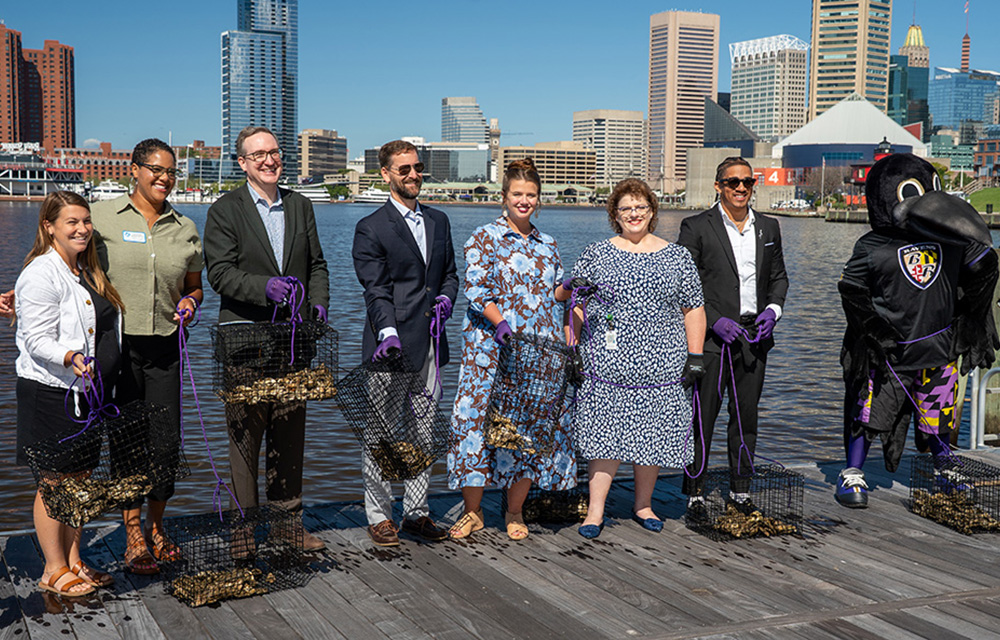
The Baltimore Oyster Partnership has started off the 2025-26 oyster season by setting a goal of planning 5 million oysters in Baltimore Harbor by the year 2030.
“Every oyster we plant is a step toward a healthier, more vibrant harbor,” Waterfront Partnership of Baltimore President Dan Taylor said in a release. “We’re thrilled to celebrate what’s been accomplished and to look ahead at the millions of oysters – and volunteers – still to come.”
With oysters in the region at just 1 percent to 2 percent of their historic populations, the federal government, state and local governments, and local conservation groups have been working to restore oyster populations in the Chesapeake Bay for years.
Research has shown that planting oysters can benefit local ecosystems and the commercial fisheries that rely on them. A Morgan State University study found that oyster restoration efforts and eelgrass recovery would boost the region’s blue crab harvest. Oysters also act as natural water filters; an adult oyster can filter up to 50 gallons of water per day, helping to improve the water quality of the harbor.
A joint initiative of the Chesapeake Bay Foundation (CBF) and the Waterfront Partnership's Healthy Harbor Initiative, the Baltimore Oyster Partnership has been working to restore oyster populations in Chesapeake Bay by planting hundreds of thousands of spat every year. First launched in 2013, the combined effort has planted more than 2 million oysters at the Fort Carroll oyster sanctuary reef in the Patapsco River. During the previous season, volunteers helped plant 417,059 spat, and the groups expect more than 1,000 volunteers to help out in the upcoming season.
“It’s incredible to see how far this program has come,” Adam Lindquist, vice president of Waterfront Partnership of Baltimore and head of the Healthy Harbor Initiative, said in a release. “From just a handful of volunteers 13 years ago to thousands of oysters being planted every season, Baltimoreans are showing that community-driven restoration works. With 5 million oysters on the horizon, we’re doubling down on our commitment to a cleaner, healthier harbor.”
The Baltimore Oyster Partnership also announced new members of the initiative for the upcoming seasons: National Football League franchise the Baltimore Ravens and the Stephen and Renee Bisciotti Foundation.
“This milestone isn’t just about oysters. It’s about people,” said Carmera Thomas-Wilhite, CBF vice president for communities and partnerships and a board member at Waterfront Partnership. “This program fills a need in our community – a need for cleaner water, hands-on environmental stewardship, and opportunities to see the impact of people’s efforts firsthand.”
In May, Maryland Governor Wes Moore signed the Chesapeake Bay Legacy Act – state legislation supporting water quality improvement and aquaculture in the bay – into law. The act simplifies reporting for oyster aquaculture companies in Maryland and allows them to continue operating while seeking permit renewals.
“We have a responsibility to hand over the state to the next generation better than we found it. That’s not just a moral priority; that’s an economic imperative,” Moore said in a statement. “The Chesapeake Bay Legacy Act will uplift every sector of our bay economy – from agriculture to aquaculture. Together, we will protect and preserve our natural heirlooms and drive economic growth. Those missions aren’t in conflict; they’re in concert.”
