



A North Atlantic right whale was found dead off the coast of North Carolina, U.S.A., nearly two months after it was found entangled, leading conservation groups to renew their calls for regulators to take further action to protect the whales.
“Another whale has died, and the blame lies squarely with the government,” Nora Ives, a marine scientist at NGO Oceana, said in a statement. “Humans have caused preventable pain and suffering for these critically endangered animals for long enough. What will it take for our elected officials to finally implement solutions like on-demand fishing gear and slowing vessels down to prevent further tragedies like this one? Continuing to ignore this issue will guarantee more right whale deaths.”
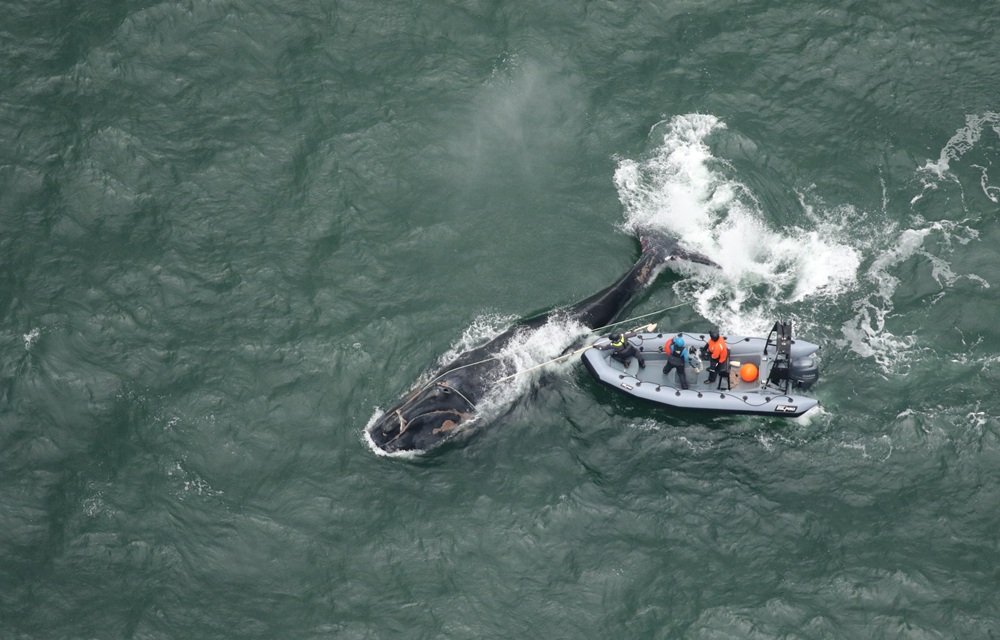
The 4-year-old whale, known as “Division,” was spotted by an aerial survey team operated by the Florida Fish and Wildlife Conservation Commission on 3 December entangled in multiple lines. NOAA Fisheries said Division was last spotted free of entanglement in July in the Gulf of St. Lawrence, Canada. On initial assessment, the agency determined that Division’s entanglement was complex and qualified as a “serious injury,” meaning the whale was likely to die from his injuries.
Still, a responder with the Georgia Department of Natural Resources attempted to free Division, and over the course of two days, the department and other partners were able to remove some gear. NOAA Fisheries said at the time it would “examine the removed line to determine its origin.” The agency continued to track Division following the rescue attempt as the whale swam north to New England and then south again, but its health continued to decline due to worsening entanglement injuries.
“Although this is not the result we wanted, our dedicated partners made every possible effort to save this whale,” NOAA Fisheries said in a statement. “Division’s case provided a unique opportunity to track the movement of an entangled right whale throughout its habitat. This valuable insight will help inform future responses.”
On 27 January, a Clearwater Marine Aquarium Research Institute aerial survey team discovered a floating partial carcass 25 miles off the coast of Avon, North Carolina, U.S.A., which researchers were able to confirm was the remains of Division.
“While this outcome is not a surprise given the severity of the entanglement, it’s still incredibly disheartening to bear witness to the death of a critically endangered right whale,” Heather Pettis, senior scientist at the New England Aquarium’s Anderson Cabot Center, said. “Division’s entanglement and ultimate death serve as a stark reminder that human activities remain a clear and present threat to this species,”
Despite a spate of positive news for the critically endangered North Atlantic right whale, the death led to renewed calls for action from conservation organizations.
“Despite 2026 starting with the most calf births since 2011, the news of a North Atlantic right whale death is a devastating reminder that this critically endangered species remains on the brink of extinction,” Hanna Vatcher, North Atlantic right whale campaigner at Oceana in Canada, said in a release. “After a year with no reported deaths, this loss is especially heartbreaking. With only about 380 individuals left, including just 70 breeding females, every death brings this population closer to collapse. “
“Each individual right whale plays an irreplaceable role in the health of the species and the ocean ecosystem,” International Fund for Animal Welfare (IFAW) Senior Campaign Manager Kathleen Collins said in a release. “These deaths are not isolated events; they are symptoms of chronic, preventable threats. Entanglement in fishing gear and vessel strikes continue to drive this species toward extinction. Science tells us that mortalities and serious injuries have outpaced births for decades, and unless we urgently reduce these human‑caused impacts, we risk losing this iconic species forever.”
According to NOAA Fisheries, fishing gear entanglements and vessel strikes are the primary threats to North Atlantic right whales. Division was the 168th whale documented as an Unusual Mortality Event impacting the population, which NOAA Fisheries has been tracking since 2017, and the first recorded death since May 2024.
Both Oceana and IFAW encouraged regulators to require the fishing industry to switch to pop-up, or ropeless, gear that removes the fixed, vertical lines that pose an entanglement risk to whales and other marine mammals.
“Oceana challenges policymakers to right this wrong and stand up for marine life and for the health of our oceans by adequately funding and staffing NOAA, advancing stronger protections for right whales, and supporting bedrock laws like the Endangered Species Act and Marine Mammal Protection Act before another whale washes up on our coastlines,” Ives said.
