




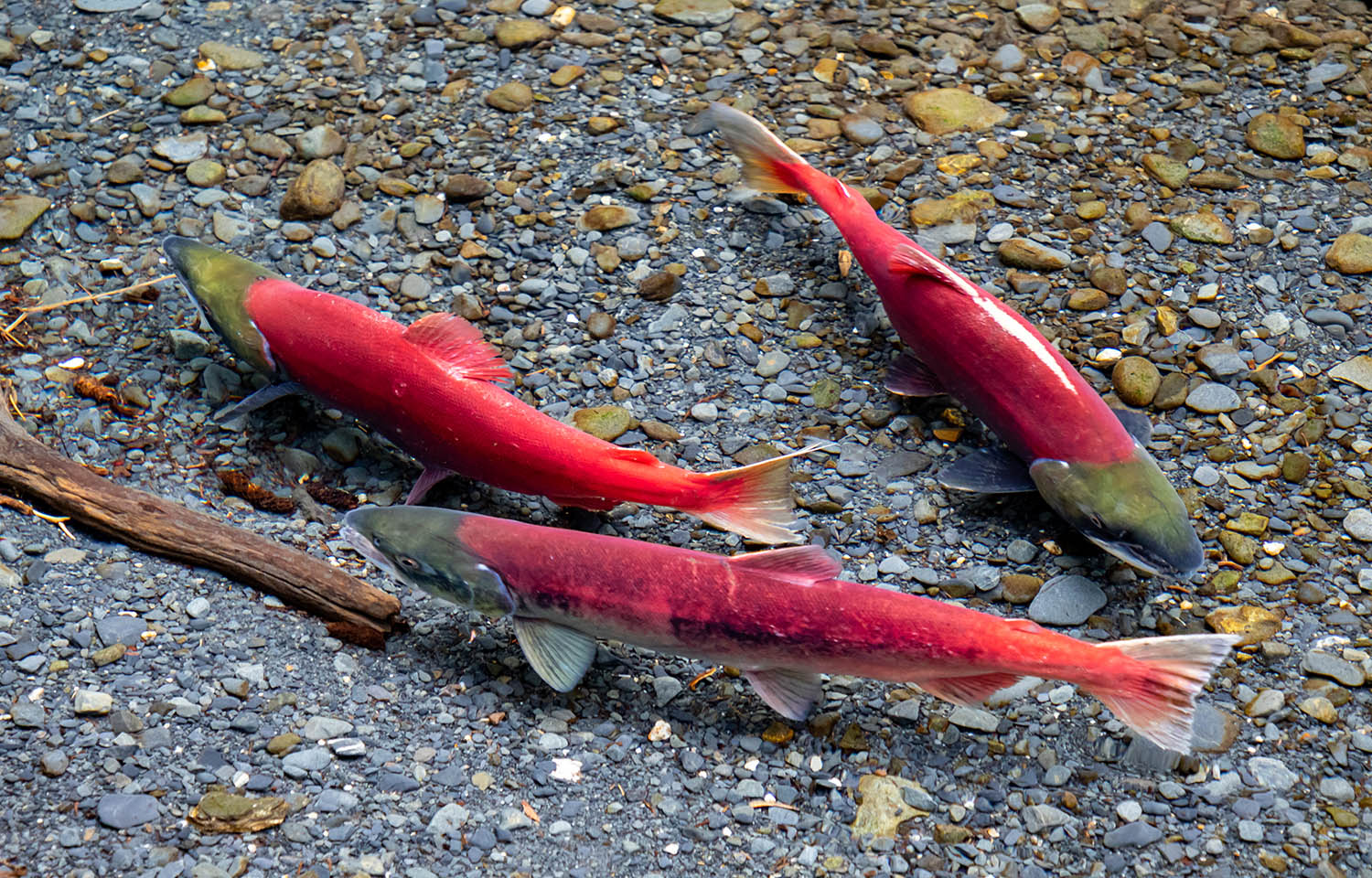
A new report from the University of Alaska Fairbanks warns that climate extremes are harming chinook salmon stocks in the U.S. state of Alaska, leading to smaller fish and smaller harvests.
The report, “Alaska’s Changing Environment," covered an array of the different climate-change related shifts in the state including air temperature, flooding, and wildfires. According to the report, those environmental changes are also having a negative impact on salmon populations.
“Chinook salmon declines in Alaska are linked to climate extremes, including marine heatwaves, high river temperatures during the spawning run, and heavy fall rains when eggs are in the gravel,” the report said. “Population declines are also linked to declining adult body sizes, associated with more competition at sea with highly abundant pink and chum salmon. Climate-linked changes in predators, prey and disease are also likely important factors.”
The report said another concern related to climate extremes is the decreasing size of salmon in Alaska across all species. Smaller salmon when spawning produce fewer eggs, which will only exacerbate population declines, the report claims. The report said that these smaller fish are associated with female salmon depositing 15 percent fewer eggs in rivers than they did in the 1970s.
“This shift (to smaller fish) is linked to warmer ocean temperatures, coupled with more competition at sea, lower quality food, and possibly more marine predators selecting the largest fish,” the researchers noted.
While massive runs of some salmon species – notably pink and sockeye salmon – have helped Alaska’s seafood sector in the short term, the report notes that these highly variable runs have had long term negative impacts as well.
“Large sockeye and pink runs benefited many fisheries, but even these had disruptive effects,” the report said. “The record high Alaska sockeye salmon harvest in 2022, coupled with large harvests in Russia, led to a global market surplus and price collapse. Some processing plants closed, hurting coastal economies and leaving some fishers without a place to sell their catch.”
The impact on Alaska’s fishing industry has been devastating.
“The closures, sales, and leases of processing facilities in 2024 left many fishermen, processing workers, and communities scrambling,” an economic snapshot produced by NOAA Fisheries found. “Numerous fishermen across the region had to attempt to find new buyers for their fish, causing tremendous distress. Plant closures displaced processing workers and left residents of fishing communities unemployed or underemployed.”
From 2022 to 2023, Alaska’s commercial seafood sector lost USD 1.8 billion (EUR 1.7 billion), and profitability declined 50 percent.
2024 was another difficult year for Alaska’s salmon fishers. The total harvest of 101 million salmon was down 56 percent from the state’s 2023 harvest of 232 million salmon.
“When compared long term (1985 to 2023), the 2024 all-species commercial salmon harvest of approximately 101 million fish and 450 million pounds was the third-lowest on record for total fish harvested and the lowest on record for total pounds harvested,” the Alaska Department of Fish and Game said in a press release. “Adjusted for inflation, the 2024 ex-vessel value estimate of USD 304 million [EUR 287 million] was the third-lowest ex-vessel value reported since 1975.”
Predictions indicate 2025 could also be a challenging year for Alaska’s struggling salmon populations.
NOAA Fisheries noted that salmon prey is at its lowest level in 27 years, suggesting poor feeding conditions for juvenile salmon. NOAA scientists ranked 2024s ocean conditions 18th out of the last 27 years based on seawater temperature, salinity, and the presence of copepods, “suggesting moderate-to-poor conditions for young salmon.”
“These are factors that influence the health and survival of salmon, so we can often connect that with how salmon will fare,” Northwest Fisheries Science Center research fisheries biologist Jennifer Fisher said. “Right now, there are some mixed signals, reminding us how important it is to continually track ocean conditions and try to understand the mechanistic linkages between ocean conditions and juvenile salmon survival.”
The University of Alaska Fairbanks report noted that Indigenous peoples and communities in Alaska have been hit hard by the decline in salmon populations.
“Without access to salmon, Indigenous peoples lose more than healthy food in rural villages where groceries are limited and prices are astronomical,” the report said. “There is also less sharing with others, time with family and knowledge passed from generation to generation through the act of catching, preparing and sharing fish. Dramatic salmon changes, and the associated commercial and subsistence fishery closures, have an economic impact in rural Alaska by reducing access to sustainable livelihoods.”
In November, Alaska Governor Mike Dunleavy requested financial relief for fishers in the Northwest Alaska district of Kotzebue, who experienced a disastrous salmon season in 2024. While official projections estimated a 2024 harvest of 200,000 to 300,000 chum salmon, fishers were only able to harvest 5,392 salmon.
“90 percent of the 148 Kotzebue District salmon permit holders live in Kotzebue or rural villages in the region,” Dunleavy said in a letter to the Department of Commerce. “Fishery losses for participants who reside in Kotzebue and other rural areas in the region were likely severe and resulted in adverse impacts because residents rely on the commercial salmon fishery for income and have very limited economic opportunities outside of the fishery.”
