






The Taiwanese government and representatives of the nation’s distant-water fishing sector are pushing back against a CNN report documenting abuses experienced by fishers in the sector, while labor rights groups are using the report as another call for action.
The report, published by CNN World on 12 July, was based on and included first-hand accounts from a number of fishers – including Silwanus Tangkotta and Adrian Dogdodo Basar, who previously shared their stories with SeafoodSource.
The CNN article documented the peril migrant fishers face in the sector and highlighted the fact they are not entitled to protections from Taiwan’s Labor Standards Act. It also described wage theft, overwork, lack of protective gear, lack of access to adequate and safe food and water, and debt bondage to employment agencies as common occurrences.
Basar recounted an incident in 2023, when he watched a friend and colleague grow seriously ill while his captain refused to return to land to access medical care. His friend ultimately died, and when he protested that his body should be returned to port immediately, he was denied food.
Both the Taiwanese government and the distant-water fishing industry have responded to the story, claiming cases like Basar’s are rare.
In a direct response to the CNN report, the Fisheries Agency (FA) of the Taiwanese Ministry of Agriculture issued a statement confirming its commitment to human rights and emphasizing the rarity of severe abuse of the kind described by CNN.
“While such cases are isolated, they shall not be exaggerated as a common phenomenon of the entire industry,” the FA said in a statement.
The “vast majority of vessel operators and captains [of Taiwan’s approximately 940 distant-water fishing vessels] operate legally, respect the rights and benefits of migrant fishers, and prioritize safety at sea,” the FA said.
The statement also noted that Taiwan’s record on labor rights is much stronger than that of most of its regional neighbors. In 2022, for instance, Taiwan launched an “Action Plan for Fisheries and Human Rights” supported by TWD 2.1 billion (USD 70.1 million, EUR 60.3 million) to improve conditions for fisheries workers and align work standards with the fisheries-related rules created by the International Labor Organization.
The FA also offered detailed responses to the first-hand accounts of abuse described in the article, which did not contradict the fishers’ primary assertions but emphasized the compliance efforts undertaken by captains and the FA in these cases.
Tangkotta, for instance, told CNN and SeafoodSource of losing the tips of two fingers when a metal door slammed closed unexpectedly during rough seas. He said that his captain refused to take him to port for medical treatment and that he was forced to operate on himself with a nail clipper to stave off infection.
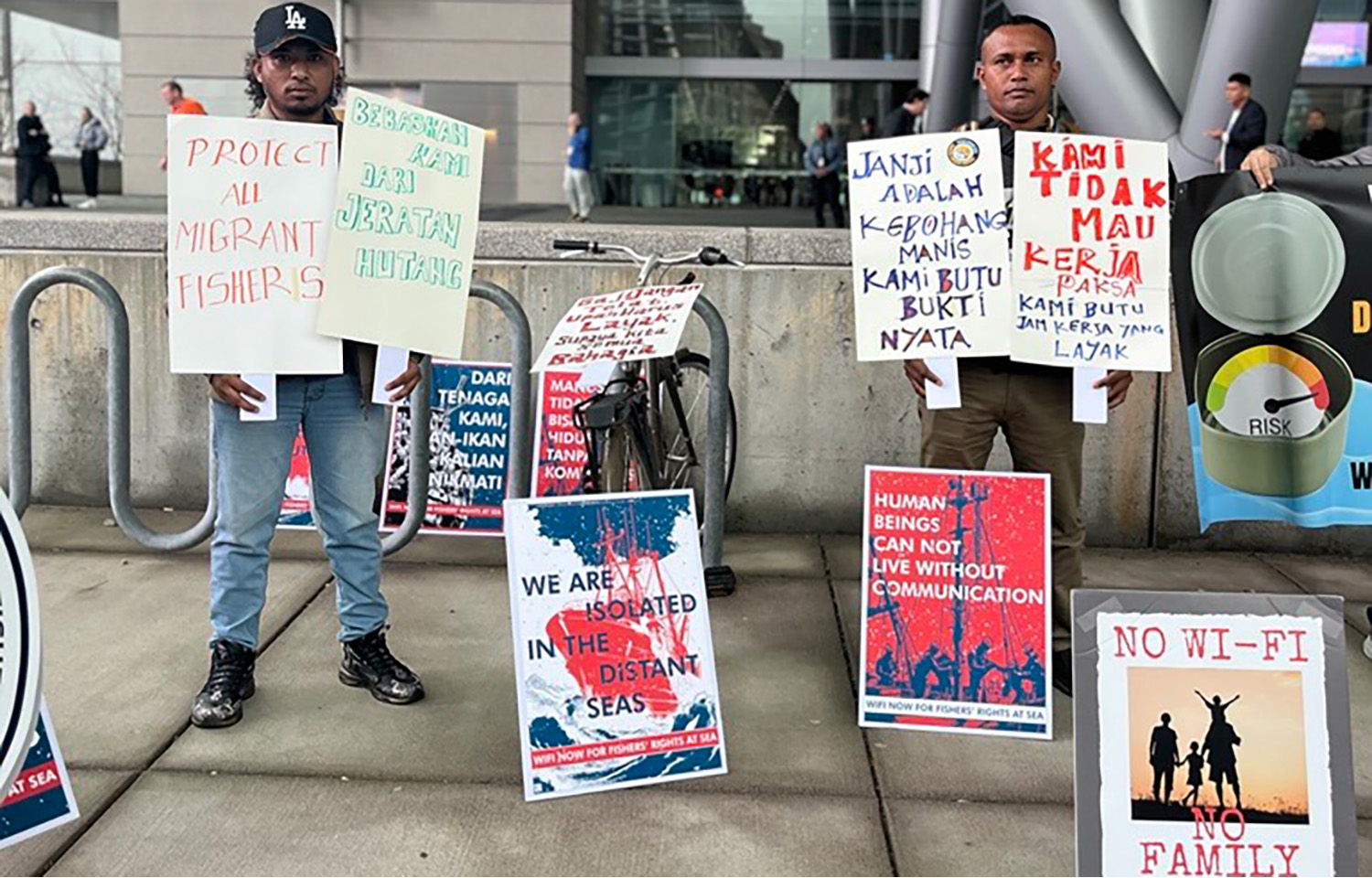
“My fingers are gone,” he told SeafoodSource through translator Truly Walean during the 2025 Seafood Expo North America (SENA) in March, where Global Labor Justice, a labor rights organization behind a campaign advocating for Wi-Fi for fishers, held a protest and panel that highlighted Tangkotta’s story.
The FA described the accident similarly but said that “the captain acknowledged the situation [and] provided first aid and continuously administered anti-inflammatory and pain relief medication.”
“The incident was reported to the FA in accordance with standard offshore medical protocols. An onshore medical assessment determined that there was no immediate threat to life,” the government statement said.
When he spoke to SeafoodSource, however, Tangkotta described saving his severed fingertips, which he kept on ice, hoping that they could be reattached on land. He believed that the reason he had been denied medical care on land was that his captain wanted to keep fishing, despite the cost to his health.
“If help would have been there right away, maybe my fingers would not be lost,” he said.
In its response to the CNN coverage, representatives of the Taiwanese distant-water fishing sector said it works to comply with efforts to safeguard worker rights.
Multiple fishing groups signed the letter – including The Taiwan Tuna Longline Association and the Taiwan Squid and Saury Association – conceding that there had been historic labor rights issues in the sector and “that isolated cases of mistreatment may still occur” as the industry reforms itself. However, it also claimed those incidences are rare.
“We believe it is misleading and unconstructive to present isolated, resolved incidents as emblematic of the entire industry today – particularly when subsequent investigations, systems responses, and institutional reforms have been disregarded. Such reporting distorts reality and undermines the credibility of a sector that has undergone significant transformation,” the letter states.
Like the FA, the industry groups emphasized Taiwan’s status as a leader on human and labor rights in Asia.
It also described the work of the Taiwanese government to set up a collective bargaining agreement (CBA) between migrant fisher unions and vessel owners.
In the light of the “demonstrable progress” the industry has made on workers rights, the letter said, accusations of systemic abuse were unfounded.
“Working at sea is undeniably arduous. We share the global community’s concern for migrant workers’ welfare. But, we reject sweeping characterizations that equate our industry with ‘modern slavery’ based on limited cases,” the letter said.
Activists were quick to condemn both the government and industry responses as inadequate.
In a press release from Global Labor Justice, which has partnered with other organizations to campaign for mandatory Wi-Fi access for Taiwanese fishers, Serve the People Association representative Lennon Wang said there is no excuse for continued inaction on the part of the government.
“The government has been presented with clear, actionable recommendations,” Wang said, referring to the extensive guidance for the implementation of Wi-Fi which Global Labor Justice has provided to the industry. "
Taiwan Association for Human Rights (TAHR) representative Shih Yi-hsiang also countered the fishing industry’s letter claiming the CNN report highlighted “isolated incidents,” instead saying that incidents just like it were systemic.
“The fishing industry would like us to believe that what CNN exposed were isolated cases, but they only represent the tip of the iceberg,” Yi-hsiang said. "These are not one-off incidents. They are symptoms of deep-seated structural problems in Taiwan’s distant-water fishing industry, including isolation, debt bondage, inability to talk to unions or raise complaints without deportation, retaliation in real time, and no access to justice.”
Global Labor Justice Deputy Director Valery Alzaga told SeafoodSource that if the Taiwanese government and the seafood industry wanted to improve conditions, they could easily do so by mandating that fishers have access to reliable, around-the-clock Wi-Fi communication, and that by continuing to avoid the issue, it is allowing the problems to continue.
“The seafood industry doesn’t have an awareness problem; it has an action problem,” she said. “If Taiwan's FA and seafood industry are truly committed to human rights, they must ensure that fishers can fully exercise their right to freedom of association in order to combat forced labor, starting with access to Wi-Fi on every vessel to end conditions of extreme isolation and employer abuse at sea.”
Alzaga also called on retailers and brands in the U.S. to take action to help push the issue by using their collective buying power to force change.
“The superficial steps the seafood industry has taken are clearly not addressing the structural conditions that lead to forced labor,” she said. “We continue to urge the seafood industry to adopt the Wi-Fi NOW for Fishers’ Rights Campaign’s demands, guaranteeing communication access for all fishers and implementing binding reforms that end isolation, uphold labor rights, prevent health and safety violations, and eliminate forced labor at sea.”
