


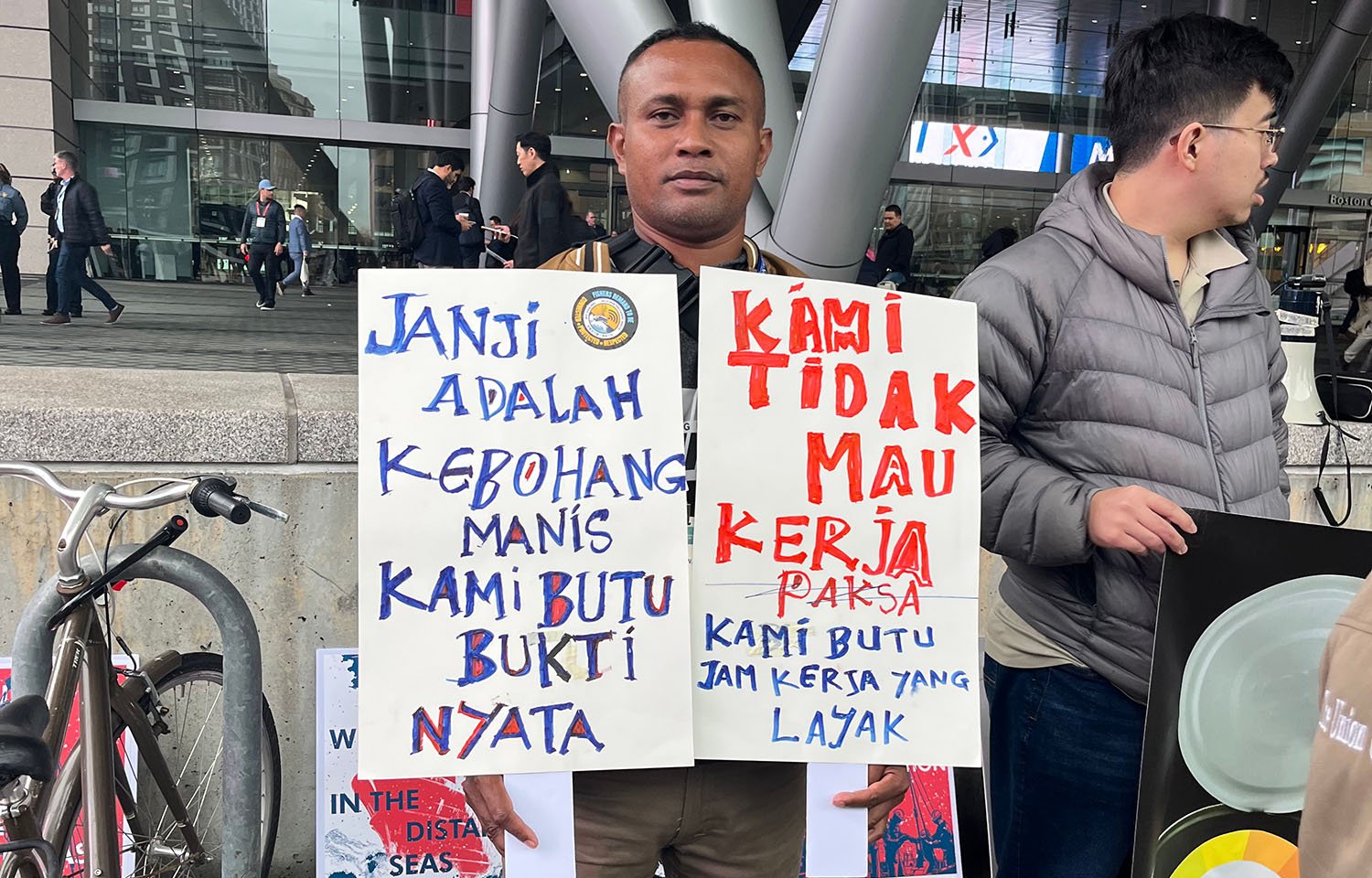
Silwanus, an Indonesian migrant fisher, was working aboard the Marine Stewardship Council-certified (MSC) Taiwanese distant-water vessel Chang Yi No. 368 in 2024 when a refrigerator door slammed shut during a big wave and severed his fingertips.
“My fingers are gone. If help would have been there right away, maybe my fingers would not be lost,” he told SeafoodSource through translator Truly Walean during the 2025 Seafood Expo North America (SENA), which ran from 16 to 18 March.
Silwanus was hosted at SENA by workers’ rights organization Global Labor Justice (GLJ), who brought him to the event to speak about how his life might be different today if he had been on a vessel equipped with Wi-Fi.
Silwanus was left with a bone protruding from his finger that he removed himself with a nail clipper. Though he kept his severed fingertips on ice, the captain of his vessel refused to return to port to seek care, and by the time Silwanus returned to land a month later, his fingertips could not be reattached.
Another Indonesian fisher, Adrian, told similar stories about life onboard a Taiwanese distant water tuna fleet.
After months aboard a vessel with inadequate stores of expired food, Adrian watched an ill friend be treated with expired medications and ultimately die, only to be stored in a refrigerator with the vessel’s tuna catch. When he and his fellow fishers threatened a work stoppage over the treatment they had received, their vessel captain withheld their wages.
Without Wi-Fi access, neither Silwanus nor Adrian had the ability to contact his union or family, and neither the captains of their vessels nor the companies the vessels supply to were held accountable for the abuses crew members suffered.
2025 marked the third year GLJ has brought its Wi-Fi campaign to SENA.
GLJ celebrated two big wins since the last time it was in Boston: the early February announcement that grocery chain Whole Foods would add labor protections to its sustainability requirements for suppliers, and the unveiling of a recent GLJ publication that codifies model operational guidelines for granting Wi-Fi access for fishers.
GLJ Legal Director Allison Gill said that the momentum gained through her organization’s campaign was enough for her to declare that “our campaign is winning.”
“It is no longer acceptable for there to be union-free zones in the ocean,” she said.
At a GLJ sponsored panel held adjacent to SENA on 16 March, Whole Foods Social Responsibility lead Emily McDuff commented that the GLJ campaign's work thus far had helped inform the Wi-Fi provision in the grocer's newly launched Seafood Code of Conduct.
GLJ Deputy Director and Wi-Fi campaign lead Valery Alzaga told SeafoodSource that the U.S. and global response to the campaign has been encouraging. Of the vigil for fishers that GLJ held at the entrance to SENA on 17 March, Alzaga said "more allies are joining us, not only in Boston, with all the trade unions that you saw there, but also in Europe, and Japan, and Tawian and Indonesia."
"The international amount of support is growing. That's exciting for Global Labor Justice because we see that having an effect."
Though GLJ has celebrated a few victories, the organization's leaders were clear the work was not over and this year’s SENA presented the group with an opportunity to inject urgency into the conversation. The organization did this through chairing a handful of panels at SENA which sought to help companies understand how they could improve their supply chains, and by holding the vigil, which was attended in solidarity by Boston unions and clergy people. With its newly published guidelines detailing how companies can implement Wi-Fi access protocols and grievance protocols for upholding fishers’ rights, GLJ aimed to push industry leaders to finally make the changes many have slowly recognized as necessary.
Citing a recent lawsuit Indonesian fishers have brought against seafood brand Bumble Bee, alleging forced labor, GLJ spokespeople argued that providing Wi-Fi for fishers is not just ethical; it’s simply good business.
"Right now ... the campaign is not about why we need Wi-Fi, but how," Alzaga said. "Brands can see that the risk is real and growing,"
While brands recognize the need for Wi-Fi, they also need to know how to bring secure access to Wi-Fi to fishers, especially those in distant water fisheries. For GLJ, the clear answer is binding access agreements between companies and the vessels they operate or buy from and the fishers who work those vessels. These agreements, Alzaga said, should ensure the right to communication for all fishers without any restrictions.
“The current situation is a risk to companies,” GLJ Senior Seafood Campaign Coordinator Zacari Edwards said, further explaining that companies that buy tuna without proper vetting are opening themselves to litigation by not safeguarding the rights of workers in their supply chains.
“The lawsuit came for Bumble Bee this week; it’s going to come for someone else next week,” Gill said, adding that the campaign specifically targets industry leadership, not individual consumers.
“[Distant-water fishing is] a high risk supply chain, and the problems are well known,” she said. “The problems may not be all that well known to consumers, but they are known to … everybody [attending SENA].”
GLJ campaigners further emphasized that secure and accessible Wi-Fi for distant-water fishers is neither cost-prohibitive nor hard to implement.
“We know how to do this,” Gill said. “We have model guidelines that lay out ways to grant Wi-Fi access. We also have examples of other sectors for finding supply chain agreements with communities and with workers to remediate and prevent forced labor conditions.”
In fact, GLJ said 60 percent of the Taiwanese distant-water fleet already has Wi-Fi installed, but without binding supply chain agreements, fishers are rarely given access.
If fishers had Wi-Fi access, GLJ said fishers would have access to their unions, families, and legal representation that would protect them in life-or-death situations, like those Silwanus and Adrian experienced. Wi-Fi would also create a path toward accountability for abusive captains, which would incentivize them and their buyers to create better working conditions for fishers.
Silwanus said that Wi-Fi would not only have protected him and his colleagues from catastrophic injury, but also would have given them an essential connection to life at home while they were at sea.
“It is very important because we work in isolated waters, and sometimes, we don’t know when we will return. Four months becomes six months. Six months becomes one year. We lost contact with our agency; we lost contact with our families,” Silwanus told SeafoodSource. “I want to talk about Wi-Fi, so that Wi-Fi is available for everyone who is working at sea.”
