



NOAA Fisheries Office of Law Enforcement has completed a second deployment of a new rapid genetic analysis tool that can detect seafood fraud.
“The new device is proving to be a valuable tool that helps officers examine more shipments in less time, with rapid results that also help clear the way for legal seafood to reach the market counter,” said Bryan Landry, assistant special agent in charge within NOAA's Office of Law Enforcement.
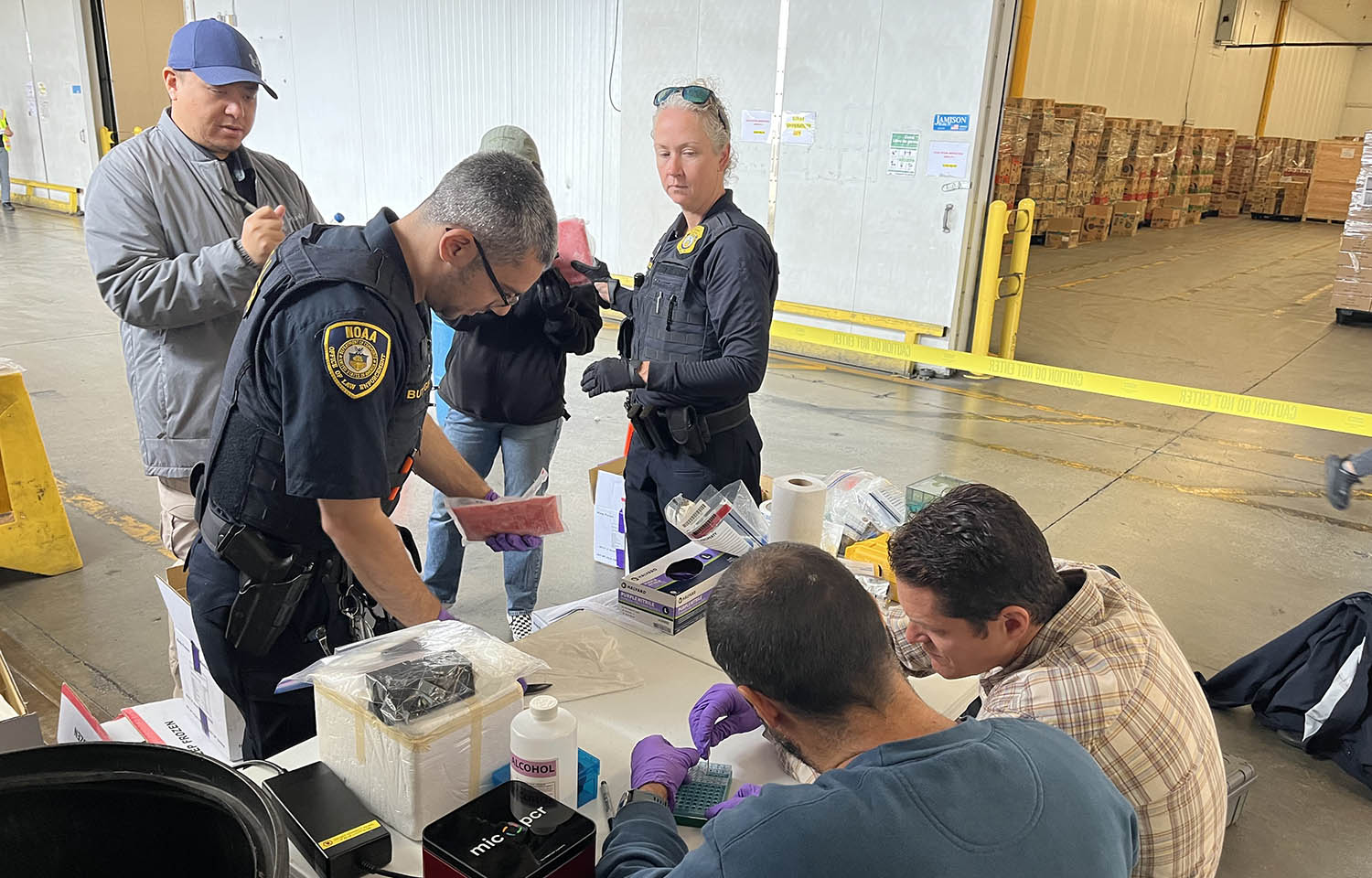
The test uses a polymerase chain reaction (PCR) device similar to a Covid-19 test, allowing law enforcement to conduct a rapid genetic analysis of a seafood sample to determine if the seafood matched its label. The tool enables officers to quickly test seafood in the field instead of sending out samples to labs – a process that can take days to weeks.
The test was first piloted during a weeklong law enforcement operation at the Port of Newark, New Jersey, in November 2024. The agency claimed the test was able to identify 27 tons of fish that “were determined to be illegally harvested, prohibited in trade, and listed in the annexes of the Convention on the International Trade of Endangered Species.”
For its second test, the tool was deployed in Long Beach, California, where officers used it to test for false labeling of imported tuna species in July 2025. NOAA Fisheries claims the tool has been streamlined and improved, now boasting an accuracy rate of roughly 93 percent. NOAA Fisheries is also developing artificial intelligence tools that may help agents interpret test results.
“We’ve invested in emerging technology to help us combat illegal, unreported, and unregulated fishing and the trafficking of these fishery products,” Landry said. “This device has made it easier to detect seafood fraud while facilitating legal and sustainable trade.”
During the Long Beach deployment, officers tested eight imports of fresh and frozen shark and tuna meat. The device detected a shark species listed as endangered and multiple instances of falsely labeled tuna.
“These devices assist us in protecting U.S. consumers from seafood fraud and to combat illegal, unreported, and unregulated fishing, which remains a high priority for NOAA Fisheries,” NOAA Office of Law Enforcement Director James Binniker said in a release.
