






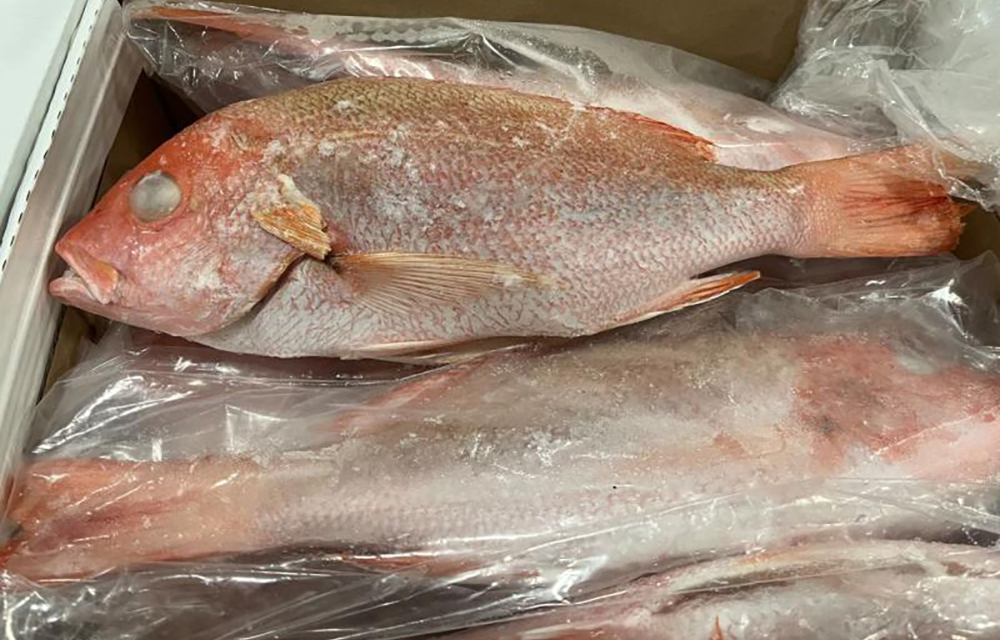
NOAA Fisheries Office of Law Enforcement discovered 12 tons of illegal red snapper at a port in Newark, New Jersey, U.S.A., sending the illicit fish back to its country of origin: Brazil.
At the same time, Brazil’s Institute of Environment and Renewable Natural Resources claims to have seized more than 40 tons of red snapper destined for export to the U.S. before it even left port.
“Our collaboration with other foreign agencies helps us to better stop illegal trade in its tracks,” said James Cassin, acting assistant director of NOAA Fisheries Office of Law Enforcement's Northeast Division. “When we can coordinate these efforts, we can better protect marine life and ensure that seafood imported into the United States is legal, sustainable, and responsibly harvested.”
Brazilian red snapper is listed as threatened under Brazil’s endangered species law, yet it remains the subject of illegal, unregulated, and unreported (IUU) fishing efforts due to its high value on the market – especially in the U.S. American law also prohibits the import of fish that were harvested in violation of foreign law and that carry false documentation.
Illegally harvested Brazilian red snapper can compete with America’s commercial red snapper fishery, which is consistently undermined by illegal fishing efforts.
According to NOAA, the agency’s law enforcement office has partnered with Brazil’s Institute of Environment and Renewable Natural Resources on multiple joint projects inspecting cargo and detecting false documentation.
“IUU fishing and the trafficking of these products is a global problem. It harms economic and food security and ocean ecosystems,” NOAA Fisheries stated. “Our partnership with Brazil is vital to the U.S. government’s efforts to combat the global trafficking of illegal marine fishery products. These efforts ensure U.S. consumers have access to safe and legal seafood and protects the U.S. seafood industry by keeping illegal products out of the U.S. market.”
In addition to blocking imports of illegal Brazilian red snapper, U.S. law enforcement has been working to break up illegal red snapper harvesting by Mexican fishers taking place in U.S. waters. The U.S. Coast Guard has intercepted multiple Mexican fishers illegally crossing into American waters to harvest the species this year.
