






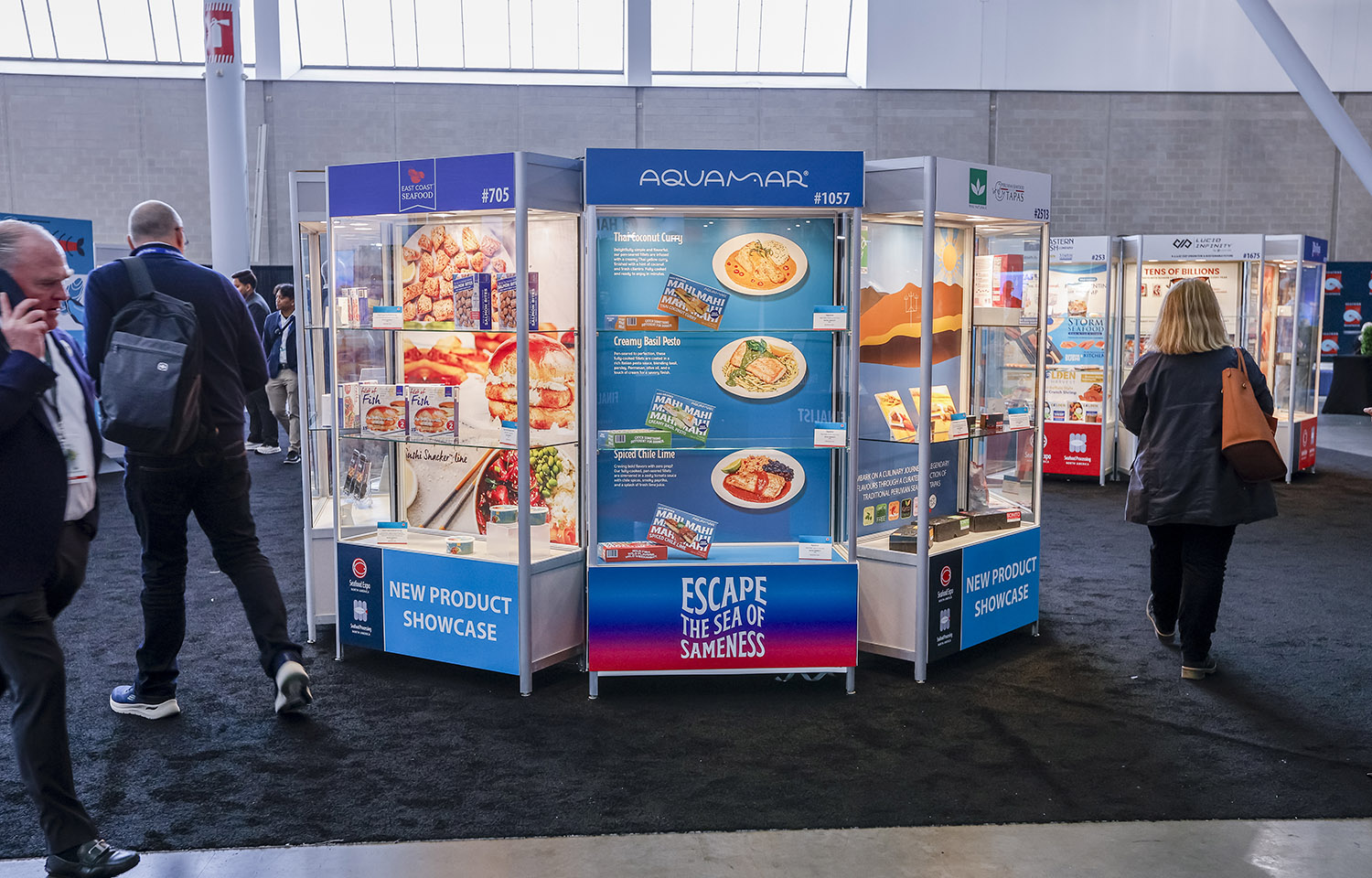
Continuing to expand beyond its surimi roots, Rancho Cucamonga, California, U.S.A.-headquartered seafood company Aquamar is setting its sights on making ready-to-heat seafood a kitchen staple within U.S. households.
“We will always be proud of our surimi heritage, but we also recognize that like surimi, there’s a convenience opportunity with seafood,” Aquamar CEO Daryl Gormley told SeafoodSource. “We’ve talked to thousands of consumers in North America to understand their relationship with seafood, and what we’ve come to learn is that people want to eat more seafood; they just don’t like to prepare it.”
At the 2025 Seafood Expo North America (SENA), which ran from 16 to 18 March in Boston, Massachusetts, U.S.A., Aquamar debuted a refrigerated, fully cooked, pan-seared mahi product, offered in several flavor varieties such as spiced chili lime, Thai coconut curry, and creamy basil pesto.
The products are not yet offered in stores, although Aquamar has secured a “couple of retail commitments already,” according to Gormley. The product features a mahi fillet sourced off the coast of Peru and marinated in one of six sauces developed by former Dean of the Culinary Institute of America Chef Ray Barnes, who based the recipes on flavors associated with various regions of North America.
The mahi fillets are the latest addition to Aquamar’s growing catalog of prepared seafood products, which includes seafood tenders, steamed mussels, and seafood medleys, all offered in a variety of flavors.
“Seafood is really underconsumed relative to the value of the protein, and we think the key to unlocking that is bringing convenience items to market,” Gormley said. “They’re refrigerated, fully cooked, clean labeled, healthy products ready in about two minutes, and they’re under USD 5.00 (EUR 4.56).”
According to Gromley, the vast majority of the meals served in the U.S. are home-cooked, but only a fraction of meals with seafood are cooked at home, with the majority being produced in foodservice.
“Foodservice is really well developed relative to retail,” Gromley said. “To me, it’s not that foodservice is overdeveloped; it’s that retail home consumption is underdeveloped.”
Part of the problem, Gromley said, is that it’s uniquely difficult to get products to market in seafood. The industry remains largely vertically integrated, with much of the focus placed on fishing fleets and supply chains rather than evolving consumer needs.
To meet those evolving consumer needs, Gormley said convenience needs to be the priority as the seafood industry looks to expand.
“Awareness isn’t the issue. I don’t think it’s about the cost, and people already know [seafood] is healthy; they know it’s sustainable,” Gormley said. “We can reinforce all those messages, but they aren’t the reason why the industry hasn’t grown.”
Before ready-to-heat refrigerated seafood products start flying off the shelves, however, consumers need to warm up to the concept, he added.
“People aren’t used to refrigerated seafood, [so] to reassure customers, we do a lot of in-store demos,” Gormley said. “It is a delicious product, but it helps when you can eat it, experience it, and get a little more comfortable with it.”
Aquamar’s traditional line of surimi products can be found at retailers throughout the U.S., and its seafood medley and mussels are available in the Chicago, Illinois, area, expanding soon to New Orleans, Louisiana, too.
