






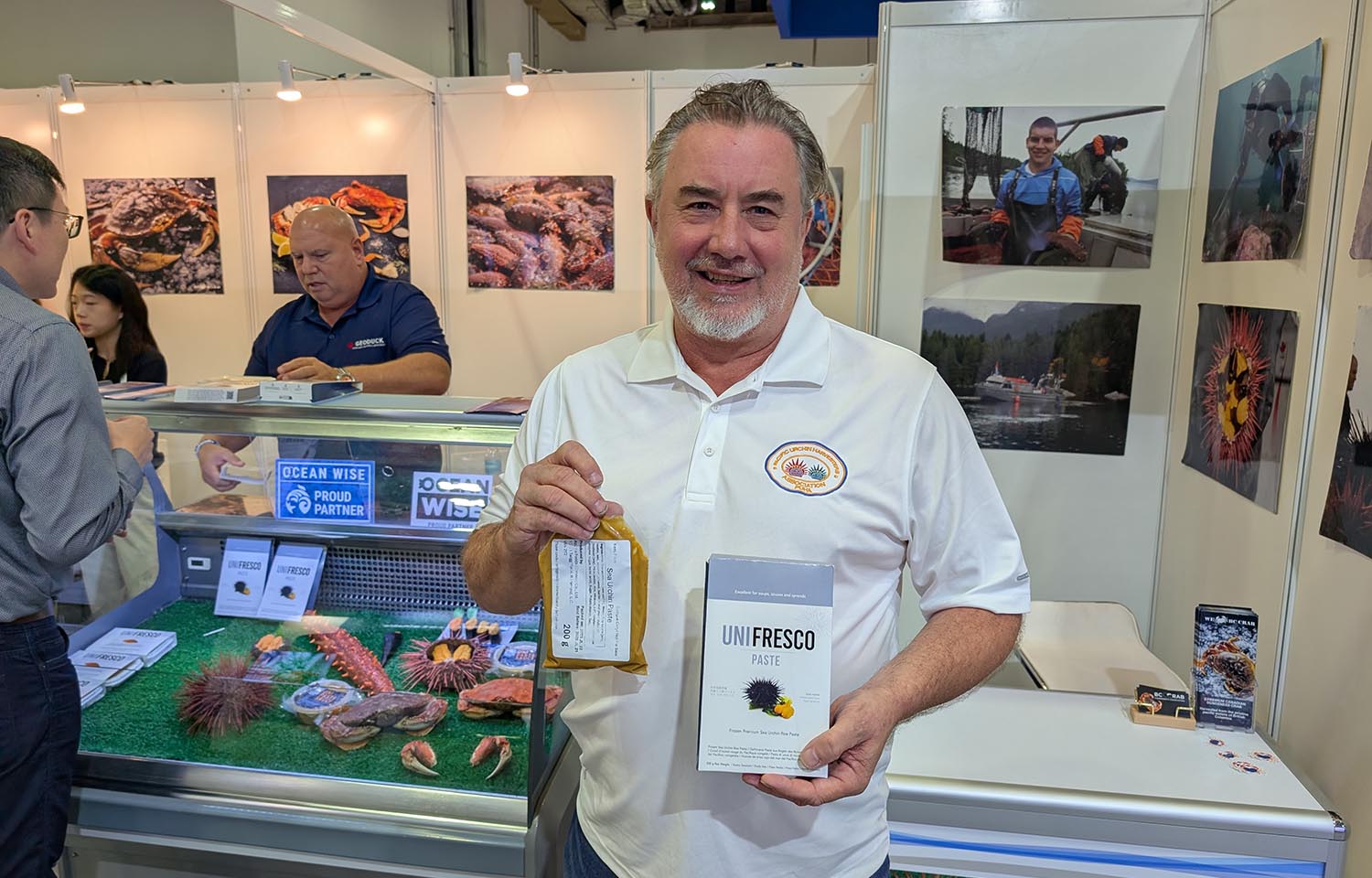
Uni supplier UniFresco has introduced a new uni paste product to help reach other customers and markets, building on the success of its chemical-free sea urchin products.
Available through Oceanmaster Foods International, the Unifresco Paste was named one of eight finalists in the Seafood Excellence Asia Awards, which were judged live at Seafood Expo Asia in Singapore in September. Unifresco’s Fraser Rieche met with SeafoodSource in Singapore to discuss his sea urchin business, which began with a goal of developing a chemical-free uni product.
“It all started in trying to expand the market for sea urchin products,” Rieche told SeafoodSource. “We were restricted from the European market because of normal additives that are put into sea urchin products – whether its straight uni style or paste or whatever.”
The aluminum phosphate, titanium oxide, and other chemicals commonly used to conserve urchin products are banned in the European Union, United Kingdom, and other high value markets, Rieche said. Beyond that, major retailers like Whole Foods don’t want to buy products with those additives, he added.
“So I started mucking around with the sea urchin products to see if we can find a way to develop a clean label and still maintain the characteristics of the sea urchin,” Rieche said. “And what we came up with is using natural brining processes, so cascading brines.”
Rieche said the development process built on his personal hobby of preserving foods.
“I just used my experience as a home preserve guy,” Rieche said. “It’s a hobby for my family; I mean, we’ve been making sauerkraut and pickles and chutneys and stuff my whole life. So you know, I had all this sort of background knowledge on that and sort of applied that to this and came up with a solution that works.”
Rieche said uni processed his way tastes more natural and avoids any metallic aftertaste that can come with using aluminum phosphate.
“I think it tastes more like something that’s right out of the shell,” he added.
Another benefit includes a longer shelf life, with Unifresco uni able to last up to a month in the fridge, giving restaurants more flexibility to add uni to their menu.
While the company has been selling its premium products for some time now, Rieche said he also wanted to offer a non-premium product that would attract consumers who weren’t prepared to spend USD 200 (EUR 173) on a kilo of uni: the unifresco paste.
“I worked with a Japanese company in Vancouver. They had a recipe already, but they were using the chemical product. So I put my chem-free product into their stream … and it’s absolutely brilliant,” Rieche said. “That’s what we launched here at the show – this is the first time the world’s actually seen this product.”
Rieche said the first production run took place in September.
As a product, sea urchins also have a natural sustainability story to share with buyers.
“Sea urchin management is a huge part of getting macro algae forests back in the ocean,” Rieche said.
While fishing activity is limited in Canada’s marine protected areas, an exception will be made when urchins encroach on kelp forests. The voracious creatures can quickly decimate seaweed growth, so regulators allow urchin divers to enter the protected areas to keep the urchins at bay. That sort of sustainability narrative has proven very attractive to today’s environmentally conscious consumers, Rieche said.
“We’re getting a huge amount of interest from people in that, and so I’ve got nice restaurants in Vancouver that are actually searching me up for my product because it’s clean label, but also because of the sustainability story,” Rieche said.
