


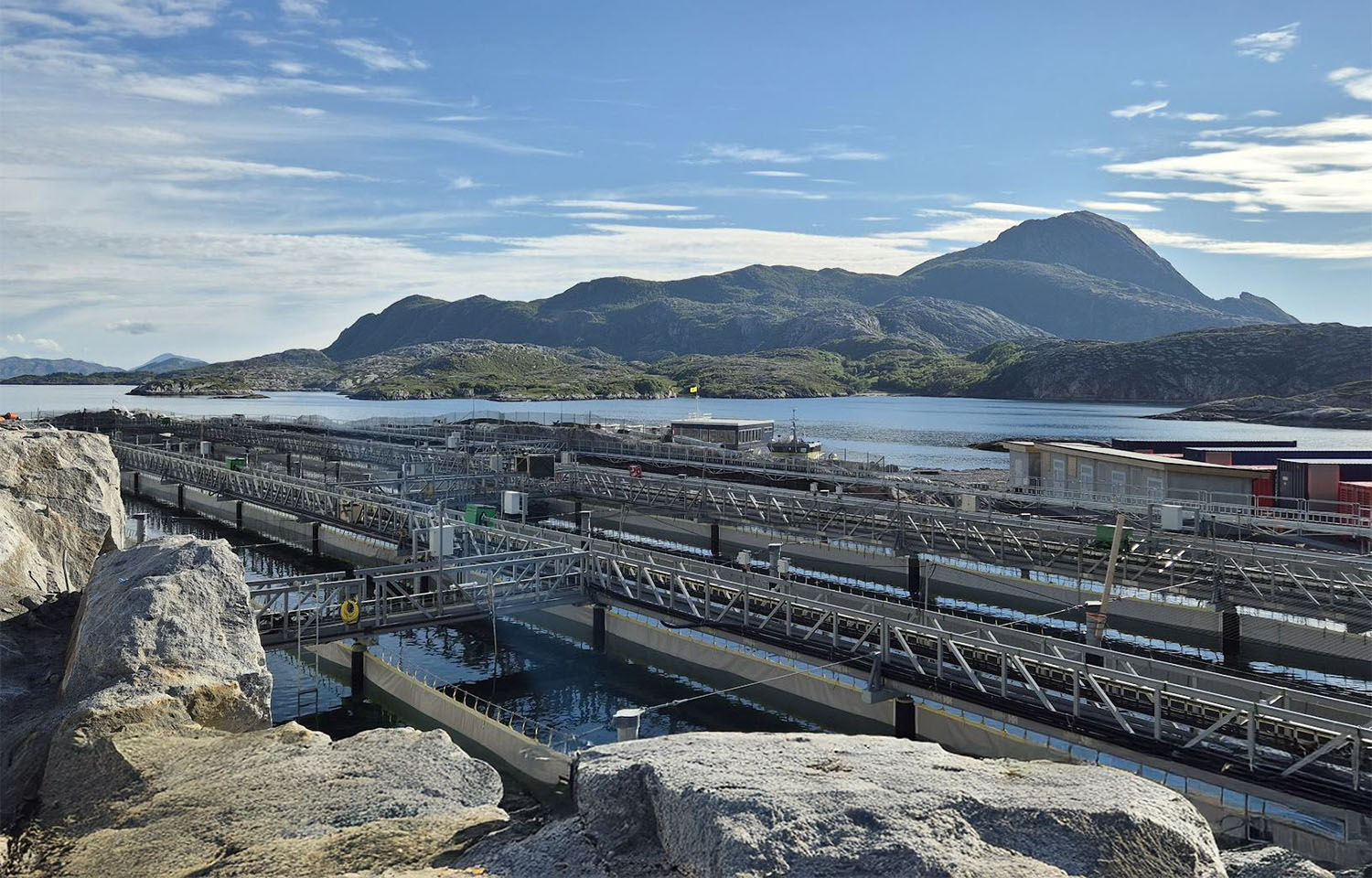
Norwegian land-based salmon-farming company Gigante Salmon hit a new revenue high in H1 2026 as the company marked the completion of its first full regular production cycle at its facility.
Gigante Salmon posted revenue in H1 2026 of NOK 113.2 million (USD 12.1 million, EUR 10.4 million), up from the NOK 44.6 million (USD 4.8 million, EUR 4.1 million) it posted in the same period of 2025. That higher total came despite a weaker Q2, as the company posted revenue of NOK 40.7 million (USD 4.4 million, EUR 3.7 million) in Q2 2026 compared to NOK 44.6 million (USD 4.8 million, EUR 4.1 million) in the same period of 2025.
The company said the first half marked the completion of its first regular production cycle, where it harvested 1,929 metric tons (MT) of head-on gutted salmon from its autumn 2024 generation, with an average harvest weight of 2.9 kilograms per fish and a superior rate of 74 percent.
While its revenue increased, the company continued to post losses, with an operating result of a loss of NOK 19.8 million (USD 2.1 million, EUR 1.8 million) in H1 2026.
“The company remains in a ramp-up and commissioning phase, with positive sales activity but negative results,” Gigante Salmon said.
The beginning of August also marked a company changeover to Kristian Lorentsen as CEO, who fully assumed the role on 1 August.
"The land-based sector is in a learning phase and so are we at Gigante Salmon,” Lorentsen said. “We are still developing and carrying out improvement projects to optimize the facility. With improvement work, you either succeed directly or you learn. This quarter has given us more learning than immediate results, and that learning is important for the way forward.”
Gigante Salmon is operating a flow-through aquaculture system at its Lille Indre Rosøy facility and said in March the company has begun to transition from a development project toward a fully-fledged salmon producer. During that transition, it has been working to improve its biological results, and the autumn 2024 generation of salmon represents a “record” for the company, despite it being affected by gill health challenges.
The following generations are also facing some issues, according to the company, and its autumn 2025 generation experienced winter ulcer issues during the winter season.
Gigante Salmon cut its 2027 harvest expectations in May 2026 after experiencing higher-than-expected mortality in that 2025 generation. At the time, the company said it implemented some operational and biological measures to improve performance in subsequent generations.
The company also said that summer efforts related to fish barriers haven’t been producing the desired results on fish health, and “their impact on sludge remains unclear.” Fish behavior since they were implemented has also not developed as the company expected.
The company said the barriers, as well as operational solutions like it, are an important part of the scale-up period of its land-based facility.
“The purpose of the measure, which is still ongoing, was to improve fish health and sludge collection in the raceway tanks,” the company said. “The measure has so far not produced the desired effect on fish health. This is due, among other things, to delays in implementation and unexpected fish behavior following installation.”
Gigante Salmon said the autumn 2025 generation has also been concentrating more densely in parts of the raceway system, which is in turn creating challenges related to oxygen levels, appetite, feeding, and mechanical injuries, largely due to issues related to the barriers.
“The fish barriers were intentionally installed at the beginning and end of the raceway. As a result, the fish are now concentrated in approximately half of the facility, close to the barriers, while the remaining part of the raceway is largely unused by the fish. This was not an anticipated outcome of the fish barrier installation,” the company said. “The company is evaluating measures including full removal, partial removal, or further modifications to the fish barriers.”
While the company is continuing to tweak its facility to achieve better biological results, it said it is still approaching a new milestone as the next stocking of fish will be the first time the facility has had salmon in all three of its production basins simultaneously. Gigante Salmon is working toward producing 16,000 MT of head-on gutted salmon per year, and to that end, the company said it invested NOK 60 million (USD 6.4 million, EUR 5.5 million) in the facility for improvements in Q2 2026.
Lorentsen said his goal as CEO is to work to realize the full potential of the company’s land-based facilities and prove its ability to serve as a profitable way to produce salmon.
“I am confident that the company has a strong foundation on which to build and, above all, a talented team of employees whom I am proud to call my colleagues,” he said.
