



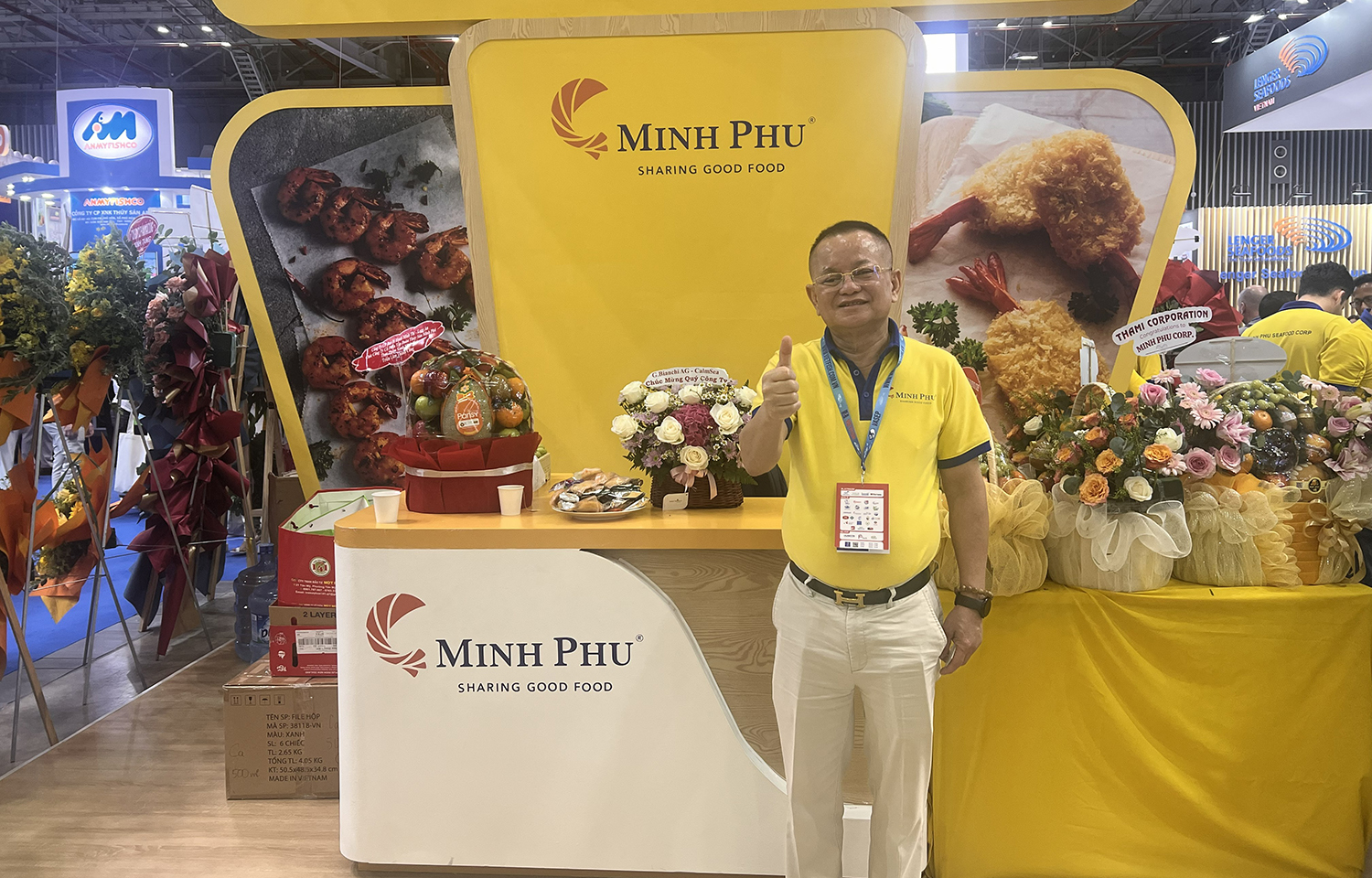
Vietnamese shrimp firm Minh Phu Seafood is expanding its processing capacity and accelerating the use of automation to do so as buyer demand has risen sharply.
The company's newest processing plant, Minh Phu Khanh An, located in the Ca Mau province of Southern Vietnam, is currently operating at about two-thirds of its designed capacity and is expected to reach full capacity by the end of September, Minh Phu CEO Le Van Quang told SeafoodSource during the 2026 Vietfish International Fisheries Exhibition.
The plant, which cost VND 1.5 trillion (USD 57.6 million, EUR 49.3 million) to construct, has a designed annual capacity of 35,000 metric tons (MT) for conventional products.
"Even if all three of our plants run at full capacity, they still cannot meet customer demand," Quang said, adding that if demand continues to grow, Minh Phu could consider investing in another processing plant.
As the firm continues to build up processing capacity, it has had to contend with a shortage of workers.
To alleviate the issue, the company's existing factories have already been partly modernized and automated, Quang said.
Minh Phu aims to eventually automate around 70 percent to 80 percent of production, leaving workers responsible for the remaining 20 percent to 30 percent.
Quang said a robot can perform roughly three times the work of one employee and operate across three shifts 24 hours a day, allowing one robot in some applications to replace the output of about 10 workers.
At its older plants, Minh Phu plans to replace machinery gradually rather than discard equipment that remains productive, introducing more robotics and artificial intelligence as existing equipment ages. Khanh An, being a newer facility, incorporates a higher level of automation and robotics than other facilities.
Automation should both ease labor shortages and lower processing costs, according to Quang.
Operating as close to full capacity is important as demand has skyrocketed for the firm.
Helping to drive that demand is the fact Minh Phu has the ability to supply large volumes of individual shrimp sizes, allowing major customers to concentrate purchases solely with the company, he explained.
Additionally, the majority of increased orders stems from value-added shrimp, a segment in which Quang said Minh Phu has spent decades building its capabilities and is less exposed to direct competition from lower-cost producers in India and Ecuador.
"[Value-added] is not something you can make today and sell immediately," he said.
As the company continues attempting to satisfy growing demand, it is targeting profit growth of around 30 percent this year compared to 2025.
The U.S. has become Minh Phu's largest market this year, overtaking Japan, which ranked first in 2025. Japan has now slotted into second place, followed by Australia, according to Quang.
Minh Phu retains an important advantage in the U.S. because its shrimp is excluded from the country's antidumping duty order; however, Vietnamese products now face an additional 12.5 percent U.S. tariff under an action concerning trading partners' policies and practices on imports of goods produced with forced labor. Comparable products from India and Ecuador face a 10 percent rate, offering them a slight advantage over Vietnam.
Still, Quang said the 2.5 percent difference is not significant enough to undermine Minh Phu's competitiveness because its value-added products do not compete directly with much of the shrimp supplied by India and Ecuador.
Minh Phu is also looking beyond its factories for ways to improve competitiveness.
Quang told SeafoodSource that new shrimp genetic breakthroughs could help reduce production costs over the next several years.
Vietnamese shrimp breeder Viet Uc has introduced a fast-growing strain of shrimp that can reach around 40 shrimp per kilogram after approximately 60 days of farming, according to Quang.
Minh Phu has trialed the strain itself and is increasing its use after seeing faster growth.
Elsewhere, CP Vietnam, a subsidiary of Thailand's Charoen Pokphand Group, has introduced a new black tiger shrimp strain that Quang said shares some characteristics with whiteleg shrimp and has resistance to Enterocytozoon hepatopenaei, or EHP, a pathogen that has caused significant problems for shrimp farmers.
Both strains are relatively new and have yet to be widely adopted by farmers in the Mekong Delta, the major seafood production region in Vietnam, but early trials have generated interest after farmers observed faster growth. Quang said he expects adoption to become more widespread next year.
Over the next one to two years, better genetics could contribute to lower farming costs in Vietnam and enable the country to compete more effectively with India and Ecuador, but Quang cautioned that genetics alone would not eliminate Vietnam's cost disadvantage.
