






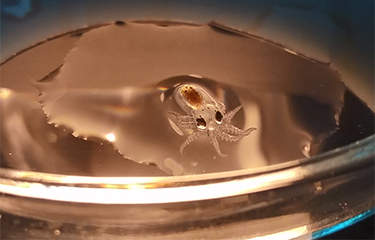
Nueva Pescanova has decided to withdraw its plans to farm octopus, drawing praise from environmental NGOs that pushed back on the concept.
Nueva Pescanova submitted plans to build the world’s first commercial octopus farm in May 2022, targeting a location in Puerto Las Palmas, located on the island of Gran Canaria in Spain’s Canary Islands. The company said it spent eight years developing a method of farming octopus and managed to successfully incubate, hatch, and raise five generations of O. vulgaris octopus in a test facility.
The farm was, at the time, projected to cost EUR 50 million (USD 44 million), with a targeted annual yield of 3,000 metric tons of octopus.
Those plans are now reportedly on hold, according to reporting from Libertad Digital Canarias, which said it has a copy of a letter submitted from Nueva Pescanova to the Port Authority of Puerto Las Palmas withdrawing its application.
According to La Voz Canaria, the letter said the company was withdrawing its application due to uncertainty regarding “completion of environmental and sectoral procedures.” Further reporting by El Diario indicates Nueva Pescanova had not begun the process of submitting a required environmental impact assessment within deadlines, and the Canary Islands government found the authorization procedures for the project’s wastewater discharge permitting had expired because the company did not submit the required documentation within the deadline.
Nueva Pescanova received heavy pushback on its plan to farm octopus from its inception.
Groups like the Aquatic Animal Alliance (AA Alliance), a coalition of more than 100 nonprofits opposed to the project, including the Aquatic Life Institute and Compassion in World Farming, said the project would have unknown impacts and could have resulted in serious biosecurity risks to surrounding waterways.
Groups gathered for protests against the concept in Madrid, Spain, calling the practice unethical.
Nueva Pescanova was not the only company considering farming octopus commercially, as both Nissui and the National Autonomous University of Mexico researched the concept.
Such organizations blamed some of the increasing opposition on the 2020 documentary "My Octopus Teacher."
Regardless of the source of the opposition, it continued to swell and was nearing another protest.
According to El Diario, multiple groups planned to protest Nueva Pescanova’s proposal on 25 July. The port authority in Puerto Las Palmas also received over 42,000 emails about the project calling for it to be officially stopped.
The Aquatic Life Institute said the decision by Nueva Pescanova shows that efforts to farm octopus, regardless of location, will face similar pushback from environmental groups and animal rights activists.
"Nueva Pescanova's decision to abandon the pursuit of the Las Palmas commercial octopus farming project is a watershed moment in the global effort to ensure this practice, which has negative implications for animal welfare, the environment, and public health, is never established," Aquatic Life Institute Director of Research and Impact Tessa Gonzalez said. "Innovation has an important role to play in improving food systems; however, it cannot resolve every challenge involving ethics, governance, and animal welfare. Sometimes, the most responsible innovation is restraint, and today's decision reminds us that progress is measured not only by what we choose to build but also by what we choose not to."
Compassion in World Farming called the decision to withdraw the project a victory for octopuses and the oceans.
“Octopuses are intelligent, wild animals, not products to be caged in factory farms. The decision to abandon this project sends a powerful message that the future of food must not be built on animal suffering or unsustainable practices,” Compassion in World Farming Senior Research and Policy Advisor Elena Lara said.
Lara then called for governments to take further steps to completely ban octopus farming.
Some U.S. states have already taken steps to ban the practice. The U.S. state of California banned octopus farming in October 2024 at a time when Washington had already banned the practice.
Efforts have also been made at the federal level in the U.S., with U.S. Senator Sheldon Whitehouse (D-Rhode Island) and Lisa Murkowski (R-Alaska) having introduced the Opposing the Cultivation and Trade of Octopus Produced through Unethical Strategies (OCTOPUS) Act in July 2024, though that bill did not make it through committee.
“Legislative proposals to ban octopus farming have also been introduced at the federal level and in more states such as Hawai’i, New Jersey, New York, North Carolina, Massachusetts, and Connecticut and countries such as Chile, Spain, and Mexico,” Aquatic Life Institute said.
