





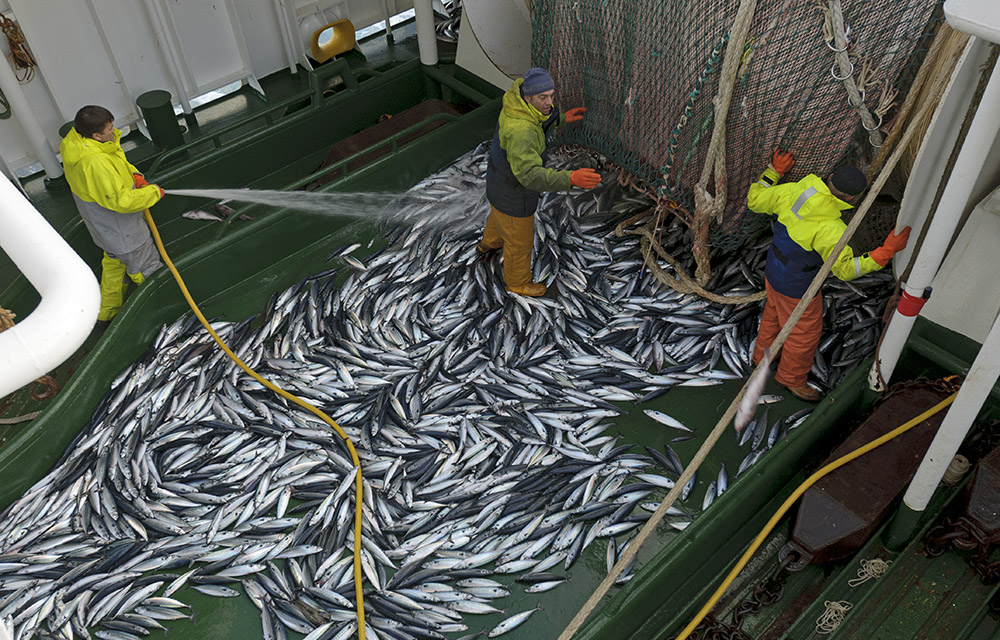
Conservation NGO Oceana claims large-scale fishing vessels in the United Kingdom are consistently breaking regulations, with 66 percent of at-sea inspections finding violations.
In a new report titled “Catch Me If You Can,” Oceana UK claims the nation's quota system favors larger fishing vessels and bigger businesses over small-scale fishers, despite evidence that those larger interests routinely violate the nation’s commercial fishing rules. After reviewing at-sea inspections conducted by the Marine Management Organization from April 2025 to March 2026, the organization found fishing vessels 12 meters in length or larger were in violation of fisheries rules during 66 percent of inspections, while vessels 10 meters in length or smaller were found to be in violation in only 10 percent of inspections.
“This data reveals the deep environmental and social injustice that is built into the U.K. fishing industry,” Oceana UK Executive Director Hugo Tagholm said in a release. “Our ocean is for everyone, and our fish stocks are a public resource. Yet, successive governments have created a system that favors a handful of large companies, allowing them to profit at the expense of the ocean and local communities.”
Oceana UK alleges the U.K. government enables environmental and social injustice through “ignoring scientific advice, poor policy design, weak monitoring, and lax enforcement.”
Only 1 percent of violations resulted in a financial penalty, the organization noted, and 70 percent of violations only received a verbal warning. In total, only GBP 28,000 (USD 36,579, EUR 33,418) in fines were levied across all violations – a fraction of the profit made by these commercial fishing ventures. Oceana UK estimates that the five companies holding the largest individual fixed quota allocation made GBP 125 million (USD 163 million, EUR 149 million) in profits in fiscal year 2025.
“Oceana UK’s report exposes the shameful mess that U.K. fishing is in,” environmental activist and journalist George Monbiot said in a statement released by Oceana UK. “A handful of quota barons have a stranglehold over the industry while those trying to make a quiet living that they can hand on to the next generation are left marginalized and scrabbling for the scraps of a degraded ecosystem. The government holds the power here; it can redistribute quota and subsidies and set sustainable catch limits.”
Despite sub-10-meter vessels making up more than three quarters of the U.K.’s fishing fleet, those small-scale fishers are allocated just 1.5 percent of the national quota by weight.
“Those who should be empowered and supported as stewards of the sea are left out in the cold,” Tagholm said. “Many law-abiding fishers are rewarded with barely any quota, scant financial support, and stocks teetering on the brink of collapse. Big industry has hidden this scandal behind slick lobbying, and the government has danced to their tune. This has to end.”
According to the report, 58 percent of catch limits for U.K. fish stocks were above sustainable limits.
Oceana UK also claims that 100,000 tons of fish from U.K. stocks were dumped in 2025, though it suggests the lack of onboard monitoring on many vessels means the number “is almost certainly even greater.” According to the Environmental Justice Foundation (EJF), pelagic freezer trawlers are at high risk for dumping, as those vessels are incentivized to discard less valuable species in order to target higher-value species or to avoid bycatch quotas. Oceana UK points to Irish Sea plaice as one example; from 2023 to 2025, an estimated 80 percent of plaice was dumped at sea.
Both Oceana UK and EJF have advocated for mandatory remote electronic monitoring (REM) to help prevent mass discards, and earlier in November, the U.K. government announced it would be requiring REM for all pelagic trawlers fishing in the nation’s territorial waters beginning in 2028.
“This is a major step forward for protecting our seas, and the fact that most of the fleet is already on board speaks volumes,” U.K. Minister for Food, Fisheries, and Farming Stephen Morgan said. “For the first time, we will be able to fully monitor fishing activity at sea, ensuring a level playing field for everyone in the industry and helping scientists get the evidence they need to support our fish stocks and marine wildlife.”
