





Maynard, Massachusetts, U.S.A.-based AquaBounty Technologies is on track to break ground for its planned facility in Pioneer, Ohio, U.S.A. by the end of this year.
The company announced a planned 479,000-square-foot farm in Pioneer, Ohio in July, with an annual capacity of 10,000 metric tons once completed. AquaBounty CEO Sylvia Wulf said in a 2 November statement the permitting process for the new facility is underway and on track.
“We have made solid progress towards finalizing site engineering designs and permitting since our site announcement in July,” Wulf said. “With hydrology studies complete, confirming that the quantity and quality of water available meets our needs as well as the needs of the local community, key water and environmental permits are currently underway.”
Wulf said the company is working in coordination with the local community, which she said has provided support throughout the process.
“We remain on track with our preliminary timing estimates to commence construction by year-end, with commercial stocking of salmon estimated to occur in 2023,” Wulf said. “We are working closely with the village of Pioneer, Williams County, the state of Ohio, JobsOhio, and the Regional Growth Partnership – whose ongoing support has been invaluable in our progress.”
Additionally, AquaBounty said it has been able to “further refine” its cost estimate for the new facility, now estimated it will cost between USD 290 million and USD 320 million (EUR 250 million and EUR 276 million). Originally, the company predicted the facility would cost USD 200 million (EUR 172 million). The increase is attributable to several factors, including the cost of building materials and the inclusion of an on-site processing plant and water-treatment facility, Wulf said.
The company also announced it is transitioning some of its salmon-egg production at its Prince Edward Island, Canada, grow-out operation from its genetically engineered salmon eggs to traditional salmon broodstock.
“This transition is expected to occur over the next two years and increase our egg-production capacity from eight million to 30 million eggs annually,” Wulf said. “There is an increasing demand for traditional salmon eggs in North America and so our increased egg-production capacity is expected to supply both our own needs and create an additional revenue stream from traditional salmon eggs.”
Wulf said the company will continue to fund its project through debt.
“As we’ve stated before, our capitalization plan for financing the farm project includes leveraging our equity contribution with debt,” Wulf said. “To that point, we have begun the process for the placement of a mix of tax-exempt and taxable bonds through the Toledo-Lucas County Port Authority, whose board has approved the issuance of up to USD 300 million [EUR 259 million] in bonds to support the financing of the project.”
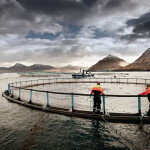
Photo courtesy of AquaBounty Technologies
