

Chilean salmonid exports reached USD 6.6 billion (EUR 6.2 billion) in 2022, a 27.4 percent year-over-year jump that cemented the industry's status as the country's second-largest export sector after mining.
However, the financial gains have been paired with greater environmental scrutiny of the industry's ecological side effects of salmon farming, resulting in Chile President Gabriel Boric opposing any expansion of salmon production.
In response, Chilean economic development agency Corfo has pushed for farming of other species, including Pacific oyster (Crassostrea gigas), golden kingklip (Genypterus blacodes), and floating kelp (Macrocystis pyrifera). It has issued a call to accelerate and consolidate the development, adaptation, and scaling of these prioritized species in the regions of Los Lagos and Coquimbo.
Corfo’s program aims to complement and expand Chile’s aquaculture production portfolio, with a clear focus on targeting regions outside of the capital city of Santiago while maintaining sustainability.
“We want new productive sources to be generated, and we’ve prioritized the species that have the most impact on local economies,” Corfo Technological Capabilities Manager Fernando Hentzschel told SalmonExpert.
Under the program, Corfo will co-finance up to 60 percent of total project costs, up to as much as CLP 3 billion (USD 3.4 million, EUR 3.2 million) per project. Participating entities must contribute at least 40 percent of the cost of each project, of which at least half of which must be pecuniary contributions. Projects that accept Corfo funding will face a six-year developmental window.
Corfo Los Lagos Regional Director Gabriel Pérez said Chile has a strong history of supporting aquaculture operations and possesses a strong labor pool of artisanal fishers, making it an ideal location for new aquaculture ventures.
“We understand that there is a context of global change – of adaptation to climate change – that urges us to explore new productive sources,” Pérez told SalmonExpert. “The selected projects are expected to generate positive impacts in their respective areas and be catalysts for a prosperous and resilient future in the aquaculture industry and in the face of climate change in Chile.”
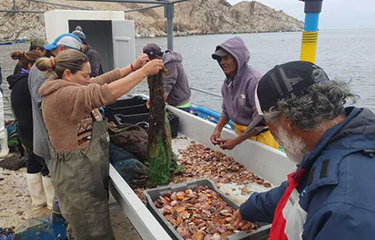
One of the first projects approved through the program is a five-year development of a Pacific oyster farm in northern Chile’s Coquimbo region, to be operated by Universidad Católica del Norte, in partnership with the Chinquihue Foundation, the Aquapacífico Aquaculture Innovation Center, and marine farming company Nanaku. A seafood diver and fisher union and the Los Pelambres mining company have joined on as associates. An additional 24 interested parties, mainly from Coquimbo, that are directly linked to coastal communities and associations will also be involved.
Another Corfo-sponsored technological program that recently earned the agency's approval is a kelp-farming project in Los Lagos to be operated by Agricultura Oceánica Regenerativa.
“Currently, a huge market is opening for algae because the cosmetics, nutraceutical, and food industries – including salmon feed – are taking [interest in] algae due to its high amount of omega-3s and nutrients, and because it is also a more sustainable source of food,” María José de la Fuente, the co-founder and director of operations at Agricultura Oceánica Regenerativa, told SalmonExpert.
An additional benefit of algae production, she said, is that salmon farmers can produce algae at salmon farms when these centers halt production between cycles, accelerating the ecosystem’s restoration and regeneration processes and providing supplemental income.
Another CLP 4.3 billion (USD 4.9 million, EUR 4.5 million) Corfo-sponsored project is under development in collaboration with a firm in Coquimbo to scale the cultivation of red kingklip (Genypterus chilensis). This project aims to lay the foundation for the cultivation of golden kingklip and drive the diversification that Corfo believes will lead to greater future success for the industry at large.
Photo courtesy of the Universidad Católica del Norte
