






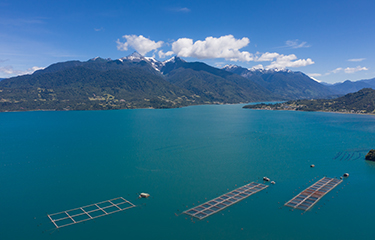
Chile’s salmon farms shipped a total of USD 6.6 billion (EUR 6.1 billion) in salmon and trout abroad in 2022, up 27.3 percent from the year before, the Chilean Salmon Council reported.
However, the increase was based mostly on higher international salmon prices, driven by a rise in the cost of inputs for salmon production, greater world demand, and the lack of harvest growth, which impacted salmon supply, Chilean Salmon Council Executive Director Loreto Seguel told SeafoodSource. In volume terms, Chile’s salmon and trout exports reached a total of 751,259 metric tons (MT) in 2022, just 3.8 percent up from 2021, according to the council’s “Quarterly Salmon Export Report,” based on information from Chile’s Central Bank and the National Customs Service.
In fact, from 2015 to 2022, annual harvests grew an average of 1.3 percent per year, according to data from the National Fisheries and Aquaculture Service (Sernapesca). Leaving out southern Chile’s region of Magallanes, where the development of the industry is a recent phenomenon, and only considering the more traditional salmon farming regions of Los Lagos and Aysén, salmon harvests actually decreased by an annual average of 0.5 percent from 2015 to 2021, the council reported.
“In recent years, the annual growth of the tons of Chilean salmon exported to the world has been moderate and this is due, in large part, to a limited growth of salmon harvests in Chile. We see the 2022 export figures as an opportunity to advance in improving regulatory frameworks and promote investment in the industry, always safeguarding competitiveness and environmental, social, and economic sustainability,” Seguel said in a release. “This is key to continue promoting the development of a productive activity that is clearly essential for [Chile’s] southern macro-zone and our country.”
The Chilean Salmon Council, a trade group that includes AquaChile, Australis, Cermaq, Mowi, and Salmones Aysén, together representing more than half of Chilean salmon production by volume, said factors including the current regulatory framework governing maximum sowing densities and the administrative processes for renewal and approval of concessions, as well as productive challenges to be addressed by the industry such as investment in R&D and innovation, were the reasons behind the sector’s deceleration.
During 2022, Chile exported salmon and trout to 75 countries. The top three relevant markets for Chilean salmon were the United States, Japan, and Brazil, representing USD 4.86 billion (EUR 4.47 billion), or 73.5 percent, of all salmon and trout exports in value terms and 534,099 MT, or 71.1 percent, of the total in volume. In those markets, Chile’s exports saw a 24.7 percent jump in value to USD 2.84 billion (EUR 2.61 billion) and a 4.8 percent increase to 251,132 MT to the U.S., which the Salmon Council attributed to higher prices, an improved array of product formats, and consolidated retail sales; while exports to Japan increased 17.1 percent to USD 1.21 billion (EUR 1.11 billion) in value, yet were nearly flat with a 0.6 percent bump in volume to 160,400 MT. In Brazil, volume actually decreased 3.7 percent, but high prices resulted in a 20.4 percent increase in value to USD 804 million (EUR 739 million).
In other markets, Chile’s salmon exports to Russia fell 5.3 percent in dollar terms to USD 276 million (EUR 254 million) and by 30.2 percent in volume to 35,386 MT, attributed to impacts from the ongoing war with Ukraine, but it continued to be the fourth-biggest market for Chilean salmon. China was Chile’s fifth-largest market, with shipments surging 82.8 percent by value to USD 188 million (EUR 173 million) and 58 percent by volume to 25,416 MT in 2022. Mexico was Chile’s sixth-largest market by volume, as shipments decreased 27.7 percent to 17,674 MT but increased 38.4 percent in value to USD 195 million (EUR 179 million).
Salmon has traditionally been Chile’s second most-important export after copper (exports of USD 43.9 billion, EUR 40.3 billion in 2022), but in 2022, it was relegated to third place as demand rocketed up for lithium by an astounding 777 percent, with Chile’s exports of the mineral reaching USD 7.76 billion (EUR 7.13 billion). In 2022, shipments of salmon and trout represented 6.8 percent of Chile’s total exports, and 12.3 percent when considering only non-copper goods.
Seguel said she is upbeat about the health of Chile’s salmon- and trout-aquaculture sector and said the industry will continue to try to work with Chile’s government and other relevant authorities to grow the industry in a sustainable manner.
“These results offer significant opportunities for employment, well-being, and industry strength to the benefit of workers, their families, the regions and also Chile,” she told SeafoodSource. “Chilean salmon farming has a strong commitment to the development of the southern macro-zone and that is why we believe it is essential to work together to promote this activity and move towards greater certainty and clear rules.”
Photo courtesy of ausfilms/Shutterstock
