






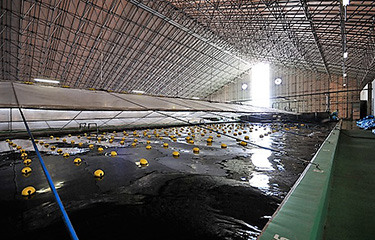
A small business ecosystem is forming around Japan’s nascent land-based vannamei shrimp production.
At the 24th Japan International Seafood and Technology Expo, held at Tokyo Big Sight 24 to 26 August, Tokyo-based IMT Engineering Co., promoted its proprietary "Indoor Shrimp Production System (ISPS)” as it had at the previous year’s show. But this year, there were additional related booths – one for the Indoor Shrimp Production System Promotion Council, and one for Inaka Pipe, which domestically produces and sells specific pathogen-free (SPF) vannamei shrimp at various stages of maturity.
One of the nascent sector’s pioneers, IMT Engineering promoted the ISPS system it developed in cooperation with the Japan International Research Center for Agriculture, Forestry, and Fisheries at its pilot farm in Myoko City, Niigata Prefecture. It is a clear-water recirculating aquaculture system featuring a wavemaker, a quasi-natural environment with artificial seaweed and hidden places to reduce stress for the shrimp, and water filtration through a biofilter and micro-screen.
In 2020, it formed a joint venture called Kaiko Yukinoya Co. along with Osaka-based Kansai Electric Power Company (KEPCO), with 2 percent owned by IMT Engineering and 98 percent owned by KEPCO. The JV set out to build a 16,000-square-meter production facility in Iwata City, Shizuoka Prefecture, with six 12-by-40-meter grow-out pool lanes and four nursery tanks with completion scheduled for 2022.
Backed by IMT Engineering, the Indoor Shrimp Production System Promotion Council provides technology and business support for creating an ISPS business. It pitches itself as a resource for those who aim to contribute to the United Nations Sustainable Development Goals (SDGs), positioning land-based shrimp as more sustainable than pond aquaculture. Indoor production systems are more expensive than pond aquaculture, but projected returns on investment are based on an expectation of a premium price, due to a cleaner image and no need for antibiotics in the controlled environment of the indoor farm, according to the council’s marketing materials.
As of August, 12 companies are members of the organization. Among the services it offers its members are: Cooperation strategy with related ministries, local governments, and financial institutions; business matching opportunities; publicizing the technology; technical meeting exchanges and site tours for members; collection, evaluation, and provision of the latest technology information; and technical training workshops.
Inaka Pipe Corp., based in Shimanto City, Kochi Prefecture, sells about JPY 15 million (USD 105,000, EUR 108,000) worth of SPF shrimp annually. They call it “shiro-ashi ebi” (white-leg shrimp), using the Japanese name to set apart from “vannamei,” which is the same species.
“This is all domestic, so we want to position it between kuruma-ebi [Penaeus japonica] and vannamei," Inaka Pipe Corp. CEO Reo Sasakura told SeafoodSource at the show.
The company’s brochure offers live adult shrimp (20 grams) for SPF broodstock, frozen adult shrimp for eating, shrimp of intermediate size (10 grams) for fishing bait, and baby shrimp (0.3 grams) for research and aquaculture.
Sasakura said that his prices are higher than those of imports, but he thinks that Japanese companies and customers will be able to put more faith in an all-domestic product.
Photo courtesy of IMT Engineering Co.
