






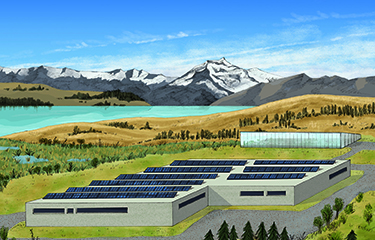
A prototype for New Zealand’s first land-based king salmon farm is in the early stages of development.
Queenstown-based Mount Cook Alpine Salmon’s USD 9.7 million (EUR 9.7 million) recirculating aquaculture system (RAS) project, which has received significant government financial support, aims to create a 1,000- metric-ton (MT) “hybrid” facility that partially emulates its existing glacial-fed canal system for farming salmon, according to a company press release.
Mount Cook Alpine Salmon Chief Executive David Cole said the facility will be designed for energy efficiency using gravity-fed water, and integrating renewable and low-energy solutions.
“This differs from the recirculated water systems used by most overseas land-based farms,” Cole said in the release. “The design will capture waste, control the flows better to suit the fish, and provide a stable, ideal growing environment. Being land-based, it has the opportunity to deliver greater automation and monitoring systems in an all-weather working environment.”
Cole said in addition to its energy efficiency, the farm will also use the waste as an additional value stream.
“The nutrients from the salmon operation will be collected to support an aquaponics crop, taking a circular approach and generating value from a zero-value waste stream,” Cole said. “This will link to a wetland area that would further purify the water.”
The location of the farm has yet to be determined, but the company said it will be located in either the Mackenzie or Waitaki District of New Zealand’s South Island, where it currently operates five salmon farms in the glacier-fed hydro-canals that run through both districts.
Mount Cook Alpine Salmon’s holdings also include two hatcheries, a stake in a third, and processing plants in Christchurch and Timaru. It describes itself as the leading producer of freshwater king salmon in New Zealand, exporting over 60 percent ofits production to global markets.
The RAS sector has faced an uphill battle in terms of energy costs and sustainability, prompting a souring of the investment climate.
Animal rights activists in New Zealand have also already come out against the project, claiming RAS operations require stocking densities that dwarf sea-cage aquaculture projects, creating risks of overcrowding, poor water quality, and disease.
Despite the hazards, the company said it is well-positioned to make its RAS venture feasible.
“There are always risks associated with innovative projects like this and government support helps cushion this risk and accelerate outcomes,” Cole said. “Despite the difficult market conditions over the last few years, our customers love the taste of our unique freshwater king salmon and demand continues to exceed our supply. This co-funding enables us to expand our production capacity through a new way of farming that has the potential to be a game-changer for the company and the aquaculture sector in New Zealand.”
Cole told Radio New Zealand the facility could potentially be paired with a wasabi farm to help purify water used in the proposed RAS facility. Future plans include adding sockeye salmon farming, he said.
A 2021 report by Ernst and Young identified 2.9 million MT of land-based salmon capacity was in the planning stages globally that year – an increase of 26 percent from 2020. Steve Penno, New Zealand's director of investment programs, said there are 70 land-based salmon projects globally in planning stages, under construction, or in operation.
The project has received backing from New Zealand's Ministry for Primary Industries Sustainable Food and Fibre Futures (SFF Futures) Fund, which has committed USD 3.9 million (EUR 3.9 million) over six years.
Penno said the Mount Cook Alpine Salmon project aligns with the government’s aquaculture strategy, which seeks to grow through an additional USD 1.75 billion (EUR 1.76 billion) in annual revenue.
“This project is an excellent example of smart thinking to explore what land-based farming could look like for New Zealand, based on next-generation salmon-farming techniques,” he said.
Photo courtesy of Mt Cook Alpine Salmon
