

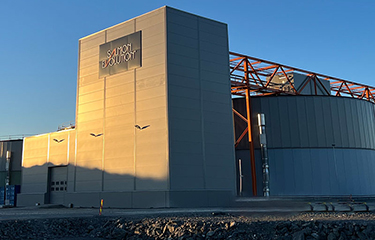
Norwegian land-based salmon farmer Salmon Evolution announced in its Q3 2023 report that it lost NOK 36.5 million (USD 3.4 million, EUR 3.1 million) before taxes, but that it also experienced strong biological performance throughout the period, ending with its best-standing biomass to date at its Indre Harøy facility, which attained Aquaculture Stewardship Council (ASC) certification in late October.
The company’s standing biomass on 30 September totaled 2,100 metric tons (MT), doubling the 1,047 MT recorded on 30 June this year for all of H1 2023. Its mortality rate in the three months came out to 1.5 percent, which Salmon Evolution said demonstrated it is “well on its way” to achieving an annual mortality rate between 3 percent and 5 percent.
With its eighth and ninth batches of 80-gram juveniles stocked in August and October, respectively, taking the Indre Harøy farm up to between 1.5 million and 1.6 million fish for the first time, Salmon Evolution began harvesting part of its third batch during the third quarter, obtaining a harvest volume of 185 MT of head-on-gutted (HOG) fish. This took its total harvest for the year to 770 MT HOG.
The expectation for the company is that with the remainder of the third batch harvested in the fourth quarter, its final quarter harvest will be between 1,000 MT HOG and 1,200 MT HOG.
Salmon Evolution CEO Trond Håkon Schaug-Pettersen said Q4 2023 will be the first quarter in which the company can say it’s working under a “normal operational modus.”
The company will stock its tenth batch in December, and this will take Indre Harøy up to “steady state production volumes,” Schaug-Pettersen said. “This means an annualized production equivalent to 8,000 MT of gutted-weight fish.”
With volumes increasing, production costs are moving in the opposite direction, and consequently, the company is on track to have its costs fully in line with conventional farming in the near future, he said.
“For us, it’s now about further streamlining production and improving a little bit every day, but I have to say that with the way things are looking, we are now closer than ever to really demonstrating the unique capabilities and potential of our facility at Indre Harøy,” Schaug-Pettersen said.
Going into Q1 2024, volumes should be similar to the closing period of 2023 before an expected “further uptick” in the second quarter of next year.
“We are also consistently seeing a very high share of superior-grade fish, which we are very happy about,” Schaug-Pettersen said.
Salmon Evolution also continues to exhibit positive signs financially, recording more than NOK 700 million (USD 64.4 million, EUR 59.3 million) in liquidity and Q3 revenues amounting to almost NOK 15.9 million (USD 1.5 million, EUR 1.3 million). The company has secured bank financing earmarked for the Phase 2 expansion of Indre Harøy.
Phase 1 will have an annual capacity of 7,900 MT HOG, while Phase 2 will elevate this total to 16,000 MT. When fully developed, Salmon Evolution said the facility on the small, 100-acre island is likely to have an annual capacity of 32,000 MT HOG, with all of the relevant licenses for this volume already in place.
Planned for completion in the second half of 2025, Phase 2 will be an “improved copy” of Phase 1 with no real fundamental changes, Schaug-Pettersen said. A third phase is expected to be completed in 2028, adding the final 16,000 MT of capacity the company wants.
Overall, the company is targeting a production capacity of 100,000 MT HOG by 2032.
To this end, it has entered into a joint venture where the company will develop, construct, and operate a land-based salmon farming facility in South Korea with an annual production capacity of 16,800 MT HOG. Salmon Evolution has also initiated a process to establish a land-based salmon farming operation in North America.
“We are currently spending a lot of time and resources on this [North America] venture because we see this as an opportunity for Salmon Evolution to really have good growth in the years ahead. Over the past year, we have scrutinized the entire region for potential sites, and we are currently in the process of narrowing in on a few qualifying sites,” Schaug-Pettersen said. “For us, it is very important to find the right site, where we are able to tick the boxes we need. Indre Harøy is [our] gold standard – probably the best site on the planet – but nonetheless, we’re seeing sites with very good potential, both in terms of quality and also in terms of the capacity to handle large volumes.”
Photo courtesy of Salmon Evolution
