






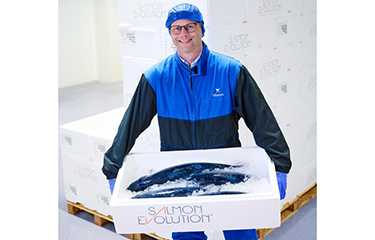
Salmon Evolution reported that its biomass production was back on track in Q2 2023 after the company reported excess mortalities related to amoebic gill disease (AGD) in Q1.
The company posted operating revenue of NOK 60.74 million (USD 5.7 million, EUR 5.2 million) in Q2 2023, up from the NOK 12.6 million (USD 1.18 million, EUR 1.1 million) it posted in Q2 2022 and the NOK 2.9 million (USD 273,000, EUR 252,000) it posted in Q1 2023. Operational earnings before interest, taxes, depreciation, and amortization (EBITDA) were once again worse in Q2 2023 than Q2 2022, with the company posting a loss of NOK 20.8 million (USD 1.9 million, EUR 1.8 million), compared to the loss of NOK 15.1 million (USD 1.4 million, EUR 1.3 million) in Q2 2022. However, the losses narrowed compared to Q1 2023, when the company posted an operational EBITDA loss of NOK 22.3 million (USD 2.1 million, EUR 1.9 million).
The company posted a loss before tax of NOK 26 million (USD 2.4 million, EUR 2.2 million) for Q2 2023, a jump from the NOK 10.4 million loss (USD 981,000, EUR 903,000) it posted in Q2 2022 and also up from the NOK 24 million (USD 2.2 million, EUR 2.1 million) loss it posted in Q1 2023.
The company’s losses compared to revenue partially reflect its status as a startup, given the ongoing construction at its Indre Harøy, Norway-based hybrid flow-through aquaculture system. The company completed its first salmon harvest from the facility in November 2022, and announced in late June that it picked Artec Aqua as the contractor for phase two of its land-based Atlantic salmon farm.
Now, the company said it is on track for “all time high biomass production” at its land-based facility, and that Batch 2 of salmon, harvested over 9 days in May, showcased strong product quality and a homogeneous weight profile.
“As published in our operational update in early July, we had very good operations going into the summer, and today I’m very pleased to share that this has continued throughout the summer,” Salmon Evolution CEO Trond Håkon Schaug-Pettersen said during a presentation of the results. “It has been an uneventful summer at Indre Harøy.”
Salmon Evolution added that the company has a plan to prevent future incidents of AGD, and has developed a freshwater treatment regime for all remaining fish groups. The company initiated the freshwater treatment on 14 May, and on 19 May all of the remaining fish groups in its facility were treated.
The company also said it has installed freshwater production capabilities and is enabling the facility to have freshwater treatment as a part of all grading operations when fish are transferred between tanks.
Salmon Evolution also offered an update on its joint venture in South Korea with Dongwon, where the two companies plan to build a 16,800 metric tons (MT) head-on, gutted (HOG) land-based salmon farming facility.
According to Salmon Evolution, the focus in Q2 for the joint-venture continued to be engineering activities, and the company’s design work on the smolt facility in Jeongseon is “almost completed.”
“Significant focus is currently devoted on cost optimization and although several areas of savings have been identified, there are site specific circumstances having an impact on cost, in particular the intake and discharge water solution due to a relatively long and shallow shoreline at the grow-out site,” Salmon Evolution said. “Different design solutions are thus being evaluated to reduce the overall cost.”
Schaug-Pettersen added that the project will see additional costs compared to its Norwegian operations, in large part due to the lack of existing salmon farming infrastructure that is more prevalent in Norway.
“In overseas projects, there’s always an element of farming infrastructure that we take for granted in Norway, which will also have an impact on the cost,” he said. “On the positive side, comparing apples to apples with Indre Harøy in Norway, the prices are comparable.”
The company said it is making progress in its search for a potential North American site as well. The company, as part of its plans to target 100,000 MT of HOG production by 2032, is planning to identify a site and build a full scale Indre Harøy-style facility somewhere in either Canada or the U.S.
“To facilitate this expansion, the Group has established a dedicated team of both in-house and external resources,” Salmon Evolution said. “Additionally, the Group has incorporated a U.S. corporate structure under its full ownership.”
The company hasn’t settled on a specific site location yet, but a map included in its Q2 2023 presentation had areas of eastern Canada, the coastline near Vancouver, Canada, and the Northwestern U.S. circled.
The company said that looking forward, it expects its next harvest to take place in September, and that it will have steady-state production volumes during Q4. It also said there will be favorable production cost development with further improvements as production volumes increased.
It added that the company is in a “strong financial position,” especially after a successful private placement in April netted NOK 525 million (USD 49 million, EUR 45 million), higher than the NOK 500 million (USD 47 million, EUR 43 million) in gross proceeds it was originally contemplating.
Photo courtesy of Salmon Evolution
