

Norwegian land-based Atlantic salmon farmer Andfjord Salmon announced it will progress with build-out plans that will enable an increase in total production volume at its Kvalnes site, on the island of Andøya, to 40,000 metric tons (MT) head-on gutted (HOG) over the next seven years.
The company, which has developed a farming system based on flow-through technology that it said capitalizes on the natural advantage of its access to oxygen-rich Gulf Stream seawater, has also secured commitment for a NOK 700 million (USD 64.8 million, EUR 59.9 million) bank loan to expand Kvalnes’s operations.
Giving a capital markets update on 13 June, Andfjord Salmon CEO Martin Rasmussen said the company’s strategy has always been to use its first pool to prove the company’s patented technology and the biological performance before progressing with the next stage of construction.
Rasmussen said in March 2023 the first production cycle has been successful and the company “couldn’t have had a better start,” with good fish health and welfare, strong growth, low energy consumption of 1 kwh per kilogram salmon produced, and a survival rate of 97.8 percent, together with an accumulated feed-conversion ratio (FCR) of 0.96.
“This proves that it works,” he said.
Andfjord released the first smolt of around 120 grams in June 2022, and Kvalnes’s first harvest – expected to be around 800 MT (700 MT) HOG – will begin in the beginning of July, with the fish weighing around 4 kilograms (8.8 pounds).
With its current license of 10,000 MT maximum allowed biomass (MAB), the facility can produce 19,000 MT HOG salmon.
Its new production capacity will gradually increase over five phases between 2025 and 2030, with 8,000 MT HOG of added production capacity slated for 2025 through four new pools. For the build-out to 40,000 MT, the company is targeting a blended capex of NOK 114 (USD 10.55, EUR 9.76) per kilogram, which includes “substantial buffers” to counter unforeseen risks such as inflation, and operating expenditures of NOK 40 (USD 3.70, EUR 3.42) per kilogram of salmon produced, including depreciation.
The plan is to build four new pools every year between 2025 and 2030 to reach the 40,000 MT target.
“We will more or less copy and paste what’s working in the first pool and increase the capacity with more units at Kvalnes,” Rasmussen said.
In the upcoming construction stage, the company is planning to establish major infrastructure such as waterways and a port area to support Kvalnes’s increased volumes. Together with construction partners Hæhre Kruse-Smith and Cflow, estimates include a budget of NOK 1.3 billion (USD 120.3 million, EUR 111.3 million), plus a risk buffer of NOK 350 million (USD 32.4 million, EUR 30 million) over the next two years.
Rasmussen said SpareBank 1 Nord-Norge and its partners, including Efskin, have financially committed to the project via a loan that includes a 24-month amortization holiday following the estimated start of production. Additionally, Andfjord Salmon has obtained a leasing facility to fund equipment in its construction phase of up to NOK 125 million (USD 11.6 million, EUR 10.7 million).
Andfjord Salmon's current NOK 75 million (USD 6.9 million, EUR 6.4 million) bank loan will undergo refinancing and replacement as a result, Rasmussen said.
Andfjord Salmon CFO Bjarne Martinsen said that with the proof of concept achieved, it’s important the firm now expands and increases its production volume.
The NOK 825 million (USD 76.4 million, EUR 70.7 million) financing is, therefore, a “major step” for the company’s expansion, Martinsen said.
During the capital markets update, Martinsen also said that key Andfjord Salmon shareholders Jerónimo Martins and Eidsfjord Sjøfarm, a multinational food distribution company and a conventional salmon farmer, respectively, have both “signaled a desire” to significantly increase their ownership stakes and are likely to cover the majority of the potential equity component. Both companies already have representation on Andfjord Salmon’s board of directors.
All future expansions – from 8,000 MT upward – are likely to include a combined financing formula of bank debt and cash flow, he said.
“When we are at 8,000 MT, we will already have a significant cash flow. We will be in a very strong position,” Martinsen said. “This first step that we are now taking is the most important step.”
Meanwhile, Andfjord Salmon’s two other locations on Andøya, Breivik, and Fiskenes, represent additional potential combined production capacity estimated at 50,000 MT, with preparatory work underway and construction expected to start in 2026 or 2027. Andfjord Salmon is expecting to achieve its 90,000 MT goal in 2032, according to Rasmussen.
“We have a clear roadmap to 90,000 MT annual production at Andøya,” Rasmussen said. “Salmon, as a product, has been very strong over many years … but there is a gap between supply and the demand. There are limits to how much you can grow with traditional salmon farming. We need other alternatives to close the gap. Some have chosen to go offshore, but we have chosen to go on land and utilize the natural coastal advantages that we have at Andøya.”
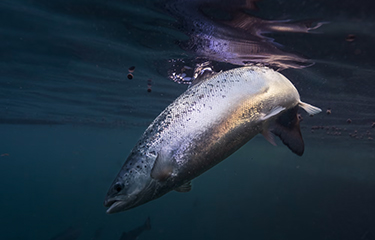
Photo courtesy of Andfjord Salmon
