






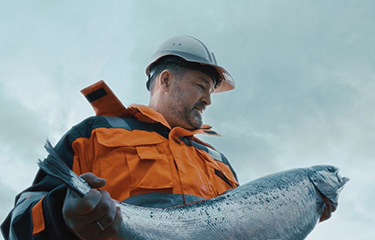
Bakkafrost Group’s first-quarter 2023 salmon harvest in Scotland more than doubled its year-over-year production, guiding the company to its highest Q1 revenue ever of DKK 2.05 billion (USD 301.9 million, EUR 275.3 million).
Bakkafrost harvested 8,093 metric tons (MT) of gutted-weight salmon in Scotland in Q1 2023, up from 3,973 MT in Q1 2022, leading it to post 25 percent higher revenue in the quarter and its second-best-ever operational earnings before interest and taxes (EBIT) for a quarter of DKK 565 million (USD 83.2 million, EUR 75.9 million), up 35 percent from DKK 418 million (USD 61.6 million, EUR 53.1 million) in Q1 2022. Its profit after tax increased 15 percent to DKK 467 million (USD 68.8 million, EUR 62.7 million).
Bakkafrost CEO Regin Jacobsen said the early signs of improvement seen in the fourth quarter of 2022 continued through the first part of 2023. The company’s Scotland segment’s posted better biology, mortality, and sea lice levels, alongside increased biomass and harvest weights, and he said the larger-sized fish it marketed attracted higher prices.
In 2019, Bakkafrost purchased a majority stake in the Scottish Salmon Company for NOK 3.76 billion (USD 411.1 million, EUR 374 million at time of sale), making it Scotland's second-largest salmon farmer by volume. It has since renamed the operations to Bakkafrost Scotland. It has since announced a "One Company" strategy to unite its Faroese and Scottish operations.
In announcing the company’s Q1 2023 results, Jacobsen said the company’s “One Company” strategy is successfully merging the Faroese and Scottish organizations, building on the strengths of each.
“Our customers recognize the high quality of the fish, whether it’s farmed in Scotland or the Faroes,” he said.
According to Jacobsen, the increased harvest weight has been the biggest change in the company’s operational history in Scotland – averaging 5.3 kilograms in the quarter, compared with 3.7 kilograms in Q1 2022.
“The strategy is to hold [onto] the fish while the growth is good and the mortality is low, which gives us much better value. We also see in Scotland that the farming KPIs have improved, with good growth and better feed conversion than last year,” he said. “There is still some way to go and some improvements to achieve but things are going in the right direction.”
Bakkafrost’s Scotland segment recorded a NOK 45.90 (USD 4.39, EUR 3.97) increase in its operational EBIT per kilogram, with a margin of NOK 28.23 (USD 2.67, EUR 2.44). Its operational EBIT climbed to DKK 155 million (USD 22.8 million, EUR 20.8 million), reversing a loss of DKK 53 million (USD 7.8 million, EUR 7.1 million) in Q1 2022.
With the company looking to mitigate biological challenges by transferring larger smolt for shorter at-sea grow-out production cycles in the sea, Jacobsen confirmed a multi-month delay of the opening of Bakkafrost’s new hatchery in Applecross, Scotland, but said the company’s goal remains to gradually start production at the facility over the summer, with its first fish introduced around 20 May.
“We believe that shorter marine cycles in Scotland will be a game-changing difference versus today’s operation,” he said.
He said the segment’s mortality rates have come down, in part due to Bakkafrost’s new capabilities to deliver dual treatments for gill health and sea lice.
In addition to its Scottish production, the company harvested 11,005 MT in the Faroe Islands. This was down 37 percent from 17,459 MT in Q1 2022. Jacobsen said the drop was expected and could be attributed to an earlier harvest conducted at lower weights to push down mortality levels from sea lice infestation.
“We prioritized early harvest over treatments,” he said.
The company transferred 3.8 million smolt into its farms in the quarter – the same total as a year previous – including 2.1 million fish averaging 424 grams in the Faroes 1.7 million fish averaging 11 grams in Scotland.
For 2023, Bakkafrost has forecast production of 98,000 MT of gutted-weight salmon for the year, including 68,000 MT coming from its Faroes segment and 30,000 MT from its Scottish operations. It expects to release around 16 million smolts in the Faroes and 9.6 million in Scotland.
Bakkafrost’s Q1 2023 feed sales fell almost 4,000 MT to 22,287 MT, while its marine raw material intake more than doubled year-over-year to 156,015 MT. Jacobsen said he expects Bakkafrost’s feed sales for the year to reach around 130,000 MT.
Bakkafrost CFO Høgni Dahl Jakobsen said its average salmon prices were at all-time highs in the quarter, particularly in the latter part of the period, at NOK 104.83 (USD 9.93, EUR 9.05) per kilo, an increase of 31 percent year-over-year and up 42 percent compared with Q4 2022.
“The Norwegian kroner has helped on the salmon price, but even measured in euros, we have a price increase of around 16 percent,” he said.
Citing the latest data from Kontali, Jakobsen said total salmon sales to all markets were down 4.9 percent in the quarter, with the European Union’s consumption falling 11 percent, Russia’s purchases falling 5 percent, and Japan’s purchases slipping 21 percent due to high air-freight costs. The Chinese market rebounded back to pre-Covid levels, and U.S. consumption has stayed “relatively stable,” he said.
At the same time, the global harvest fell 4.9 percent in Q1 2023, including a 6.2 percent drop in the European harvest to 352,000 MT, with Norway’s harvest slipping 6.7 percent in the period. There was also a 1.2 percent reduction in the harvest in the Americas at 191,000 MT.
Jakobsen said he expects a 2 percent increase in the global salmon harvest in 2023 and 2024.
Photo courtesy of Bakkafrost
