






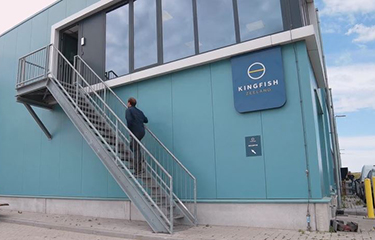
Dutch land-based yellowtail kingfish producer The Kingfish Company recorded its best-ever harvest of 932 metric tons (MT) in the first half of 2023 and, amid high demand for larger-sized fish, saw its revenue for the period increase 31 percent year over year to EUR 11.2 million (USD 12 million).
By comparison, the company posted revenue of EUR 8.4 million (USD 9 million) in H1 2022 on the back of a 742 MT total harvest.
In H1 2023, The Kingfish Company achieved per-kilogram revenue of EUR 15.10 (USD 16.22), versus EUR 12.00 (USD 12.89) in H1 2022.
Kingfish concluded its 58th production cycle in June 2023, and the company’s H1 2023 results statement emphasized that its gross margin in the period increased 50 percent year over year to EUR 1.5 million (USD 1.6 million), equating to 13.9 percent of revenue, despite significantly higher input costs.
The company said improved biological performance and the introduction of new feed formulations partially offset higher feed prices, which were up 35 percent year over year. Its energy costs, which peaked in H2 2022, were lower in H1 2023 as the company “benefitted from a favorable contract.”
Overall, increased sales prices offset higher input costs, leading to an increase in gross margin of EUR 2.10 (USD 2.26) per kilogram, compared to EUR 1.50 (USD 1.61) per kilogram in H1 2022.
Kingfish’s H1 2023 operational earnings before interest, taxes, depreciation, and amortization (EBITDA) amounted to a loss of EUR 2.2 million (USD 2.4 million), which was the same as a year previously. Its EBITDA per kilogram was EUR -3 million (USD -3.2 million), which was up from EUR -3.1 million (USD -3.3 million) in the same period a year prior.
Its selling general and administrative costs increased 19 percent year over year, with the increase mainly related to one-off transformation-related costs intended to strengthen the organization in anticipation of additional volume slated for Q1 2024.
Kingfish’s net loss after tax totaled EUR 4.2 million (USD 4.5 million), up from a loss of EUR 2.8 million (USD 3 million) in H1 2022, with the company attributing the rise mainly to higher financial expenses. The group spent EUR 16.1 million (USD 17.3 million) in the first six months of this year, including EUR 1.3 million (USD 1.4 million) in farm and U.S. growth capex. Operations in the facility’s phase 2 expansion started in May, with 60 percent of the grow-out systems operational at the end of August. The company plans to have phase 2 fully stocked by October.
Kingfish Company CEO Vincent Erenst, who was appointed in January 2023, said growth and performance have been “outstanding” and that farm biomass is likely to more than double to 1,000 MT before the year’s end.
Erenst confirmed that at the start of July, the company raised EUR 32 million (USD 34.4 million) by way of a convertible loan with a fixed interest rate and a duration of four years. This loan and Kingfish’s other remaining facilities will provide full funding for the completion of its phase 2 expansion and the company until it reaches positive cash flow and profitability.
Erenst’s said Kingfish’s financial results for H1 2023 entailed key progress in operations and in strengthening the company’s balance sheet.
“We have laid out a solid foundation to accelerate growth and reach profitability. In the second half of the year, we will complete the phase 2 expansion in the Netherlands, continue our efforts to improve our operational performance, and increase sales volume,” he said.
In August 2023, Kingfish received a boost when Maine’s Superior Court rejected an appeal of a challenge to permits granted to its expansion project in the U.S. state. In a press release, Kingfish Maine confirmed it remains a fully permitted project. Kingfish Maine aims to produce 8,500 MT of yellowtail using a recirculating aquaculture system in Jonesport, Maine.
Roque Island Gardner Homestead Corporation and Eastern Maine Conservation Initiative, the main opponents of the project have backed, Protect Downeast, which on 1 September circulated a letter citing the company’s borrowing history and cash burn rates in warning it cannot currently afford to build its farm in Maine.
“Kingfish Maine appears to have been granted a free option to build its project based on an illusion and a prayer, shrouding a highly speculative economic situation with misleading and selective operational highlights from the Netherlands pilot project of its parent,” it said. “Maine and its environment deserve better than this.”
Kingfish Maine Operations Manager Megan Sorby responded to the letter by calling it "the typical misinformation campaign tactics we have seen all along from the family who owns Roque Island."
"Higgins, who fails to disclose his bias as he is a member of this family appealing Kingfish's permits, cites financial information that is all publicly available – the benefit of being a publicly traded company. Kingfish, though extremely successful, is still in a start up-scale up phase of the company life, which is plain to see from anyone really familiar with business. Mr. Higgins' main point is that the company has failed to demonstrate financial capacity for the Maine build, and nothing could be further from the truth," Sorby said. "Our company has continued to meet our goals, and at every turn, when we have embarked to raise funds for an expansion or new endeavor, we have succeeded, sometimes surpassing the intended raise. That speaks volumes about the strength of our team, the belief in the sector, and the belief that this company delivers."
In April 2022, Ohad Maiman, who was then the Kingfish Company’s CEO but who has since transitioned into an advisory position, acknowledged a tightened funding situation for RAS projects, including his company’s.
“I would say funding for growth right now is not optimal,” he told SeafoodSource. “We are working still with several banks and continue to have investor relations and incoming approaches, but we need to find efficient funding and the right moment in time to move it forward. And then we will be better ready to execute efficiently. So we have patience but we’re working hard to expedite where possible.”
Maiman said the long-term outlook for the project’s success remained positive.
Photo courtesy of The Kingfish Company
