



Highlighting rising salmon prices and a strong operational performance, SalMar achieved operational earnings before interest and taxes (EBIT) of NOK 627 million (USD 75.8 million, EUR 62.5 million). While this was significantly below the record NOK 1.07 billion (USD 129.4 million, EUR 106.8 million) that it posted in the first-quarter of last year, it did represent a 48 percent rise on the previous quarter.
“Towards the end of the first-quarter, the price of salmon rose steadily compared with the levels seen in the autumn of 2020 and at the start of this year. Together with a strong operational performance from our employers along the entire value chain, this enabled SalMar to announce yet another good result, with margins up on the previous quarter,” SalMar CEO Gustav Witzøe said.
The Norwegian-headquartered salmon farmer’s gross operating revenues of NOK 3.18 billion (USD 384.7 million, EUR 317.3 million) in the last quarter was NOK 442 million (USD 53.5 million, EUR 44.1 million) less than in Q1 2020, while the harvest totaled 36,900 metric tons (MT), compared with 40,000 MT a year previously, and the operating EBIT-per-kilogram slipped to NOK 17.02 (USD 2.06, EUR 1.70).
Regionally, Fish Farming Central Norway, the group’s largest business segment, harvested a total of 20,800 MT of salmon in the last quarter, some 1,400 MT less than in Q1 2020. Fish Farming Northern Norway harvested around 13,500 MT of salmon in the first three months of this year, which was 100 MT less than a year previously.
According to the producer’s Q1 report, both segments continued to post solid results in the period, driven by solid operations and stable costs. The bulk of the volume was harvested in the quarter’s last month, when the price of salmon was at its highest.
Fish Farming Central Norway is expected to harvest 107,000 MT of salmon in 2021, while Fish Farming Northern Norway will harvest around 56,000 MT.
Meanwhile, its subsidiary Icelandic Salmon harvested 2,500 MT of salmon in the first-quarter 2021, compared with 4,300 MT in the same period of last year. The company posted an operational EBIT of NOK 4 million (USD 483,796, EUR 399,066), versus NOK 22 million (USD 2.7 million, EUR 2.2 million) in Q1 2020, but with SalMar highlighting improved operational and biological performance and higher salmon prices than in previous quarters.
SalMar expects to harvest 14,000 MT of salmon in Iceland this year.
Its report also states that “after a year of pandemic and a market characterized by global uncertainty,” the roll-out of mass vaccination programs in large parts of the world has helped to make the outlook brighter for the salmon industry, and that the price of salmon has now returned to a pre-pandemic level.
“SalMar is well placed to continue growing sustainably, not for growth’s sake alone, but because salmon is a sustainable marine protein which is needed by Norway and the rest of the world. SalMar has been producing farmed salmon for 30 years, and intends to carry on doing so indefinitely. Food will never go out of fashion,” Witzøe said.
Citing the NASDAQ Salmon Index data, the report said that Atlantic salmon was traded at a low of NOK 45.80 (USD 5.54, EUR 4.57) per kilogram at the start of 2021. In January and February, the price fluctuated between NOK 44 (USD 5.32, EUR 4.39) and NOK 55 (USD 6.65, EUR 5.49) per kilogram, before gradually rising to NOK 68.61 (USD 8.30, EUR 6.84) per kilogram at the end of March.
The price of salmon averaged NOK 52.78 (USD 6.38, EUR 5.26) per kilogram in the quarter, 23 percent less than the average price of NOK 68.50 (USD 8.28, EUR 6.83) per kilogram achieved in the same period last year.
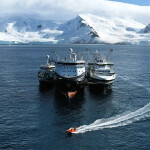
Photo courtesy of SalMar
