




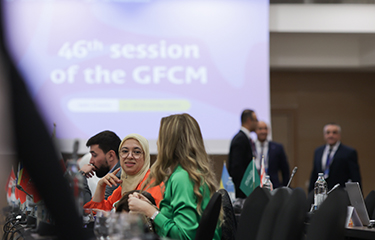
E.U. member-states and additional member countries of the General Fisheries Commission for the Mediterranean (GFCM) adopted several measures at the regional fisheries management organization’s 46th annual session in early November.
The GFCM adopted a series of recommendations aimed toward minimizing fishery impacts on the wider marine environment, along with measures to refine the reach and effectiveness of the science-based management plans for key commercial stocks introduced by GFCM over the past decade.
It also agreed on a regional plan of action to protect vulnerable species such as seabirds, cetaceans, and sea turtles, while critically endangered species such as European eels and Black Sea sturgeon are now under increased levels of protection. Additionally, in line with the Paris Agreement, the RFMO launched a long-term initiative toward achieving decarbonization within the region’s fishing fleet, including the promotion of sustainable energy sources, carbon sequestration techniques, and low-impact production methods.
The GFCM also confirmed a resolution to launch guidelines that support the implementation of environmental monitoring programs, as well as proactive efforts to reduce plastic use and improve sector waste management.
Establishing the highest number of adopted decisions at one meeting at 34, GFCM Executive Secretary Miguel Bernal hailed the meeting as one of the most productive in the GFCM’s history.
“By definition, making plans for the conservation and sustainable use of shared marine resources depends on trust and collaboration between many different stakeholders,” Bernal said. “I’m delighted by the ambitious attitude our members brought to the session this year, coming together to achieve common aims and objectives.”
According to the European Commission Mediterranean and Black Sea Fisheries Management Head Valérie Lainé, these plans have been “making a real difference” toward sustainability targets.
“It’s very encouraging to see the impact of our shared efforts,” she said.
In terms of compliance, the GFCM meeting focused on ensuring its decisions undergo effective implementation and also that member countries meet the commitments they’ve made for the development and regulation of their fisheries and aquaculture operations.
To ensure that compliance, the GFCM launched two permanent inspection and surveillance schemes for international waters and new catch documentation schemes for commercially important Black Sea turbot and Mediterranean red coral to increase accountability and contribute to the fight against illegal, unreported, and unregulated (IUU) fishing.
Governmental representatives also strongly agreed on the establishment of a regional vessel monitoring and controls system.
Ahead of the meeting, NGOs urged the GFCM to adopt a sanctioning system that would allow the RFMO to tackle illegal fishing and cases of noncompliance within its region.
The GFCM responded, creating a sanction system that will enable it to take action against countries that continue overfishing or illegal fishing, with the Med Sea Alliance hailing it “a crucial step toward building a culture of compliance” and that’s “essential for the rebuilding of Mediterranean fish populations.”
The system, which comes into force in 2025, authorizes the GFCM to take action if a member-state fails to stop its trawl fleet from fishing in no-trawl areas or if a member does not respect GFCM rules on fishing gear or catch restrictions.
Marine conservation-focused NGOs Global Fishing Watch, Oceana, and WWF the GFCM for its work.
“After decades of inaction against illegal fishing and Mediterranean countries not complying with the rules, times are changing,” Oceana Europe Senior Marine Scientist Helena Álvarez said. “Starting in 2025, the GFCM will finally have the power to make its members act against those who fail to adhere to catch or landing requirements or those who do not stop trawlers from fishing in areas where it’s forbidden.”
ClientEarth Senior Lawyer of the Marine and Mediterranean Team Nils Courcy said the measures will ensure the RFMO’s rules are obeyed.
“Compliance with the rules adopted by the GFCM members is an essential step toward improving the status of fish stocks and marine ecosystems in the Mediterranean,” he said. “This new recommendation and the clear intentions announced by the GFCM to extend it to the monitoring, control, and reporting obligations by ‘2026 at the latest’ are much-needed improvements to secure a healthy marine environment in the Mediterranean.”
Environmental Justice Foundation CEO and Founder Steve Trent said a “breakthrough in the protection of Mediterranean fish populations and marine ecosystems” had been achieved at the meeting.
“The GFCM will now be able to sanction breaches of conservation rules, which is a vital step on the road to recovery,” he said. “The success of conservation efforts in the Mediterranean basin will depend in large part on how effectively this tool is implemented and enforced and I urge GFCM members to apply it fully when the rules are broken.”
Photo courtesy of GFCM/Nikola Brboleža
