




Recommendations on how to include local and traditional knowledge into the North Pacific Fishery Management Council (NPFMC) has received broad support from tribes, industry groups, environmental groups, and other stakeholders.
“At a time when our fisheries are in crisis, and the subsistence Way of Life practiced by our people since time immemorial is in jeopardy, it is imperative that we use all available resource to identify solutions to this disaster – including traditional and indigenous knowledge,” Association of Village Council Presidents CEO Vivian Korthuis said in supporting the recommendations.
In 2020, the NPFMC created the Local Knowledge, Traditional Knowledge, and Subsistence (LKTKS) Taskforce and directed it to identify potential onramps for incorporating local and traditional knowledge – and related social science – into its decision-making process. The taskforce has returned with 11 individual recommendations, ranging from providing opportunities for tribes to engage directly with the council to creating dedicated Alaska Native Tribal seats to its various advisory bodies and committees. In October 2022, the council added a designated Alaska Native Tribal seat to its Advisory Panel, an action that the taskforce would like to see expanded.
The taskforce also created a protocol for identifying, analyzing, and incorporating traditional and local knowledge, which it has asked the council to adopt. Last year, the LKTKS Task Force created a searchable database with the social science and knowledge it had collected so far.
The taskforce’s recommendations have garnered support from tribal organizations and representatives, industry groups, the U.S. Fish and Wildlife Service, and conservation groups.
The council will decide what actions to take on the task force’s recommendations at its October meeting in Anchorage, Alaska.
“The October meeting will provide the space for what we view as a monumental occasion, to fully support and adopt the protocols and develop a strategy for implementation,” Alaska Marine Conservation Council Fisheries Policy Director Theresa Peterson said in public comments. “We encourage the Council to refrain from substantive changes to the document as the product before you is wide-ranging, comprehensive, and forward thinking.”
U.S. Rep Mary Peltola (D-Alaska), who previously led the Kuskokwim River Inter-Tribal Fish Commission in Alaska, has called on regulators to better incorporate traditional and indigenous knowledge into their decision-making process. Peltola has repeatedly used the example of one of the commissioners accurately predicting how big salmon runs would be based on the prevalence of migratory Canadian geese. The commission used his predictions to successfully manage salmon fishing in the area, Peltola said.
“I shouldn't consider it uncanny,” Peltola said in a May interview with Ocean Strategies. “This is traditional knowledge. If a group of people have been living in one place for 12,000 years, they are going to have an understanding of the resources. And we may not consider it science, but on some level, it is science and it is traditional knowledge and it is relevant. And I think that it can fill gaps that we have in western science and complement it.”
NOAA Fisheries is also considering increasing the amount of local and community input in decision-making agency-wide. In May, NOAA Fisheries issued an advance notice of proposed rulemaking as it looks to update its national standards to address equity in the representation of local fishing communities. Tribal organizations and salmon industry advocates seized on the agency’s announcement as a path for communities and subsistence fishermen to push back against the industrial pollock fleet in the Bering Sea.
“We’ve seen multiple species of salmon dramatically decline on the Kuskokwim in recent decades, including chinook and chum salmon, both of which are caught as bycatch by the Bering Sea pollock trawl fleet,” Kuskokwim River Inter-Tribal Fish Commission Executive Director Kevin Whitworth said. “These declines are devastating for our communities and our ways of life, and they’re happening in part because marine managers at the North Pacific Fishery Management Council and NOAA Fisheries do not equitably consider our traditional foods or our Tribes when making decisions about pollock allocation. Revising these national standards may bring the change we need to see in fisheries management to protect our salmon and cultures.”
However, it’s not clear that incorporating local and traditional knowledge will be the pushback to the pollock industry that some in Alaska anticipate. In fact, some pollock producers see the LKTKS recommendations as an opportunity to have their voices heard more clearly in council decision-making.
The At-sea Processors Association (APA), a trade group representing major pollock companies, expressed broad support for the LKTKS recommendations, suggesting that its members could be a source of local knowledge for the council moving forward.
“APA member skippers and crew have many decades of experience of fishing in the Bering Sea, and have direct knowledge about the marine ecosystem and the ongoing effects of climate change,” APA Executive Director Stephanie Madsen noted in public comments. “We believe that they are local knowledge holders that make up a community of Bering Sea fishery stakeholders with valuable knowledge and perspectives to contribute to the Council’s fishery management process.”
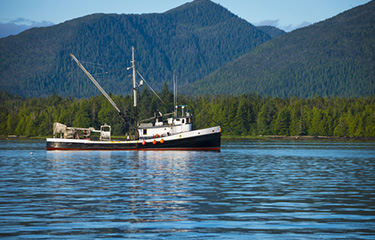
Photo courtesy of Shutterstock / Kent Weakley
