






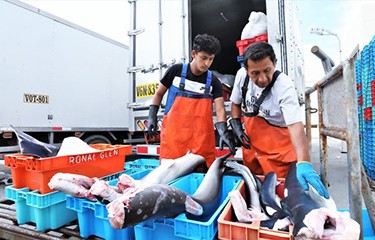
Peru’s Production Ministry (PRODUCE) is working to establish regulations for the country’s first-ever national fisheries policy, which aims to position Peru’s fishing industry as more competitive and sustainable by 2030 and address food security issues, among other goals.
PRODUCE will begin the process with a diagnosis of the fishing sector, based on which long-term strategies and action plans will target the entire seafood value chain, including artisanal fishers, shipowners, processors, purveyors, and consumers, Peru Production Minister Raúl Pérez Reyes said in a press release.
“The main objective of the national fisheries policy is to make fishing more competitive, leading to an increase in exports of value-added hydrobiological products, new technologies to improve extraction and processing, as well as the creation and improvement of infrastructure such as artisanal fishing whar[ves],” he said.
Such value-added fishing products contributed PEN 4.57 billion (USD 1.27 billion, EUR 1.15 billion) to the Peruvian economy in 2022, representing 0.8 percent of national GDP, PRODUCE stated, while fish exports brought in USD 4.09 billion (EUR 3.72 billion), comprising 6.9 percent of Peru's total exports last year.
The move to draft a national fisheries policy comes shortly after the 20 May publishing of a modification to the country’s existing general fisheries law. The modification, published in Peru’s official daily newspaper, El Peruano, recognized traditional artisanal fishing as a distinct category and promoted fishing preservation within five nautical miles of Peru's coastline.
That law first received approval in 1992; since then, it has undergone modification three times.
According to Percy Grandez, maritime governance legal specialist at the Peruvian Society for Environmental Rights (SPDA), the latest version of the law covers five key topics: protecting the first five nautical miles off the Peruvian coast, differentiating between artisanal and small-scale fishing, defining the meaning of an “overexploited” resource, creating a national registry for ancestral and artisanal fishers, and ensuring fisheries control regulations avoid future degradation through political turnover.
Regarding the first topic, the recently passed law prohibits fishing with mechanized purse seines within the first three nautical miles of the Peruvian coastline. Along the same lines, it declares the first five nautical miles as a protection zone for flora and fauna and prohibits larger-scale extractive activities from occurring in that zone, giving the legislation sweeping power of enforcement in what authorities only previously controlled at the regulatory level.
The first five miles off the Peruvian coast comprise a crucial ecosystem, hosting the main hydrobiological resources that sustain fishing for direct human consumption in the country. The area also contains habitats indispensable for the reproduction, spawning, and grow-out of coastal species of commercial importance.
The law also establishes that PRODUCE, upon the recommendation of its technical institute Imarpe, shall approve the list of fishing gear and methods allowed within the first five miles. If it deems it appropriate, PRODUCE may also determine differentiated extraction areas for artisanal and small-scale fishing due to the varying geographical characteristics of the coast.
Before the approval of the updated law, it previously divided fishing activity into two categories: artisanal/small-scale fishing and large-scale fishing. With the new law, artisanal fishing becomes a different category than small-scale fishing.
Artisanal fishing depends predominantly on manual labor for the collection of fishing gear, while small-scale fishing entails the use of smaller boats with mechanized fishing equipment and systems for the collection of fishing gear.
The law requires PRODUCE, within a maximum of 60 working days, to establish parameters around the term “manual labor” and define the technical characteristics that differentiate each of the categories of commercial fishing, as well as the other requirements and conditions that fishers must meet to ensure they are carrying out viable fishing activity.
In relation to the overexploitation of resources, Imarpe must now assess the biomass and the level of exploitation of a resource before allowing access to that resource.
Previous to the current legislation, the regulated degrees of exploitation were “unexploited,” “underexploited,” “fully exploited,” and “in recovery.” The newly incorporated category of “overexploited” – when fishing activities have exceeded the natural recovery capacity of the biomass – allows PRODUCE to define the respective fisheries management measures necessary to ensure the recovery of those threatened resources. Authorities will base total allowable catch measures on these measures to guarantee the sustainability of fisheries.
The new law also creates a national registry of traditional ancestral fishers and artisanal fishers, respectively. It calls for PRODUCE, in coordination with the Ministry of Culture and the Directorate of Port Captaincy, to implement these registries through their digital platforms within a period not exceeding six months from the law’s enactment. The idea is to define such fishers in order to establish public policies aimed at improving their quality of life, providing them increased access to public services, bonuses, education, training, and other benefits.
In May 2022, Peru’s executive branch approved reducing the fines imposed for committing fishing infractions by up to 90 percent, which weakened fisheries control and the sanctioning power of the state. The newly approved law states that in no case may PRODUCE establish discounts greater than 40 percent.
Photo courtesy of PRODUCE
