






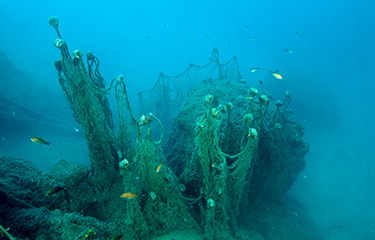
The second of five planned meetings hosted by the Intergovernmental Negotiating Committee (INC) of the United Nations Environment Program (UNEP) to discuss global plastic pollution ended with greater emphasis and discussion on marine debris, including abandoned, lost, or discarded fishing gear (ALDFG) – also known as ghost gear.
The INC sessions aim to negotiate an international, legally binding plastics treaty, as global plastics pollution – including ALDFG throughout the world’s oceans and microplastics now found in such remote places as Mount Everest – has continued to proliferate mostly unabated on an international level.
The first INC session (INC-1), which took place in late November 2022 in Uruguay, covered the objective, scope, and structure of the agreement.
Notably, marine debris and ghost gear were largely absent from the discussion, causing concerns from nonprofits such as Ocean Conservancy, which pressed member nations to address these issues in the second session (INC-2) ahead of a zero draft – the first written version of the agreement up for negotiation that outlines the treaty’s background followed by principles and proposed provisions.
“This is a once-in-a-generation opportunity to try to address plastic pollution in a holistic way,” Ocean Conservancy Global Ghost Gear Initiative (GGGI) Associate Director Joel Baziuk said. “We’re starting to see momentum from a lot of different countries wanting to include sea-based sources of marine debris [in the agreement] like ALDFG or ghost gear, for example, but also things like microplastics and how these are present in the ocean.”
Due to the lack of emphasis on marine debris in INC-1, Ocean Conservancy published a paper ahead of INC-2 with a series of specific recommendations for voluntary and mandatory additions to the treaty regarding marine debris, and ghost gear in particular.
“Since [ghost gear] is pound for pound the most harmful form of marine debris, we want to make sure that it is adequately addressed in the ILBI [international legally binding instrument],” Baziuk said. “What form that actually takes at the end of the day is still unsure. So, it's difficult to know exactly what provisions to be included in there.”
Ocean Conservancy’s recommendations include built-in traceability in gear components where feasible, government-subsidized training and awareness courses to avoid gear loss, no-fault reporting schemes that would allow fishers to alert authorities on the loss of ALDFG, and gear made out of truly marine biodegradable materials, among other guidance.
“We work with the fishing industry because what we want to see is positive change,” Baziuk said. “No fisher ever wants to lose their gear; it costs them money, [and] it's the means by which they harvest seafood in order to feed their own families and the rest of the world.”
Ocean Conservancy estimates that ghost gear comprises 10 percent of marine litter and is responsible for a 30 percent decline in some fish stocks, such as Greenland halibut catch in Norway. An estimated 5.7 percent of all fishing nets, 8.6 percent of traps and pots, and 29 percent of fishing lines end up lost or abandoned in marine environments annually.
A report from SEAwise, a research program aiming to understand current fisheries management across Europe, echoes Ocean Conservancy's findings, stating that plastic and fishing-related litter doubled from 2012 to 2021 in European waters.
“Our hope is that the outputs of this work can be useful to … see the evolution of the volume and accumulation of plastic on the seafloor, as well as useful to monitor the hot spots of plastic accumulation and see if these are decreasing,” SEAwise Mediterranean Case Study Lead Maria Teresa Spedicato said.
Even though the statistics about marine plastics are concerning, UNEP estimates plastic pollution could decrease 80 percent by 2040 if systematic change takes place.
INC-2, held from 29 May to 2 June 2023 in Paris, France, addressed ALDFG and other marine debris, which, certain groups like Ocean Conservancy hope, is a positive step toward having this alarmingly growing issue featured prominently in the treaty’s zero draft.
The second session ended with a mandate from 169 member nations for the INC chair to prepare a zero draft during the intersessional period ahead of INC-3, taking feedback from involved parties and invested observers into account.
According to Planet Tracker, a nonprofit that provides data aiming to align financial markets with a sustainable future, 135 countries call for binding rules rather than voluntary agreement, and 94 nations called to prioritize bans or phase-outs of problematic polymers, chemicals, and high-risk plastic products.
“Planet Tracker calls for an ambitious zero draft that embraces the full life-cycle approach of plastics and encourages the reduction of production of fossil-based plastic,” Planet Tracker Senior Investment Analyst (Plastics) Thalia Bofiliou said.
One of the most essential takeaways Planet Tracker believes should come from the INC sessions is that financial institutions realize the plastic industry poses arguably the largest investment risks of any industry. These risks include toxic releases, harmful additives, carbon emissions, marine and terrestrial pollution, microplastics, nonrecyclable waste, and increasing regulations.
“In its most ambitious version, the treaty would cover the whole supply chain from the upstream resin producers – comprising oil and gas and chemical companies – [to the] midstream containers and packaging converters, through to the downstream brands and retail companies, ending with the waste industry,” Bofiliou said. “However, there is a strong group of member states – including the U.S. and oil companies – which want to focus on downstream recycling as the solution and ignore restrictions to production.”
Nonprofits like Ocean Conservancy and Planet Tracker will have to wait and see whether the zero draft of the treaty is as ambitious as they hope.
Observers must submit their recommendations for the zero draft by 15 September 2023, and member nations have another month to do so. Member nations have the final say on the contents of the draft.
INC-2 was the second of five planned meetings expected to conclude in 2025, with INC-3 being held in November in Nairobi, Kenya. Completion of the zero draft is likely to occur in the lead up to INC-3.
Photo courtesy of zaferkizilkaya/Shutterstock
