






What was once a simple fishcake shop in a Japanese seaside town has now grown into a budding tourism complex teaching the history and process of fish paste manufacturing to visitors, while simultaneously continuing to develop innovative products.
Suzuhiro Group started as a side company for the fourth-generation owner of an Odawara-based family fish shop in the 1860s, who made and sold kamaboko fishcakes and handled the regular tasks of running the fish shop. After its incorporation in 1951, it’s now the eighth-largest fish paste producer in Japan, with fiscal year 2019 sales of JPY 10.2 billion (USD 68.5 million, EUR 64.5 million) and over 700 employees.
After garnering this success and establishing a legitimate foothold in the fish paste market, Suzuhiro has opened a tourism complex in Odawara – a city that has both a fishing port and pure spring water, providing the essential ingredients needed for fishcake manufacturing. The city is also just an hour south of Tokyo, allowing the company to capitalize on a massive tourism market from the nearby city.
Visitors to the tourism complex can browse the company’s diverse products while also learning about the history of both the company and the city. At the Kamaboko Museum next door, visitors can also make their own fishcakes, and at the Hakone Brewery, they can sit and enjoy craft beers. Food options include a buffet restaurant called Buffet Elenagosso; the handmade buckwheat (soba) noodle restaurant, Soba Mikura; and the high-end Japanese restaurant, Kaiseki Shionone. All of these businesses comprise the tourism complex as a whole.
Taking further advantage of the tourist trade, the company has established two more retail shops in Odawara, as well as two other shops in nearby towns that serve as bases for visitors to Hakone and Mt. Fuji. The company also sells merchandise through department stores, souvenir shops, and hotels.
Suzuhiro largely attributes its success to the way it conducts business, epitomized in its motto: “It’s a long-establish store, not a long-established store.” This means the company has continued to look forward and stick to its ethics of working directly with customers, being honest and sincere, and constantly innovating.
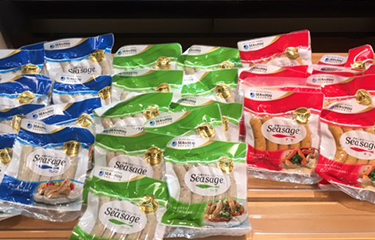
Among the company’s innovative products are seasage and sea franks – imitations of sausages and frankfurters, respectively.
Fishmeat, or gyoniku, sausages made from surimi have been common in Japan since their development in the 1950s, but these are usually pink, soft, salty, and wrapped in a nylon film that consumers peel back. Suzuhiro’s sausage products, meanwhile, use all-natural ingredients and have a distinctive pop when bitten due to the natural sausage casings the company uses for the product.
“The distinguishing characteristic of our seasage is texture,” Suzuhiro Project Manager Tomohiro Suzuki said. “Our seasage has a smooth, soft, but coarse texture with a comfortable bite resilience. To produce the unique texture, we mix surimi and three different kinds of chunky kamaboko together. The texture is closer to pork sausages than conventional gyoniku sausages. We also use natural sausage casings, which provide snap in each bite. Seasage is seasoned with salt, herbs, and spices. We don’t use any artificial flavors, artificial colorings, or preservatives.”
In all, there are three flavors each of seasage and sea franks. The other two flavors of seasage are herbs – comprising basil and parsley – and chili. Sea franks are larger than seasages and come in shrimp, scallop, and squid flavors.
Suzuhiro eliminated all preservatives from its products and focused on using natural colors and spices, including sea salt from Mexico.
In addition to its ordinary retail channels, both items are available through the company’s online shop. A pack of five seasages is priced at JPY 486 (USD 3.28, EUR 3.08) including tax, while a pack of three sea franks costs JPY 648 (USD 4.37, EUR 4.10). A set of all six types is JPY 3,618 (USD 24.39, EUR 22.89).
Photo by Chris Loew/SeafoodSource
