






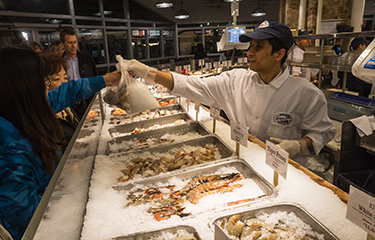
U.S. fresh, frozen, and shelf-stable seafood sales at retail stores all declined in September despite price deflation among seafood categories.
Fresh seafood prices dropped 1 percent in September, but sales slid 6.6 percent to USD 408 million (EUR 385 million) in the period. Shelf-stable prices fell even more, declining 2.9 percent in September, but the category also saw a decrease in sales, dipping 4.4 percent to USD 206 million (EUR 195 million).
Frozen seafood prices, meanwhile, increased 1.6 percent and realized the steepest decline in sales, dropping 8.7 percent to USD 466 million (EUR 440 million), according to Circana data analyzed by Lakeland, Florida, U.S.A.-based 210 Analytics.
Specifically, in fresh seafood, shrimp sales dropped 16.5 percent, tilapia sales fell 10.8 percent, lobster sales dropped 10.5 percent, crab sales slid by 6.1 percent, and salmon sales dropped 4.2 percent.
Frozen crab sales – which have been soaring since the start of the year – declined a significant 15.8 percent in dollar value and 61.4 percent in volume. Frozen shrimp prices, conversely to the frozen seafood category as a whole, dropped 8.1 percent in September, but sales still plummeted 9.4 percent.
210 Analytics Principal Anne-Marie Roerink said she was surprised by the seafood sales declines in August and September, surmising that higher gasoline prices are to blame for a drop in overall grocery spending.
“The renewed increase in gasoline prices on already elevated levels puts another dent in people’s ability to spend on groceries,” she said.
Exacerbating the issue, seafood often has much higher prices per pound than chicken, leading Americans to employ a “constant balancing act to stretch their paychecks as far as possible,” Roerink said.
Overall, the frozen food industry is “struggling to bring back the high engagement seen in the first two pandemic years and has experienced above-average unit and volume pressure because consumers are buying less when they shop the frozen food aisles,” Roerink explained. “This has been a widely used tactic by consumers to make ends meet across departments.”
Many consumers leverage frozen food as a backup plan for days when their fridge is empty, but meal planning ahead of time, which is growing in popularity, is hurting the frozen seafood category, Roerink said.
“With more consumers doing meal planning and sticking to the list, perhaps having frozen shrimp on hand is something fewer people think about,” she added.
Some products fared better than others in September, as frozen salmon prices fell 4.7 percent in the month, resulting in a sales hike of 5.9 percent and an 11 percent increase in pounds sold.
“Wholesale prices for several species are looking much better, but there is always a delay in which retailers are working their way through inventory,” Roerink said. “Hopefully, the market will be able to take advantage of more favorable retail pricing during the holiday season.”
Seafood inflation remains more consumer-friendly than overall food trends, as the food index rose 0.2 percent in September, according to the U.S. Bureau of Labor Statistics Consumer Price Index (CPI). Plus, total food and beverage inflation rose 3.1 percent in the month, according to Circana.
Food-at-home prices increased 0.1 percent in September compared to August and 2.4 percent year over year. While that number remained relatively unchanged month over month, food-away-from-home prices saw a bigger hike of 0.4 percent in September compared to August and a significant 6 percent incline year over year, according to the CPI.
The acceleration of food service inflation is “worrisome,” particularly for the seafood industry, Roerink said.
“Restaurant prices are higher to start, which means the higher-percentage increase hurts consumers’ ability to purchase from restaurants,” she said. “Now, think about most restaurants charging a premium for substituting chicken … salmon, shrimp, etc., and eating seafood out is becoming a challenge for many households.”
Despite the higher prices for dining out, sales at “eating and drinking places” rose 0.9 percent to USD 91.9 billion (EUR 86.8 billion) on a seasonally adjusted basis in September, according to preliminary data from the U.S. Census Bureau. Additionally, consumer spending in restaurants increased 9.7 percent compared to Q3 2022.
Eating out for Americans has become more of a “planned occasion, a treat, instead of the last-minute resort when running out of time or not being in the mood to cook,” Roerink said.
As a result, grocery stores are increasing their efforts regarding deli-prepared foods.
“Chicken is the dominant protein in [the] grocery deli-prepared [category] – both in ready-to-eat and ready-to-cook, but we’re seeing grocery stores experiment with seafood in this space as well; I believe this is a big growth opportunity, including a way to connect with Gen Z and millennials,” Roerink said.
Photo courtesy of gabriel12/Shutterstock
