




Executives with a plant-based seafood analog producer and a developer of cell-cultured seafood said competition is heating up between the two types of products and their makers’ quest for funding.
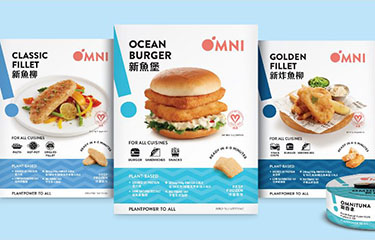
China’s new preoccupation with food security and food price inflation are potential game-changers for alternative proteins producers in the country, according to Stephanie Fong, a spokesperson for Green Monday, the parent company of Hong Kong-based Omnifoods, which produces the OmniSeafood range.
Fong said her company is hopeful about signals of support for the plant-based protein industry from the Chinese government – specifically, a new five-year plan published earlier this year that includes cell-cultivated and plant-based meat in the country’s blueprint to secure its future food needs.
Food security has become a policy priority for China, which is nervous about becoming overly reliant on imports in light of rising tensions with key suppliers of its agricultural imports, including the U.S. Additionally, rising meat prices due to inflation has pushed China’s government to further support the development of alternative proteins, Fong said.
Fong said the wide variety of tastes found across Omnifoods’ seafood product range is a competitive strength for the company as it competes for stomach share in Asia and elsewhere.
“The OmniSeafood series is one of the most-comprehensive plant-based seafood lines, covering naked fish to fried fish, as well as salmon, tuna, and crab cake. The comprehensiveness is unparalleled,” she said. “We are also the first in the world to introduce a non-battered plant-based whitefish to the market, which can fit in many Asian cuisines.”
Fong also a move by the government of the U.S. state of California to invest USD 100 million (EUR 95 million) in plant-based ingredients for public school meals.
“The key for companies [producing plant-based proteins] is to continue innovation,” Fong told SeafoodSource.
Omnifoods recently opened a production facility in Yangxi, Guangdong province, China, with the goal of creating products catering to tastes in Asia, the world’s key market for both pork and seafood.
“65 percent of all meat consumed in China is pork, therefore, our first R&D product Omnipork is one that is tailored for Asian cuisine and palettes,” Fong said. “It is a highly versatile ingredient that can work in dumplings, dim sum, and other applications.”
However, Lou Cooperhouse, the CEO of cell-based seafood producer BlueNalu, which is based in California said rapid developments in lab-grown seafood have paid off, with investors flocking to cell-based seafood production over plant-based.
“We are a solution to global supply chain problems,” he told SeafoodSource. “We take the unpredictability out.”
Cooperhouse said BlueNalu has “cracked the code” on large-scale production of cell-based seafood, and is more attractive to investors than plant-based peers “because its scalable technology” will allow it meet huge pent-up demand for premium, rarer species like bluefin tuna.
Cooperhouse said governments worldwide will begin to liberalize their regulation of cell-based meat and seafood cultivation and sales.
“It’s a matter of time,” he said.
Photo courtesy of Green Monday
