






New net technology suitable to be used alongside offshore wind farms in exposed offshore locations could unlock an additional GBP 4.2 billion (USD 5.1 billion, EUR 4.9 billion) in turnover for Scotland’s aquaculture sector, according to the findings of a research project led by start-up Impact-9.
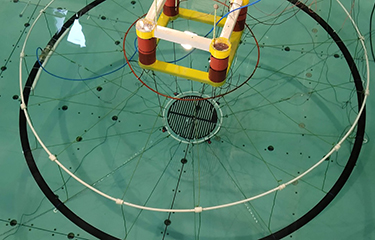
The company has designed a system that is now ready to be tested at scale. Called “Net9,” the concept is a submersible, floating structure that utilizes the ocean’s natural ecosystem and conditions.
Its development marks the end of the latest phase of the GBP 200,000 (USD 242,431, EUR 231,522) Inflatable Marine Products for Aquaculture Containment Technology project (IMPACT), which was funded by the U.K. Seafood Innovation Fund (SIF) with additional support from the Sustainable Aquaculture Innovation Centre (SAIC).
Engineers from Tension Technology International (TTI) and blue economy project developer Simply Blue Group were involved, looking at regulatory issues and fish health and welfare as well as the cost challenges associated with bringing aquaculture into open ocean environments.
Impact-9 said once at full scale, a single Net9 pen could be used to produce up to 2,500 metric tons (MT) of salmon per annum. It has identified an opportunity to use the new technology within existing and planned offshore wind energy zones, where a small portion of these zones – around 12 square kilometers – would be enough to house 280 pens and quadruple Scottish production.
“A move further offshore can pave the way for a new sustainable seafood industry of scale, worth billions of pounds in the U.K. alone. The economic potential is similar to that of offshore wind; however, it will occupy a relatively small amount of ocean real estate and could fit in with existing and planned offshore wind turbine arrays,” Impact-9 CEO John Fitzgerald said. “In the same way that lithium-ion batteries are the key to green transport, we believe that smart flexible structural elements like those used in Net9 will be the enabler of offshore seafood production.”
Fitzgerald said, for him, the most-exciting part of this phase of work was to see the positive cross-over between fish welfare and structural engineering.
“The potential for stormy weather is of course unavoidable in these environments, but the design of the system allows the net and the fish contained in it to move together with much more flexibility than a rigid structure,” he said.
Impact-9’s system uses a flexible structure which is designed to move with the waves and weather any storms, rather than fighting against the water, reducing the potential stress on fish.
Next year, the research team plans to begin building a unit suitable for technical demonstration at the European Marine Energy Centre (EMEC) in Orkney, which will also provide interested producers with an opportunity to see a model of the system in operation.
“This is part of a systematic engineering approach to address technical novelty and undergo carefully managed tests to qualify that new features will perform as desired. The process is similar to offshore renewable systems development, and we have brought to bear expertise from that sector to help Impact-9 manage the risk of adopting their novel structures in the Net9 application,” TTI Engineering Manager Tom Mackay said.
Photo courtesy of Impact-9
