






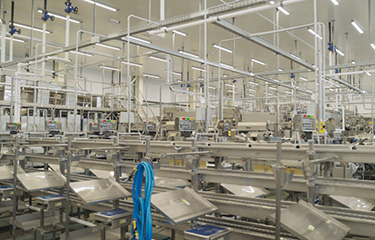
Petropavlovsk-Kamchatkskiy, Russia-based Lenin Collective Farm Fishery (RK Lenina) officially opened a new processing plant it has dubbed Kommandor on 19 September, 2022, with claims that the new facility is unique even by global standards.
The new facility is in the village of Oktyabrsky, located in a coastal area of the Kamchatka Peninsula in Russia’s Far East. The new facility has a daily production capacity of 230 metric tons (MT) of canned fish, fillet, and mince; 40 MT of fishmeal; and 30 MT of fish oil and is, according to the company, outfitted with equipment capable of processing any type of fish.
The launch of the facility is a significant milestone for Kamchatka’s seafood industry, as it marks the last facility to start operations built under Russia’s investment quota initiative. Russia has used aggressive incentives to renew both its fishing fleet and its processing capacity, and under the program eight processing facilities were planned to be built in Kamchatka. The Kommandor is the last such facility – and the second facility that RK Lenina had built under the initiative.
RK Lenina CEO Sergey Tarusov said the facility will focus on pollock, herring, and cod – with a lesser focus on fluke and salmon. According to the company, it will be able to output products in a variety of formats, including cooled, frozen, and canned. Tarusov told the Fish Kamchatka news agency the new processing plant – which will employ 220 people, cost RUB 1.9 billion (USD 31.6 million, EUR 31.7 million).
Kamchatka Government Executive Head Yulia Morozova said the plant is “unique” thanks to a seven-month working period and a high processing rate for all kinds of fish. In Kamchatka, where the vast majority of Russia’s national catch is landed, processing plants typically work during the salmon season – which starts on 1 June and finishes in late September. Kommandor’s prolonged work period will help turn Kamchatka into a fish-processing hub that can handle catches from across Russia’s Far East, Morozova said in a press release.
The company will likely have plenty of raw material to supply the new plant’s production lines. RK Lenina is one of the largest fishing companies in Russia, and in addition to its two processing plants, the company also has vessels under construction via the quota-incentive program. One of those vessels is a 121-meter supertrawler being built by the Yantar Shipyard in Kaliningrad, Russia due for delivery by the end of 2022. The vessel will have twin-trawling capabilities, allowing it to fish for multiple species at once. It also has its on onboard processing capabilities, and 5,100 cubic meters of storage for processed fish.
In addition to the supertrawler, the company has another six seiners slated to be built, with the keels of two of the vessels already laid.
The Kamchatka Ministry for Fisheries claimed the new plant will help curb rising prices for seafood locally - a politically sensitive topic in Russia's Far East, a poorly populated region where prices for many goods are high and salaries are below the national average.
However, the plant still faces the obstacle of moving its finished products from Kamchatka to the major domestic markets in Russia's west. The Kamchatka Peninsula is more than 1,000 miles away from Moscow, Russia’s most-populated city, and most seafood making the trip faces a difficult journey by rail across Russia.
Russia has considered subsidies for pollock and salmon transport by rail, and the country has tried a number of methods to improve perishable shipments, including using satellite networks to help control temperature and humidity. It is also investigating exploitation of the Northern Sea Passage, which has become feasable as global warming has cleared the route of ice for longer periods of the summer.
In 2021, Russian Railways transported 93,400 TEUs (20-foot equivalent units), up 31 percent to 2020. From January to March 2022, it moved 27,300 TEU, an increase of 34 percent to the first quarter of 2021. March 2022 alone saw a 29 percent year-over-year increase to more than 10,000 TEU. The volume of seafood, primarily frozen fish, shipped in reefers via rail was 459,400 MT in 2021, about 10 percent of the national catch, yo 40 percent from 2020. Most of this seafood traveled from the Primorye region to the western part of Russia.
However, Russia is now facing a looming refrigerated container shortage – the country needs about 1,500 new units each year but sanctions against Russia have restricted that supply.
Photo courtesy of Kamchatka Fisheries Ministry
