





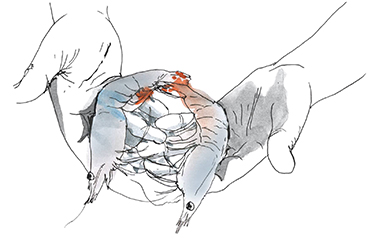
 Atlantic seabob (X. kroyeri)
Atlantic seabob is primarily produced by Guyana (50 percent), Brazil (30 percent), and Suriname (18 percent). While previously exports were dominated by Guyana and Brazil, nowadays Guyana and Suriname are the two remaining exporting countries. While Guyana exports its Atlantic seabob primarily to the U.S., followed by the Netherlands and Belgium, Suriname exports it mainly to the Netherlands.
In the Netherlands, the distribution of Atlantic seabob is dominated by the Heiploeg Group, with its investments in fisheries in Suriname and Guyana. The company sells the product mainly as a salad shrimp to the ready-meal market and as peeled and cooked refreshed chilled products into retail in Germany, the Netherlands, and Belgium. Being MSC-certified, retailers see it as a good alternative to the more expensive Northern prawn and Asian uncertified pink shrimp (Farfantepenaeus sp.).
Guyana’s Atlantic seabob
Although Guyana’s shrimp exports used to vary between 10,000 and 20,000 MT, since 2013 exports significantly dropped to between 8,000 MT and 10,000 MT. In a recent interview with SeafoodSource, a representative of BEV Processors, a company previously responsible for exporting 5,000 MT of shrimp annually mainly to the U.S. market, stated that the sector in Guyana is struggling. Prices for Atlantic seabob are dwindling and companies in Guyana are having difficulties with the new, more stringent international market requirements. BEV Processors, which does not own a fishing fleet, closed its factory in 2018.
Guyana’s exports are now dominated by three companies that have their own trawlers: Gopie Investments, Noble House Seafoods, and Pritipaul Singh Investments. According to Raoul Gopie, managing director of Gopie Investments, the drop of exports to the U.S. was caused by a number of factors. First, U.S. processors reduced their demand for tiny shrimp, previously supplied by Gopie Investments. Larger sizes, in turn, are currently widely available from farmed sources.
Moreover, demand for breaded shrimp, one of the products made from Atlantic seabob, is declining. Another key factor is that Guyana’s fisheries face competition from fisheries that are already MSC-certified. Now that Guyana has obtained MSC certification (in August 2019), new markets may open up, including Europe and China. The Chinese market has been expanding rapidly as exports from Guyana to China are up by almost 30 percent compared to five years ago, according to Gopie.
“Processors are looking to increase the prices for seabob and this certification can help prove that the fishery is being managed in a conservative manner,” Dawn Maison of the Guyana Association of Private Trawler Owners and Seafood Processors said.
