






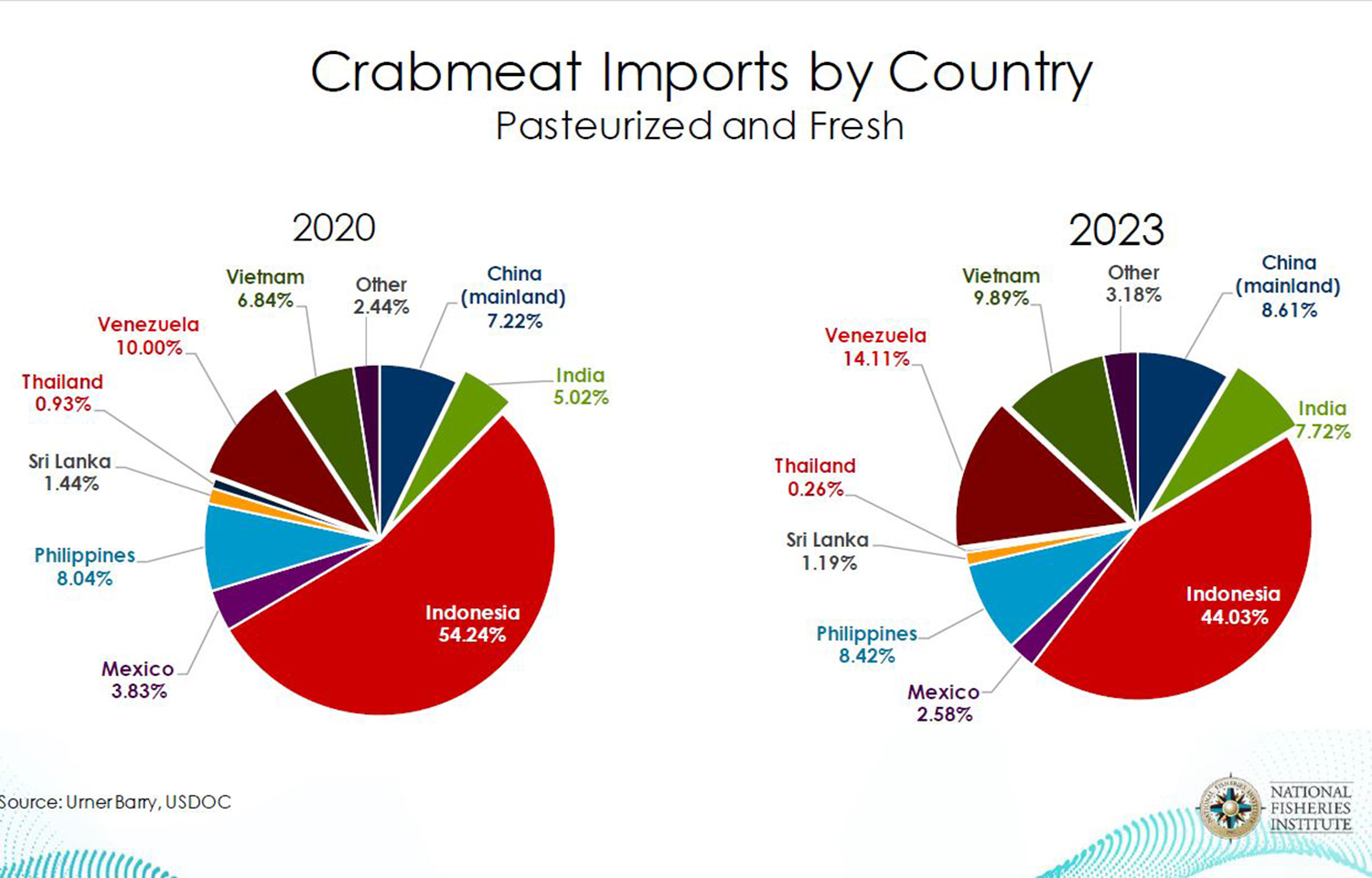
A controversial escrow rule put in effect by the government of Indonesia in August 2023 has taken a bite out of the country’s pasteurized crabmeat exports.
The regulation requires exporters sending cargo with a value of USD 250,000 (EUR 232,000) or more to deposit at least 30 percent of their earnings in a special bank account controlled by the Indonesian government for a minimum of three months. The government’s justification for the regulation, which took effect on 1 August, is that Indonesian exporters often retain their foreign exchange earnings overseas in order to capitalize on more favorable interest rates and support their international operations, instead of that money funneling back into Indonesian operations.
Indonesia had a 55 percent share of the global crabmeat export market in 2020, but that dropped to 45 percent in 2023, partially as a result of the policy, according to Ready Seafood Vice President of Sales Rob Kragh.
“It’s an unintended consequence that’s floating through the entire supply chain,” he said at the 2024 Global Seafood Market Conference in Orlando, Florida, U.S.A. on 23 January.
Kragh said the policy shift favored bigger companies.
“Smaller companies are going to find it really hard to handle that cash flow because they're undercapitalized to begin with, while large companies are going to do better,” he said.
Supreme Crab and Seafood COO Troy Turkin said companies are wary of tying up so much working capital in an Indonesian escrow account for months.
“The reality is that if you don't have a strong cash flow, you're not going to be able to continue to buy from Indonesia. Really, since it's more of the processors that are having to fund this, they’re going to look to ship elsewhere if they can,” he said. “It's just so costly – a container might be USD 500,000 [EUR 460,000] ballpark, which requires the company to put up USD 150,000 [EUR 138,000] per month for 90 days, so that’s USD 450,000 [EUR 415,000]. If you bring in four or five containers, that’s USD 2 million [EUR 1.8 million].”
Brice Phillips, the vice president of sustainability and business development at Baltimore, Maryland, U.S.A.-based Phillips Foods, which specializes in crabmeat and crab cakes, told SeafoodSource in September 2023 his company was going to be hit hard by the law.
“I’d say that about 95 percent of our containers will be valuable enough to have this fee applied, while some of the most valuable containers would be over double the value threshold that Indonesia has decided on,” Phillips said.
In fact, exports are down for nearly every production country, with overall exports down 14.5 percent year over year in 2023, dropping from 55.2 million pounds to 51.7 million pounds, according to Turkin. One exception was India, which increased its exports from 5 percent of the world’s total in 2020 to 7.7 percent in 2023. U.S. tariffs have also had a negative impact on the sector, according to Turkin.
“They were put in play in 2018, and sales movement starting to go down. Then, Covid hit, and now it has gotten to the point where it’s not as economical to keep fishing at the level the [industry was] at before. It’s costing a lot more, and the U.S. isn’t going to pay higher prices to offset the 25 percent tariff,” he said.
Overall, U.S. crabmeat imports were down 6.3 percent year over year in 2023.
“It’s still a price thing. Demand has diminished,” Turkin said. “Pricing had been higher. It started to come down, but that has leveled off.”
A pound of jumbo lump meat from Southeast Asia was selling for around USD 33 (EUR 30.40) per pound through 2023 – down from the 2021 highs of USD 45 (EUR 41.46) per pound. Chinese jumbo meat sold for under USD 20 (EUR 18.43) per pound on average through the year.
Kragh said crabmeat remains “a hard category to predict where you’re going to be in 12 weeks.”
“It goes back to the whole idea of premium risk and interest rates and how your vendor is going to bring in product,” he said. “I look at imports being done as a function of how much risk I want to take as an importer to bring product in, and the reality is I don't want to take the risk unless I know where it's going to go. Nobody likes surprises in this business – we like things to be average.“
Image courtesy of National Fisheries Institute
