





Catfish, lobster, haddock, pollock, and crab each have regional strongholds in the U.S. But a few species have broken through to national popularity, with shrimp, salmon, and cod leading the charge.
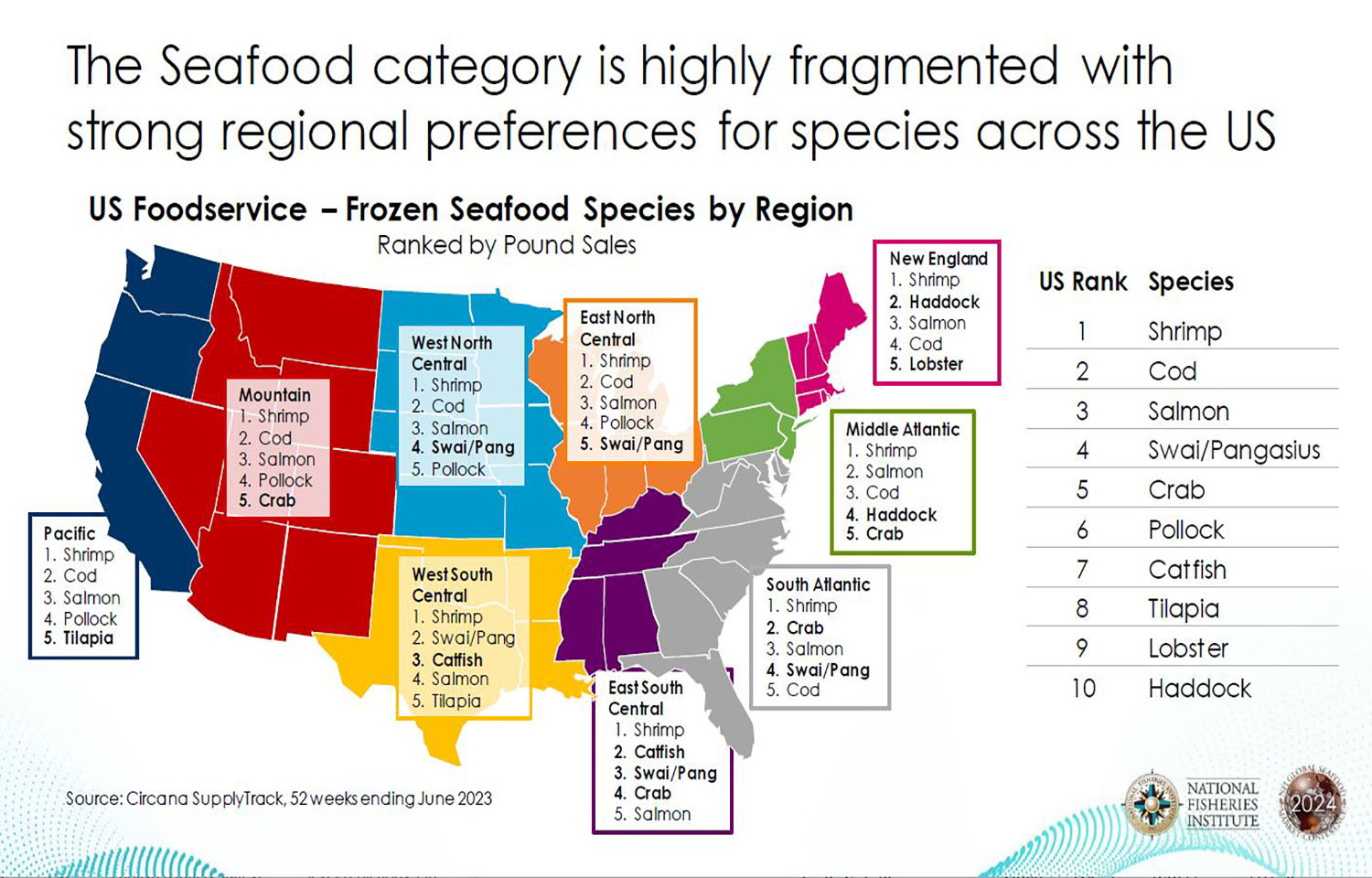
Shrimp was ranked the most popular species of seafood in every region of the U.S. for 2023. Salmon also made an appearance in the top five seafood species in all nine regions of the U.S., as identified by a Circana SupplyTrack survey done over 52 weeks ending June 2023. The data was presented at the Global Seafood Market Conference on 25 January 2024 in Orlando, Florida, U.S.A.
The regional trends echo national data released by the National Fisheries Institute, which ranked shrimp the top-consumed species in the U.S., and salmon second. But cod, which ranked seventh on the national list, appeared in the top five species consumed in seven of the nine U.S. regions surveyed by Circana.
New England’s top five preferred species were shrimp, haddock, salmon, cod, and lobster. The Middle Atlantic preferred shrimp, salmon, cod, haddock, and crab, in that order.
The South Atlantic favored shrimp, crab, salmon, pangasius, and cod as its top five species. The East South Central U.S. states favored shrimp, catfish, pangasius, crab, and salmon.
The West South Central region of the U.S. saw shrimp, pangasius, catfish, salmon, and tilapia as its top five preferred species. The Mountain region of the U.S. ranked shrimp, cod, salmon, pollock, and crab. The Pacific region preferred shrimp, cod, salmon, pollock, and tilapia as its top five choices.
Regional preferences have always played an important role in how U.S. seafood vendors approach the market. At the 2019 GSMC, Danielle Charette, the vice president of sales at Bensenville, Illinois, U.S.A.-based Fortune Fish and Gourmet, warned against thinking that the U.S. consumer is monolithic in its tastes.
“Premium is regional. What somebody thinks is premium in Florida is not necessarily what someone in Chicago thinks is premium. You have these different parts of the country where customers see things differently for many species. In the Midwest, we will pay for whitefish or walleye – no matter how much it costs, we’re going to sell it all,” she said. “That’s part what makes this business so difficult, is figuring out where it all fits in, and definitely [incorporating] that regional component.”
Presenting the data at the 2024 GSMC, Maritime Products International President Matthew Fass said pangasius also has an opportunity to break through as a nationwide favorite. He noted few people have heard of pangasius in the U.S., yet it remains a top-selling species in many regions.
“That is just incredible to me that it’s one of the top 10 seafood species sold in the United States, and most consumers have never heard of it,” he said. “I think it’s very illustrative of what pangasius still can be and how we get there.”
As a relatively inexpensive, versatile protein, pangasius has mass-market appeal, according to Fass.
Pangasius must play a bigger role “if we are as serious as we say we are about food security and growing seafood consumption across the United States across all economic levels,” Fass said.
But value isn’t the only trend driving consumption in the U.S. A desire to experience new tastes and to eat more sustainably, especially amongst millennials, is helping to boost the popularity of “undiscovered species” like monkfish, croaker, walleye, rockfish, barramundi, yellowtail, and rainbow trout.
Image courtesy of National Fisheries Institute
