



The Irish seafood industry saw a boost to its value in 2022, largely driven by an increase in domestic consumption of seafood within foodservice channels and higher prices for products.
The GDP of the Irish seafood industry increased 4 percent to EUR 1.3 billion (USD 1.4 billion) last year, according to the latest Bord Iascaigh Mhara (BIM) “Business of Seafood” report. Launched by Ireland’s Minister for Agriculture, Food and the Marine Charlie McConalogue on 18 April 2023, the seafood development agency’s report found domestic consumption of seafood increased 13.5 percent to EUR 475 million (USD 519.4 million) in 2022. A strong, post-pandemic recovery in foodservice was key to this upturn, with 70 percent year-on-year growth taking total sales to the sector to EUR 169 million (USD 184.8 million), partially offset by a 4 percent decline in retail sales value and an 8 percent decline in retail sales volume.
McConalogue said significant challenges faced the industry in 2022, including unprecedented rises in energy prices caused by Russia’s invasion of Ukraine, a war that has also caused “a difficult trading environment for the whole seafood sector.” On top of high energy prices Ireland’s fishing industry also saw reduced quotas, and difficult trading conditions with the United Kingdom in the aftermath of Brexit.
“However, the industry has once again shown resilience to such shocks and continues to be a key socio-economic driver in coastal communities, employing more than 15,000 people. I recognize the pressure those working in the industry have faced in the last year, and that is why I have delivered significant funding under the Brexit Adjustment Reserve [BAR] to assist the sector,” he said during the report’s launch event.
The report found that overall investment in the seafood space decreased by 1 percent to EUR 443 million (USD 484.4 million). However, government investment in the industry increased 10 percent to EUR 255 million (USD 278.8 million) last year as funding under the (BAR) began to come on stream.
The report also confirmed that the volume of Irish seafood exports fell 13 percent to 293,000 MT, largely thanks to lower quotas of mackerel and blue whiting because of new post-Brexit fishing arrangements. Those declines have brought heavy criticism from the Killybegs Fishermen’s Organisation (KFO) which called out the Irish government for failing to yet provide any BAR money to pelagic fishermen despite the increases in government investment in seafood.
The Brexit withdrawal period brought a 26 percent loss of mackerel quota, among others, and the KFO said the sector has now been waiting 30 months for access to the BAR funding.
“It beggars belief that a tranche of money which will provide so much relief to our members is not being disseminated,” KFO CEO Seán O’Donoghue said “We lag behind our E.U. counterparts and what’s of most concern to us is that if we don’t distribute this funding by year end, it’ll be returned to Europe and permanently lost to our fishermen. This is potentially an appalling vista and we’re calling for the most urgent of political action by Minister McConalogue on this matter.”
Brexit, O’Donoghue said, resulted in direct cuts of more than 12,000 MT to Ireland’s mackerel quota resulting in a loss of EUR 18 million [USD 19.7 million], a heavy blow for pelagic fishermen. “No business can nor could, be expected to sustain losses on this scale,” he said.
The organization said if financial support and other burden sharing measures are not forthcoming, then Ireland’s pelagic sector will shed more than 1,200 jobs by 2030 because of Brexit. It has also calculated that because of the U.K.’s departure from the E.U. from 2021 to the end of 2023, pelagic fishermen lost more than 37,000 MT of their mackerel quota – resulting in a loss of more than EUR 52 million (USD 56.9 million).
Those reduced quotas saw the volume of seafood produced by the Irish sector fall 15 percent year-on-year to 303,300 metric tons (MT), largely as a result of quota transfers under the E.U.–U.K. Trade and Cooperation Agreement (TCA). Despite the drop in volume BIM’s report showed that market inflation resulted in strong price growth, particularly in the wild-caught fish category, which averaged increases of 38 percent. During the year, a total EUR 507 million (USD 554.4 million) worth of seafood was landed at Irish ports, a 14 percent increase on 2021 in value terms.
In total the value of Ireland’s wild-caught seafood sector increased by 13 percent to EUR 703 million (USD 768.7 million), with the value of aquaculture products rising 10 percent to EUR 196 million (USD 214.3 million).
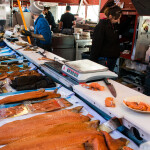
The two top-selling species on the Irish domestic market in 2022 were salmon and cod at EUR 119 million (USD 130.1 million) and EUR 44 million (USD 48.1 million) respectively.
Price increases also shifted which species Ireland earned the most from across all markets. A 53 percent increase in the price of langoustines, which are also known as “Dublin Bay prawns” in the Irish market, resulted in it overtaking mackerel as the country’s most valuable wild-caught species, with 6,200 MT of product achieving an ex-vessel value of EUR 82 million (USD 89.7 million). Mackerel landings totaled 52,300 MT, earning Ireland EUR 80 million (USD 87.5 million). In third place, the fleet’s crab landings remained stable in volume terms with 7,200 MT landed, but prices led the species to grow 19 percent in value to EUR 25 million (USD 27.3 million).
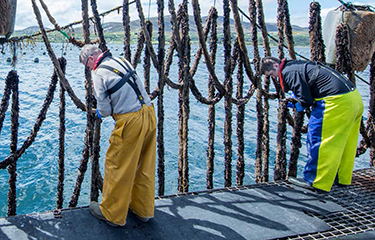
Within Ireland’s aquaculture sector, rock oysters and rope grown mussels experienced strong price growths of 8 percent and 7 percent, respectively. Organic salmon was the top species produced by the aquaculture sector, with a total harvest of 13,500 MT and an estimated value of EUR 124 million (USD 135.6 million).
The seafood industry’s export value climbed 4 percent to EUR 696 million (USD 761 million), while Ireland’s seafood imports declined 12 percent in volume to around 20,000 MT. The drop in volume did not coincide with a drop in value as higher prices again caused a 24 percent increase in value to EUR 312 million (USD 341.1 million). Irish organic salmon continued to be the sector’s most valuable export species, with the 2022 trade valued at EUR 120 million (USD 131.2 million).
Ireland’s seafood industry last year comprised 1,993 registered vessels, 101 seafood processors, and 296 aquaculture sites. More than 8,200 people are directly employed, with a further 7,100 jobs indirectly supporting the sector.
Photo courtesy of Bord Iascaigh Mhara
