


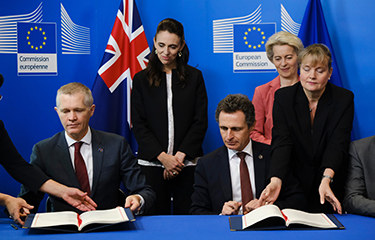
On 9 July, New Zealand signed a free trade agreement (FTA) with the European Union, a move that should provide a boost to New Zealand’s seafood industry when it goes into effect next year.
The FTA, which the two governing bodies signed a year after negotiations concluded in June 2022, will eliminate most export tariffs, ensure nondiscriminatory treatment for investors, improve market access for companies, and significantly reduce compliance requirements and procedures to promote a more efficient flow of goods between New Zealand and the E.U.
FTA negotiations began in June 2018, and endured 12 rounds of negotiations through March 2022, followed by intersessional discussions that concluded on 30 June 2022, when von der Leyen and New Zealand’s then-New Zealand Prime Minister Jacinda Ardern announced the deal.
The FTA will enter into effect starting Q1 2024. The final step before enforcement is for the E.U. and New Zealand to ratify the agreement.
According to the European Commission, this new agreement further demonstrates that the E.U. – the world’s largest seafood-buying market – is delivering on its Indo-Pacific strategy. EC President Ursula von der Leyen said in a 9 July announcement the agreement will foster closer collaboration with New Zealand, which she described as “a key partner.”
“This modern free trade agreement brings major opportunities for our companies, our farmers, and our consumers – on both sides,” von der Leyen said. “With unprecedented social and climate commitments, it drives just and green growth while reinforcing Europe’s economic security.”
The deal will cut an estimated EUR 140 million (USD 153.6 million) in duties for E.U. companies in the first year of the deal. Bilateral trade is expected to grow by up to 30 percent within a decade, with the E.U.’s annual exports to New Zealand possibly rising by up to EUR 4.5 billion (USD 4.9 billion) and its overall investment into New Zealand potentially soaring 80 percent.
The FTA will minimally affect the current trade of E.U.-origin seafood heading to New Zealand, but it could be a very different story for products going in the other direction, according to John Young, the manager of trade policy at the Ministry for Primary Industries (MPI), a New Zealand government ministry that manages and regulates the country’s fishing industry.
Young told SeafoodSource the FTA will benefit New Zealand companies exporting seafood products to the E.U., with New Zealand’s exports of hoki, mussels, squid, rock lobster, and salmon likely to increase.
New Zealand will likely export more seafood to the E.U. than vice versa, and of the more than 40 species currently shipped to the E.U., the largest annual export earnings stem from sales of hoki – NZD 75 million (USD 46.4 million, EUR 42.3 million); squid – NZD 35 million (USD 21.7 million, EUR 19.7 million); greenshell mussels – NZD 34 million (USD 21.1 million, EUR 19.2 million); ling – NZD 27 million (USD 16.7 million, EUR 15.2 million); and hake – NZD 6 million (USD 3.7 million, EUR 3.4 million).
“Under the N.Z.-E.U. FTA, all fish and seafood tariffs will be eliminated, with 99.5 percent of New Zealand’s fish and seafood trade entering the E.U. tariff-free at entry into force,” he said. “This is expected to generate savings of NZD 20 million [USD 12.4 million, EUR 11.3 million] based on current trade volumes.”
Just 0.5 percent of New Zealand’s fish and seafood exports to the E.U. will continue to be taxed, including frozen hake fillets and whole frozen hoki, which will continue to face tariffs of 6.1 percent and 7.5 percent, respectively. However, language included in the FTA will likely trigger the removal these remaining tariffs within five years after implementation.
Seafood New Zealand Chief Executive Jeremy Helson said it’s still too early to accurately estimate the FTA’s long-term consequences, but said it enables New Zealand to be more competitive with countries that mostly export to the E.U. tariff-free, such as Japan, Canada, and Chile.
Helson told SeafoodSource the main E.U. markets for New Zealand seafood vary by species, with Poland, France, and Germany being top buyers for hoki; Greece the main market for squid; and Portugal, the Netherlands, and Germany serving asessential markets for New Zealand greenshell mussels.
Helson said the FTA’s benefits will flow in both directions, with E.U. consumers who are conscious about sustainability and traceability benefiting from New Zealand’s wide array of sustainably-certified seafood.
“E.U. customers can more easily access the sustainable, high-quality New Zealand fish they want,” he said. “E.U. customers tell us they regard New Zealand’s world-leading ecosystem approach to fisheries management highly. New Zealand's hoki fisheries were the first major fisheries in the world to be certified sustainable by the Marine Stewardship Council (MSC). Hake, ling, southern blue whiting, orange roughy, skipjack, and albacore tuna are also certified.”
Photo courtesy of Alexandros Michailidis/Shutterstock
