
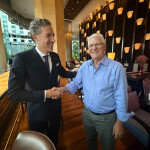


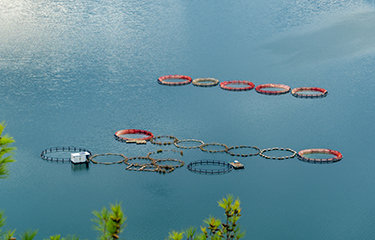
A delegation of representatives from 11 Turkish trout producers recently visited Tokyo and Osaka for business matching meetings with importers. The trip comes as Turkey is experiencing a boom in exports, and as Japan seeks to diversify its sourcing beyond Norway and Chile.
The meetings, held in Tokyo on 31 January and in Osaka on 2 February, gave the Turkish exporters a chance to promote their farmed rainbow trout, which is marketed as “Turkish salmon,” an appellation that is readily accepted in Japan, as the Japanese usually refer to trout farmed in salt water as “salmon-trout.” Substitution of trout for salmon is not considered as mislabeling, as trout is considered a kind of salmon in Japan.
Global Media Corporation, based in Tokyo, acted as secretariat for the events and recruited Japanese buyers and importers to participate in the business meetings. In addition to meeting with importers, the delegation met with staff of the Japan Fisheries Association and the Japan Fisheries Agency on the last day of the event in Tokyo.
The participating companies were members of Turkey's Eastern Black Sea Exporters Association, which organized the trip. Established in 1998, the Eastern Black Sea Exporters Association (DKIB) represents over 2,000 companies operating in the provinces of Artvin, Gümüşhane, Rize, and Trabzon. This area is about a 10-hour drive from the epicenter of the earthquake that recently hit Turkey's southeast, near the Mediterranean Sea.
Exports of trout and salmon from Turkey to Japan declined from around 3.4 metric tons (MT) in 2019 to 1.5 MT in 2020 due to Covid-19 before rebounding to 6.2 MT in 2021, and then jumping to 31.1 MT in 2022.
Turkey’s global salmon-trout exports rose from 145.8 MT in 2019 to 176.8 MT in 2020, then ballooned to 273.6 MT in 2021, and to 445.6 MT in 2022.
Zafer Ertem, the project manager who organized the delegation for DKIB, said the Turkish delegation met with 35 Japanese companies during the matchmaking events and received very clear requests from Japanese companies for ready-to-eat products, and trim-E fillets.
“Because these companies were mostly operating internationally, the interest was above and beyond the expectations,” he said. “Japanese companies try to decrease their dependency level on products and services supplied by Norway, Chile, and others … We are expecting heavy demand from Japanese companies in the upcoming years. Japanese companies seem ready to sign contracts even for 2023,”
The delegation represented a cross-section of the industry in Turkey, including small-scale producers, farm operators, and large processors and exporters.
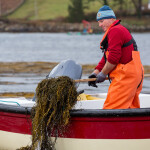
At the smaller end, hatchery and fish-farming operations are integrated into tourist facilities. For example, the parent company of Inan Kardesurel Trout Aquaculture, based in Trabzon, operates a hotel, but since 1974 it has also operated a trout hatchery. Some of the production is raised in a land-based system, while some of the fish are transferred to nets in the sea and farmed by other companies.
According to its website, the hatchery and farm are tourist attractions for the hotel, and the trout are served in the hotel’s restaurants. Though smaller, another participant, Sezginrel, has a similar business model, operating the Sezgin Hotel, a restaurant, and a fish farm in the village of Uzungol.
At the large end of the spectrum of countries on the Japan visit were Kuzuglu and Akerko Seafood.
Kuzuglu, based in Rize, is a fish-farming and processing company that claims to be the top Turkish “salmon” exporter to Japan for the last four years. It also claims to be the leader in production in Turkey, accounting for 18,000 metric tons (MT) per year. Kuzuglu offers whole, smoked, fillet, marinated, salted, and sauced fish, and sells in at least 10 export markets. The company also deals in sea bass and sea bream.
Akerko Seafood, a member of Kobyalar Group, was established in 2007 in Trabzon with shareholders who are among Turkey’s biggest fishing groups – the Akgün Balikcilik and Ergün Kardesler Balikcilik Groups. The company’s activities include fishing, fish farming, and operating a processing plant. In addition to trout in a variety of forms, it offers anchovy, fish meal, and fish oil.
Many of the companies in attendance had connections with each other, as the industry in this area of Turkey tends to work together as a cluster or ecosystem of cooperating companies, rather than going it alone.
Trabzon-based Politech Corporation, which markets its product under the Polifish brand, purchased and modernized the first and largest cold storage of the region, in the Arsin Organized Industrial Zone in 2007. It has 45 MT of freezing capacity and a storage capacity of 2,000 MT, and processes and packages a variety of wild and farmed fish. In Japan, it was promoting anchovy and trout.
Nearby Tuna Marine Products Corporation began cultivating trout and sea bass off the coast of Trabzon in 2007 and has regularly added additional facilities to boost its annual production. It is experienced in exporting to Japan, and is affiliated with Yomra Aquaculture Research Co, based in Yomra, which also joined the delegation. Yomra processes trout and operates Yomra Sea Farm jointly with Polifish.
Rounding out the delegation were five Trabzon-based companies: Karsom, another trout farming company with experience exporting to Japan; Lafçıoğlu Seafood, a trader and exporter dealing in trout in various forms, caviar, crustaceans, mollusks and fruits and nuts; Omega 61 Fisheries Trading, which farms and processes trout; and Sadiklar, a processor offering deep-processing of bonito and rapa whelk meat, in addition to trout.
Photo courtesy of fotopanorama360/Shutterstock
