



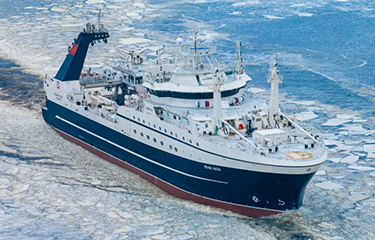
Russian Fishery Company launched its newest supertrawler, the Mekhanik Maslak, from the Admiralty Shipyard in Saint Petersburg, Russia in February 2023.
The freezer-trawler, which is being deployed to perform pollock and herring pelagic trawling in the Bering Sea and the Sea of Okhotsk, as well as in adjacent waters of the East Coast of Russia, is one of the most advanced fishing vessels in the world. It joined its sister ships, the Vladimir Limanov and the Kapitan Vdovichenko, which have both exceeded production figures since their own launches. And Admiralty Shipyards will be delivering the next two vessels in the 10-vessel RFC order, the Mekhanik Sizov and Kapitan Martynov, soon.
At the official launch event, RFC General Director Olga Naumova, who was appointed in January 2022, two months before the company was sold by its former owner, Gleb Frank, after he was sanctioned by the United States, said the progress highlights RFC's continued focus on modernizing its fishing fleet and focusing value-added products such as surimi.
“The completion of the construction of the supertrawler Mekhanik Maslak is another significant step in the execution of our fleet upgrade strategy that will help us strengthen the vector aimed at high value-added production,” she said. “The new supertrawlers that we are building and have already built are the contribution of the RFC in the modification of work conditions, in advanced, efficient, comfortable and safe workplaces. Our new vessels demonstrate their effectiveness, they are already the leaders in harvest and performance.”
RFC upped its total companywide harvest to 309,000 metric tons (MT) in 2022, up 4,300 MT from 2021. Included in that total was 283,000 MT of pollock, up 6 percent year-over-year; and the company’s production of value-added products, including fillets, mince, and surimi, rose to 48,500 MT, up 57 percent from 2021.
RFC also managed to increase its sales 22 percent by volume compared to 2021, and 54 percent by value, primarily due to shifting its product mix toward more high value-added pollock products, it said.
Despite sanctions imposed by numerous countries, including the United States and the European Union, RFC upped its exports by 30 percent, reaching nearly 40,000 MT. It did so by expanding its sales reach into Singapore, Vietnam, Bulgaria, and China. The company also sold 46 percent of its product into Russia’ domestic market, and increased its sales of high-quality pollock surimi to Russian crab stick manufacturers by over 1,000 percent.
This year through April, RFC continued to outdo its historical performance, increasing its pollock catch 19 percent to 158,280 MT between 1 January and 8 April, in Russia’s “A” pollock season. The Vladimir Limanov led the entire Far Eastern Fisheries Basin in total catch, with 27,180 MT, and the Kapitan Vdovichenko was second with 27,163 MT, U74.ru reported.
RFC said it had attained the higher catch total even though it reduced its total number of vessels operating in the basin from 12 to 10. The Mechanik Maslak will join RFC’s fleet in the Far Eastern Fisheries Basin for the “B” pollock season, beginning in the fall of 2023.
“Each new vessel is designed for an annual catch of 60,000 tons of fish, which is 2.5 times higher than the productivity of the vessels that today form the basis of the fishing fleet in the Far East of the Russian Federation,” RFC said. “The company's large-tonnage fishing fleet is capable of performing work in all fishing zones and under any climatic conditions. [RFC] processor trawlers are equipped with modern fishing and processing equipment from leading international suppliers, which makes it possible to harvest and process various types of aquatic biological resources at sea.”
In September 2022, Naumova said at the VII Eastern Economic Forum the company would focus even more of its attention on selling into Asia.
“The most promising, developing export segment is Asia. Today, more than 60 percent of the [world’s] total fish consumption comes from Asian countries. But here it is impossible to move forward without offering new products to the market, and at the same time it is necessary to be competitive in the mass consumption products market,” Naumova said. “The investments made by the Russian Fishery Company in the construction of a modern fleet are aimed primarily at this. With the help of modern ships, we can offer more and more products to the global market. Even for China, which is considered to be the world’s fish-processing factory, we can offer not just raw materials, but products specifically for the Chinese consumer.”
RFC Technical Director Konstantin Globenko said much of the credit belongs to the company’s pivot to value-added and the receipt of its new trawlers.
"New trawlers are replacing the aging vessels of the current fleet. At the same time we can see that they are of a greater performance capability in terms of fishing and manufacturing,” he said. “With the new trawlers we’ll be able to meet the challenge of manufacturing ultra-processed foods that meet the highest requirements in terms of quality and environmental friendliness.”
Photo courtesy of Russian Fishery Company
