



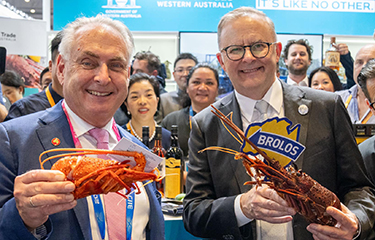
A visit by Australian Prime Minister Anthony Albanese to the China Export Import Fair in Shanghai on 5 November partially aimed to encourage the Chinese government to renew its approval of permits for Australian seafood companies seeking to export lobster.
Albanese’s visit was the latest step in the normalization of relations between the two countries, but this thawing has yet to deliver any major benefit to the seafood sector, despite the fact that the photo of Albanese’s visit carried in most Chinese media reports was of the prime minister holding up a rock lobster.
“From honey to beef, lobster to wine, Chinese consumers love Australian products. It’s wonderful to see so many familiar brands on display at the International Imports Expo in Shanghai,” Albanese said. “Our government is working to see more world-class Australian products on supermarket shelves and kitchen tables in China. I’ve met producers today who are so pleased with the progress we’ve made. My government will always back Australian producers, and we will do it in a considered and calm way.”
Chinese trade authorities banned the import of Australian lobster in 2020 after the Australian government suggested China’s role in the origins of the coronavirus be further investigated, and now, live Australian lobsters are still prohibited from being shipped directly to China, though they are entering the Chinese market through secondary locations, including Hong Kong. However, rumors have been swirling all year that Australian lobster exporters might be able to attain export licenses to China as diplomatic relations between the two countries have warmed.
“Australia lobsters are still blocked as of today; however, the ban is expected to be lifted shortly,” Jack Yuan, the head of WhatFresh, which imports seafood for the southern Chinese market, said.
Beijing-based Sunkfa International Food (Beijing) Co. Purchasing Head Qiang Weng joined Yuan in his belief that China’s de facto ban on Australian lobsters will end soon.
“Australian lobsters are recognized as premium in China,” Weng said. “Since the trade war, China has not imported any live Australian lobsters directly. Most of the Australian live lobsters are coming from third countries, but with the visit of Albanese, I think the lobster trade will resume soon.”
Australia, which ships half its exports to China, has suspended a complaint it had taken to the World Trade Organization about China, while Beijing promised an expedited review of duties on Australian wine imports.
“We want to see any impediments which are there for our trade to be removed and dealt with,” Albanese said during his visit to China, according to the Sydney Morning Herald.
In the meantime, opportunistic Chinese aquaculture firms are producing what they’re marketing as Australian lobsters on the local market.
One of those local producers is Hainan-based Shou Feng Aquatic Science and Technology Co., which is producing what it’s marketing as “Australian lobster” in a freshwater aquaculture-solar project model that has become popular in China. The market potential for the company’s Australian lobster is “vast,” Shou Feng Deputy General Manager Wu Min told the Hainan Daily newspaper.
On the other side of the country, in Xinjiang, two brothers guided and subsidized by the local government have set up a freshwater facility, farming what it’s also calling Australian lobster..
“Compared to ordinary crayfish, the Australian lobster is much longer, and it’s very popular on the local market,” Wu Zhijun, one of the brothers, told local media.
Fry for the project was shipped from the Anhui province on China’s east coast, but the company plans to erect a fry production facility and to expand production of its Australian lobsters in 2024. Technical direction for the project came from Zang Yundong, an “aid cadre” or official, sent from the city of Rizhao in Shandong, an important aquaculture region in China.
Several other projects are also underway across the country, including in Anhui and Hubei, though Yuan said a reopening of the Chinese market to Australian lobster may not necessarily lead to sales seen heretofore, given the weaker state of the Chinese economy.
“The market is weak, and consumption is down; so, making business is really tough,” Yuan told SeafoodSource.
The Australian Ministry for Agriculture, Fisheries, and Forestry has sought to diversify away from a dependence on China, noting that “developing and maintaining a diversified market base is important for minimizing problems associated with having too few markets that are economically and geographically co-located.”
A strategic plan published in 2022 by Seafood Industry Australia (SIA) suggested that the U.S. is the better alternative, as “onerous barriers to entry” exist to the E.U. and U.K. markets.
Australian’s seafood exports totaled AUS 1.2 billion (USD 768 million, EUR 783 million) in 2021, compared to AUD 1.5 billion (USD 959 million, EUR 978 million) in 2019. Lobsters comprised approximately half the figure for exports in both years.
Photo courtesy of Office of Prime Minister of Australia
