






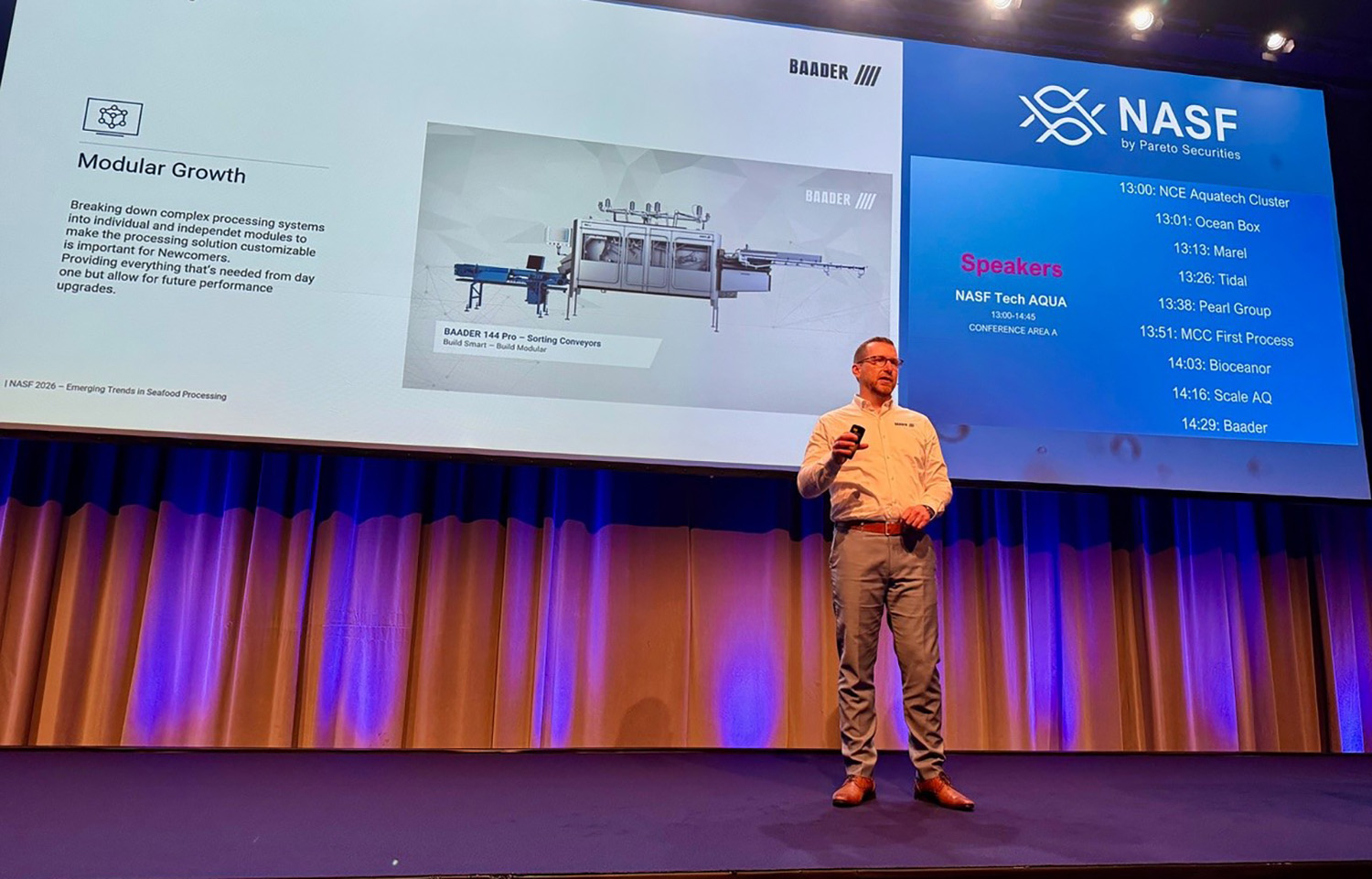
As salmon processors are facing tighter regulations, rising welfare expectations, and increasingly fragmented supply growth, Lübeck, Germany-headquartered processing firm BAADER is positioning modularity as a key component of the industry’s next growth phase.
Speaking at the 2026 North Atlantic Seafood Forum (NASF) in Bergen, Norway, BAADER Global Sales Director for Fish Nils Rabe outlined how ethical responsibility, processing versatility, and modular equipment design are converging to reshape salmon-processing strategies.
“Ethical responsibility for our food is one of the biggest consumer megatrends that we see in the market,” Rabe said, noting that transparency around feed conversion rates, carbon footprints, and animal welfare is not just a priority for regulators anymore but is now also influencing purchasing decisions from retailers responding directly to consumer expectations.
He highlighted that in the U.K. alone, more than half of retailers have written humane slaughter requirements for seafood into their sourcing policies.
BAADER’s response has been heavy investment in R&D, particularly around slaughter and bleeding systems. Rabe pointed to the company’s latest percussive stunning and bleeding solution, the BAADER 102, as marked progress in animal welfare performance.
“This system actually measures every single fish that's coming through the system and adapts the processing parameters to match the specifics of that fish to have the most accurate result in a stunning process,” he said.
Importantly, the system does not operate on averages, Rabe added, explaining that each fish is assessed individually, with parameters adjusted in real time. Fish that do not fit system parameters are automatically discharged to a humane backup process for manual handling.
Beyond welfare, the system delivers operational benefits such as extended pre-rigor time, less intense rigor, and improved flesh quality.
Looking further ahead, Rabe pointed to structural shifts in global seafood supply, telling delegates that by 2050, global food demand is expected to rise by 50 percent while wild capture fisheries are projected to stagnate. Aquaculture, by contrast, is expected to expand sharply.
Within aquaculture, Rabe affirmed salmon remains one of the most valuable species, but growth in marine farming is increasingly constrained by environmental, regulatory, and biological limits. Annual output growth of 2 to 3 percent is expected, while demand is forecast to rise by 7 to 9 percent.
“That gap has to be filled somehow,” he said.
Rabe said BAADER is treating smarter raw material utilization as part of the answer. Advanced detection systems and algorithms can assess internal and external quality as fish enter a plant, enabling processors to route each fish through the facility to maximize value, improve yields, and reduce waste.
At the same time, production inputs are becoming more diverse. Processors may need to switch between Atlantic salmon, trout, or even wild-caught Pacific salmon at short notice, Rabe said, again pointing to BAADER products as a solution, such as its digital platforms that allow such changes to be made “at a touch of a button,” combining machine data with processing intelligence to support fast operational decisions.
The rapid emergence of land-based salmon farming is also on the radar for the German processor.
Rabe noted around 110 land-based salmon projects have already been announced globally, with a combined expected output of 2.4 million metric tons (MT) – equivalent to roughly 80 percent of current marine-farmed production.
While not all projects will reach full scale, Rabe said analysts are increasingly confident that land-based systems will become a major contributor by the early 2030s.
“Land-based salmon farming is different than other trends we see,” he said. “Both market and technology exist already. We need to now pave the way for a new player in the game.”
Those new players often resemble startups rather than established multinational corporations, Rabe said, creating a mismatch with traditional large-scale processing solutions.
BAADER’s answer is a modular processing framework that breaks complex systems into independent building blocks. Rabe cited the BAADER 144 Pro grading system as an example, which “breaks down a complex processing system into individual and independent modules, allows for customized processing solutions and automation demands, and supports economically viable business cases independent from the actual operational scale.”
In practice, this means processors can start with essential functionality and add automation, vision systems, or cleaning-in-place (CIP) solutions later as volumes and capital allow. Camera-based quality evaluation, automated feed, and advanced hygiene systems can be introduced incrementally rather than upfront.
“Maybe you can start without camera systems and just upgrade them later on, as you're winning in scale,” Rabe said.
